Showing posts with label macarons. Show all posts

Wednesday, September 4, 2013

Dessert | tea & pastry in the Emerald City

I took a trip to Seattle last week, so you can imagine how many wonderful adventures I had while I was gone (which also means I have hundreds of photographs to sort through :P). This will be first of five feature posts (plus a Wanderlust summary of what I did over the duration of my trip once I finish posting everything else) -- i.e., the coffee shops, teahouses, bakeries, and ice creameries I explored over the three-day stay.

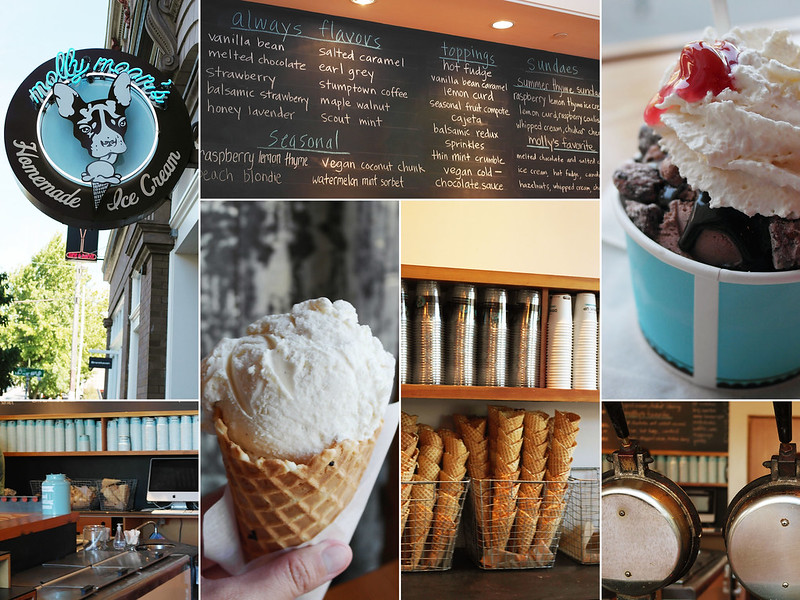
{1} First stop after lunch at HoneyHole Sandwiches was to Molly Moon's Homemade Ice Cream in Capitol Hill. Molly Moon's combines milk and cream from hormone-free dairy cows at family-owned Edaleen Dairy Farm with local, seasonal, as well as organic fruits and spices (as much as possible) "to make combinations that are both familiar and surprising." Molly Moon's tries its best to source everything it can from local farmers, including sugar from Idaho, lavender from Sequim, honey from the Olympics, and more than 90% of all ingredients. For things that don't grow well in the Pacific Northwest (namely chocolate, vanilla, coffee, and tea), it "works with local companies like Theo Chocolate and Stumptown coffee to buy organic, fair-trade ingredients we can feel good about."
01B - Molly Moon
{2} The smorgasbord of flavors at Molly Moon's includes Always flavors (i.e., its classics) as well as a limited selection of seasonal ones. {6,7} The waffle cones here are freshly made with special waffle irons. Among the ice creams sampled that afternoon:

  • {5} A waffle cone with Earl Grey ice cream, which is made using organic and fair-trade tea steeped overnight in the shop's sweet cream. Absolutely heavenly -- just like the perfect milky black tea. Definitely want to dive into making this from the eponymous cookbook -- it's just too delicious to resist!
  • {3} Molly's Sundae with melted chocolate and salted caramel ice cream, hot fudge, candied hazelnuts, whipped cream, and a cherry on top. The melted chocolate is made using locally-made organic, fair-trade Theo chocolate and is "extra fudgy" while the salted caramel is very salty and "caramelly" (incidentally Molly Moon's bestseller). Certainly a solid sundae that is perfect for sharing (it's pretty sizely), though the salted caramel was a lot saltier than I anticipated.


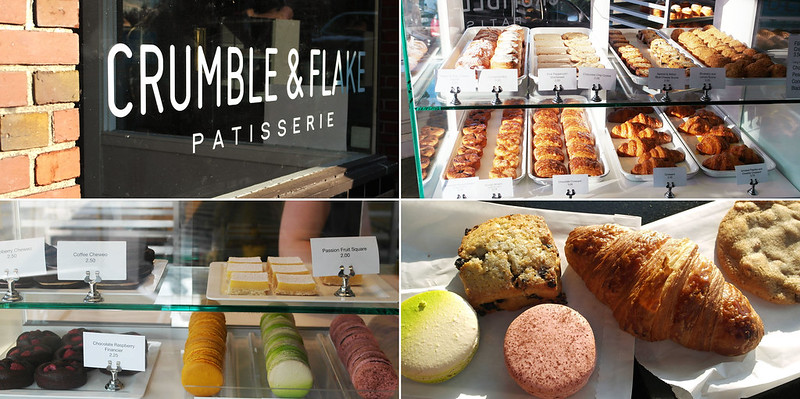
The next morning, before heading to the Space Needle for an early time, {1} I stopped at Crumble & Flake Patisserie (also in Capitol Hill). {2,3} It is "a tiny bakery making pastries in small batches with care and attention" as well as one that closes at 3 PM daily (or until it sells out). I now know why!
02A - C&F
So getting there roughly an hour after opening on a Thursday, there was still a decent selection of pastries from which to choose. I ended up with a lime mojito macaron, a black cherry-dark chocolate macaron, a plain croissant, and a blueberry-lemon scone. The cookie of the macarons were of the ideal consistency (just enough airiness and meringue), and the buttercream/ganache was light yet flavorful. The scone was really refreshing -- the inclusion of lemon zest really goes a long way. And the croissant was pretty solid -- really crispy, buttery, and flaky. If this isn't a great way to start a morning, I'm not sure what is!

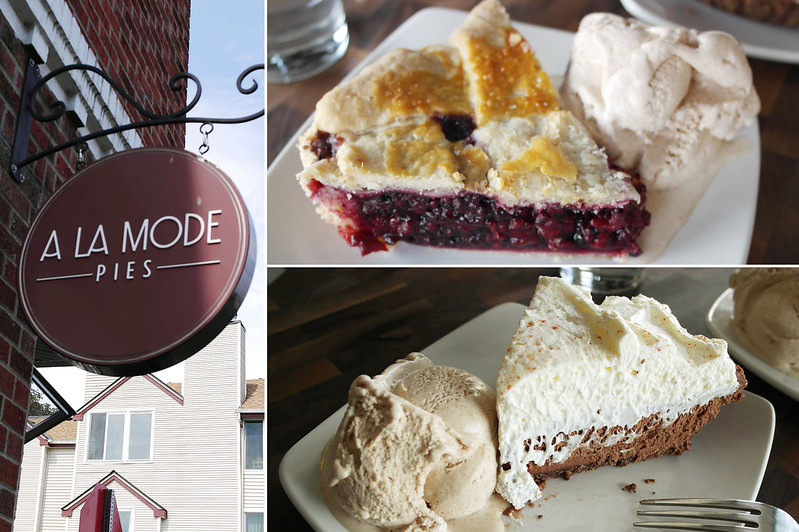
{1} Later that afternoon, I ventured up to Phinney Ridge, a neighborhood in the northern part of Seattle, to have some pie at A La Mode Pies. Chef Chris Porter, owner of A La Mode Pies, was inspired to open his own pie shop as an ode to his love for pie that began in during his childhood days, when his mother would pack store-bought frosted fruit pie in his sack lunch during special occasions. His mother taught him that "patience, technique,a nd invention in the kitchen is often rewarded with wide eyes and happy taste buds." So his vision for A La Mode Pies is "not just to recreate his mother's recipes, but to reinvent them using imagination and high-quality ingredients" as it creates pies and tarts that "look as good as they taste -- no sprinkls, frosting, or grocery store gimmicks."
02G - A La Mode
To my happy surprise, A La Mode Pies offers two flavors from Bluebird Microcreamery, which had been on my Seattle wishlist for this trip but we couldn't fit it in. Yay for two birds with one stone! Here were the varieties sampled:

  • {2}Marionberry and hazelnut pie -- a blend of sweet marionberries (considered the "cabernet of blackberries") with a flaky crust that is marbled with the sharp, toasted flavor of hazelnuts -- was served a la mode with snickerdoodle ice cream. The marionberries were a lot more tart than I was anticipating, and I was surprised to find out that the hazelnuts were in the crust, not in the filling itself. Nevertheless, this sliver was quite lovely, especially balanced out with the warming spiced snickerdoodle ice cream.
  • {3}Mexican chocolate mousse pie -- spiced with cinnamon and a hint of cayenne pepper, filled inside a chocolate graham cracker crust, and topped with freshly whipped cream -- was also served a la mode with snickerdoodle ice cream. I was told that this was the bestselling pie at A La Mode, and I can certainly understand why. The rich chocolate mousse as light as air with a touch of heat from the cayenne in the toasty graham cracker crust. It was even better with the creamy ice cream. A sliver of pie here is worth the trip up to Phinney Ridge, for sure!
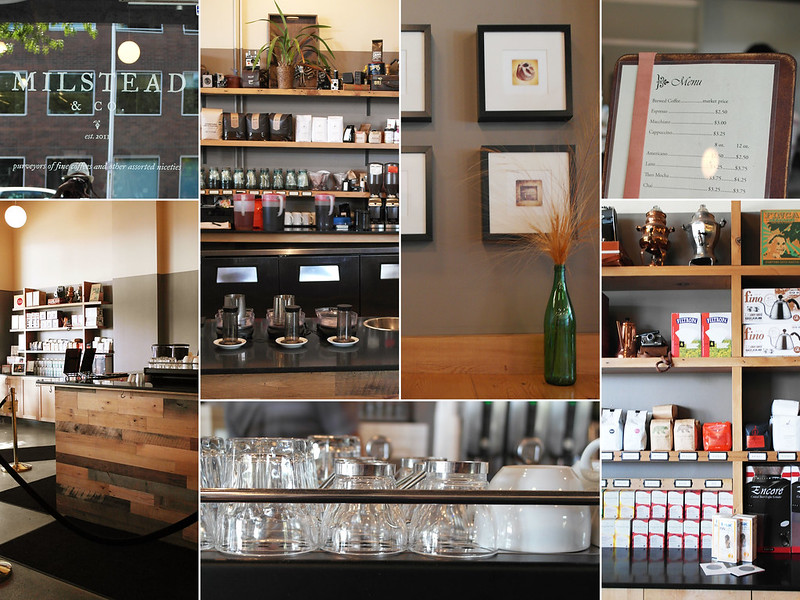

02I - Milstead
On the way back towards downtown Seattle, I inadvertently passed under the George Washington Memorial Bridge where the Fremont Troll lives and {1} stopped by at Milstead & Co. for some iced chai (though now in retrospect, I wish it was an espresso beverage! :P). With a high ceiling, Milstead is housed in a loft-like space with an open and airy atmosphere that plays off the cold slates and the warm woods of the furniture, floors, and walls.

{1} The next morning, I took a stroll over to Remedy Teas in Capitol Hill for some morning tea and {5} to check out its offering of over 150 organic teas, specializing in signature artisan blends that are sourced from across the globe.
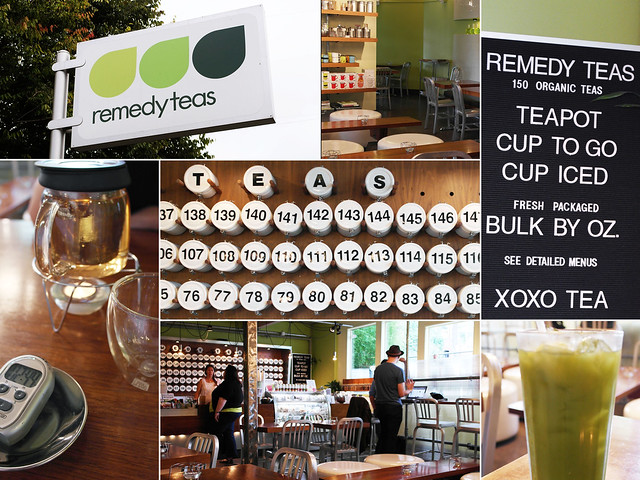
03A - Remedy Tea
{2,6} The teahouse's space was very calming, with an earthy level of zen to it. {3} The menu offered three tea preparations -- a tea pot, a cup to-go, or a cup of any tea iced. {4} I tried the peach oolong in a teapot, for which the counter girl gave me a nifty Bodum teapot steeper with a double-wall insulated glass; a set timer counting down to when the ideal steep is done; and a stainless dish for resting the used tea steeper. Love the precision and the enthusiasm that Remedy Teas has for its hot tea preparation! {7} I also tried the iced matcha green tea lemonade, which was refreshing and a little tart-and-sweet from the lemonade.

Later that afternoon, I ventured to Bainbridge Island on the Seattle State Ferry, which had gorgeous views of the Emerald City and of the islands across the Puget Sound. {2} While I was over there, I made sure to stop at Mora Iced Creamery, a little ice cream shop tucked away within the downtown shops run by Argentinian expats who have developed more than 70 flavors since the shop's opening in 2006. Mora, which means "blackberry" in Italian and Spanish, pays homage to the Island's beloved wild blackberry. Making its ice creams in small batches using fresh milk, real eggs, and cane sugar, the shop does not taking any shortcuts or using any powdered mixes, but instead has "developed its own recipes, carefully testing them repeatedly to make certain that one ingredient doesn't overwhelm another as well as ensuring a texture that is smooth and creamy." {5} It churns Old World flavors like gianduja, marron glace (i.e., candied chestnut), and dulce de leche as well as new-school favorites and seasonal specialties throughout the year.
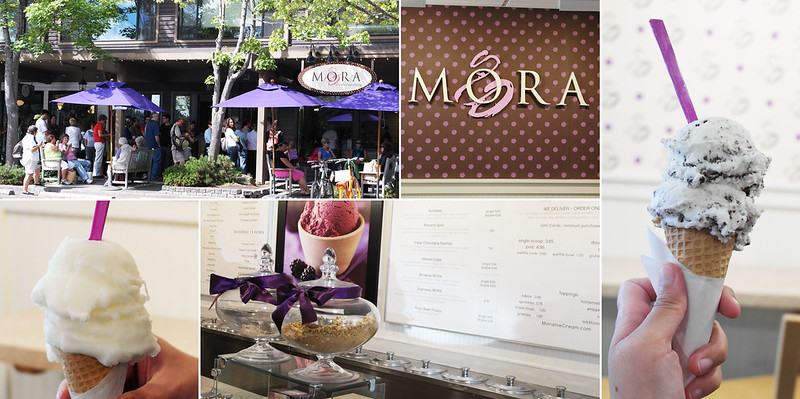
03I - Mora
{1Food & Wine named Bainbridge Island as one of America's Best Ice Cream Cities, citing Mora Iced Creamery as a must-visit, which explains the crazy long line spewing out its front door when we arrived early that afternoon. The line moved pretty quickly, and before I knew it, I was enjoying {3} a sugar cone with a scoop of mint with shaved chocolate fudge and {4} a sugar cone with a scoop of lemon sorbet (made using hand-squeezed lemons). Both were really light and refreshing on the warm summer day -- you could really discern the use of the freshest ingredients, especially with the mint -- it wasn't that artificial peppermint/spearmint flavor you'd typically find in candy, gum, etc., but rather extracted from fresh spearmint leaves. The thin shavings of chocolate fudge were a fun contrast compared to the chocolate chips you'd typically find in similar ice creams.

Findings: Seattle and Bainbridge Island undoubtedly have some amazing confections and hot beverages to offer. I had a generous sampling of ice creams, pastries, pies, and teas, and I am happy to report that not one disappointed! So if you find yourself in Seattle, be sure not to miss out on its original ice cream flavors (Molly Moon's Homemade Ice Cream, Bluebird Microcreamery, and Mora Iced Creamery), small-batched pastries (Crumble & Flake Patisserie), homemade pies just like how Mom used to make 'em (A La Mode Pies), or its coffee/tea scene (Milstead & Co. and Remedy Teas are great places to start)!

Price point: $3 for single scoop of ice cream at Molly Moon's Homemade Ice Cream, $5 for a lil' sundae; $2.50-$3.50 for each pastry at Crumble & Flake Patisserie; $5 per pie slice at A La Mode Pies; $4 for each beverage at Milstead & Co.; $4 for each tea at Remedy Teas; $3 for each scoop at Mora Iced Creamery.

--August 21-23, 2013

Molly Moon's Homemade Ice Cream (Capitol Hill)
 917 East Pine Street
Seattle, WA 98122
http://www.mollymoonicecream.com

Crumble & Flake Patisserie
1500 East Olive Way
Seattle, WA 98122
http://www.crumbleandflake.com

A La Mode Pies
5821 Phinney Avenue North
Seattle, WA 98103
http://www.alamodeseattle.com

Milstead & Co.
770 North 34th Street
Seattle, WA 98103
http://www.milsteadandco.com

Remedy Teas
345 15th Avenue East
Seattle, WA 98112
http://www.remedyteas.com

Mora Iced Creamery (Bainbridge Island)
139 Madrone Lane
Bainbridge Island, WA 98110
http://www.moraicecream.com

Thursday, January 5, 2012

Cooking Class | DessertTruck Works macarons & soufflés

Happy Belated New Year to the readers of Four Tines and a Napkin! Just wanted to start this post by saying this will be my last full, unabridged post for 2011 food happenings. Stay tuned for "Best Things I Ate in 2011," a few "Best Of" lists, and a conglomeration of "Blog-Shy" posts during 2011.

After taking the advanced baking class, "Classic French Macarons," at the Institute of Culinary Education, I stumbled upon a Groupon deal for a macaron-baking workshop at DessertTruck Works (DT Works). While Marcus and I learned quite a bit behind the "science" of creating the perfect macaron, it was still a lot of information overload, and attempting to make any on our own would still be a cloudy endeavor. As such, I felt a fresh new perspective from a rather hip and fun bakery like DT Works would help us better grasp "the moodiest cookie in the world" (as dubbed by our instructor at ICE). This was back in June.

As I've mentioned before in my Macaron Day 2011 post, Jerome Chang, former sous pastry chef at Le Cirque, left in 2007 to start DessertTruck, a high-end dessert truck at "dressed-down" prices, with his business school friend, Chris Chen. It became a smashing success, leading them to open up this store front, DT Works, on the Lower East Side with two former Le Cirque alumni, Susana Garcia and Vincent Jaoura.

Inside DT Works, with an "island" baking prep station set in the middle of the shop, ready to be used by workshop participants.

Chef Chang started off the class immediately with a brief introduction about the macaron, how it is typically prepared in the culinary universe, and his experience with it as a pastry chef. He also asked if anyone had attempted to make them, and if they had, what problems had they run into. Then he followed this discussion with how we'd be addressing those problems in the workshop. He was very easy to understand as he was very straightforward with the process. Also, throughout the class, Chef Chang addressed many, if not all, of the "things that could go wrong" during the baking process. For these reasons, this workshop is great for beginners that are hoping to learn something as advanced as baking macarons.

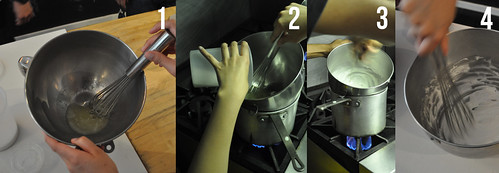
We began by preparing the meringue. {1} After briefly whisking 50 grams of egg whites in a large heat-safe bowl, we put it over a {2} simmering water bath, whisking together with approximately 1/3 of 110 grams of granulated sugar. We then continued to gradually add the remaining sugar, {3} as the whites increase in volume, whisking until hot to the touch. {4} Removing it off heat, we continued whisking until the meringue became stiff.

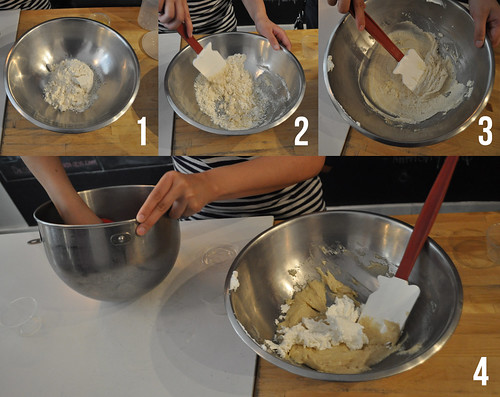
{1} We were given a well-mixed bowl of 125 grams of blanched almond flour and 125 grams of confectioner's sugar, already blended in a food processor for 20 seconds, with no lumps. We finished the macaron mixture by {2} using a rubber spatula {3} to mix in another 50 grams of egg whites into the almond flour mix. {4} Next, we folded the meringue into the almond flour mixture, until it was all well-incorporated into the meringue, regularly running the spatula along the very bottom of the bowl. The final mixture was homogenous with a thick viscosity -- if anyone had a mixture that was too stiff, they added about 1 tablespoon of egg white at a time until the proper consistency is reached.

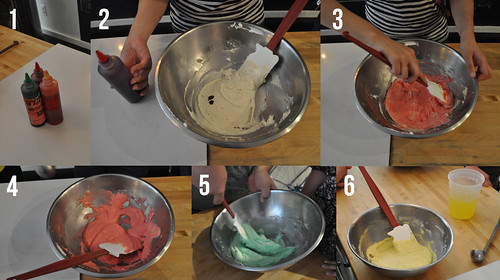
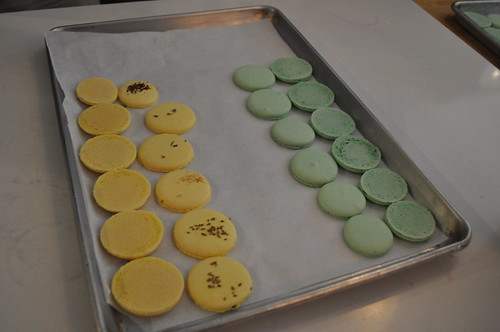
{1} After finishing creating the macaron mixture, Chef Chang gave us a choice of three shades of food coloring to add to the mixture -- red, green, and yellow. {2} Marcus and I picked red, adding few tiny drops to be sufficient. {3} We all thoroughly mixed the food coloring into our mixtures until {4, 5, 6} an even shade was produced.

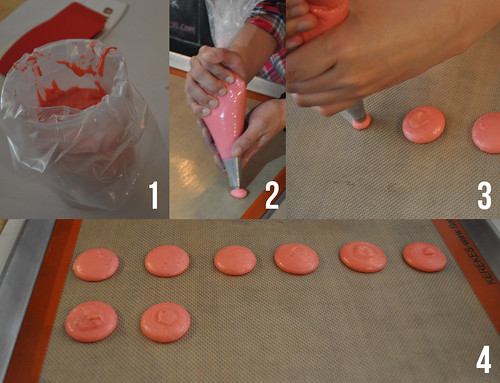
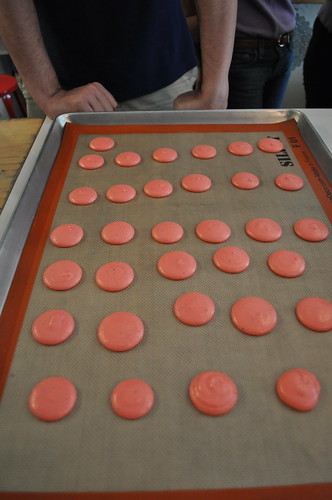
{1} As far as piping goes, Chef Chang showed us an easier way to transfer the macaron mixture into a piping bag fitted with a straight tip (size #805) inside. He put a piping bag over a solid, plastic container that was deep enough to hold up the piping bag with most of the macaron mixture. {2} Cutting an appropriately sized hole and onto sheet pan (18" x 13") lined with a Silpat baking mat, we piped silver dollar-sized disks, {3} keeping the piping tip about 1.25" away from the surface of the sheet pan to ensure rounded tops of the macaron disks. {4} Normally, we would set the sheet pan aside to allow the surface of the macarons to dry (anywhere from 30 minutes to two hours, depending on the humidity). In a preheated oven at 300 degrees Fahrenheit, the macarons were baked for approximately 7 minutes, turning the pan halfway through the duration. The macarons are typically "deemed finished" when the tops are firm and dry, and the "foamy" base is dry as well. Upon completion, let the sheet pan with the macarons cool.

Marcus and I's finished sheet pan with piped macaron disks.

However, due to time constraints of the class, Chef Chang had macarons, baked and ready for us to which we would add center fillings. He removed the macarons by gently running an offset spatula underneath each one. Each macaron was then paired by size, lined up next to each other with one facing up in each pair.

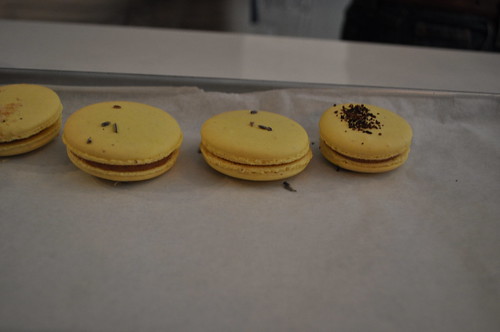
We piped our desire filling (our choice of buttercream, marmalade, and ganache) onto one half of the macaron pair, then sandwiching each with the other half of the pair.

So woohoo! We successfully "made" macarons at DT Works, leaving with a half dozen each!

Several months later in October, I found another class deal offered for DT Works on Groupon, but this time for a chocolate soufflé-making class. I immediately nabbed two Groupons (one for me and one for Marcus) for this deal and signed up for the next available class in December. Since we had such a great experience with Chef Chang during the macaron-baking class -- he's a great teacher (as I've already illustrated above), especially for beginners for he is very precise, succinct, extremely knowledgeable, and patient -- I figured tackling something as notoriously challenging as making chocolate soufflés would be something he would teach very well, too. Plus, I've always wanted to learn how to make a great soufflé (I've never attempted before this class, actually), but I've always been too intimidated to do so. This was my chance to do it (and to do it right)!

The same "island" prep station inside DT Works, laden with the first ingredients and tools needed for the first steps of the soufflé recipe. Similarly to the macaron-baking class, Chef Chang discussed the history behind the finicky yet coveted dessert, debunked some common "myths" behind it, as well as his experience with this particular dessert. He also told us the recipe we would be using is adapted from the one used for the chocolate soufflé served in the past at Le Cirque.

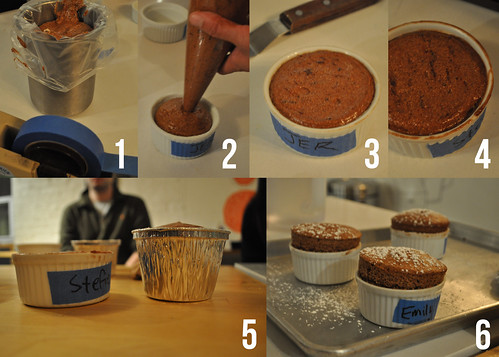
After preheating the oven to 375 degrees Fahrenheit, Chef Chang had us {1} label our ramekins with some painter's tape, writing our names in marker over it and adhering it to the side. {2} Then we brushed the interior of our ramekins generously and thoroughly with softened butter (about 4 tablespoons), ensuring the entire interior was buttered (including the rim), followed by coating the buttered ramekin with sugar (about 1/2 cup), knocking out any excess sugar. The reason for doing this is so that the soufflé batter can rise easily within the vessel as it bakes in the oven.

We did the same with the foiled "ramekins" that Chef Chang said we'd prepare the batter for, but would be saved to bake at home. The soufflé within the porcelain ramekin would be eaten at the end of class.

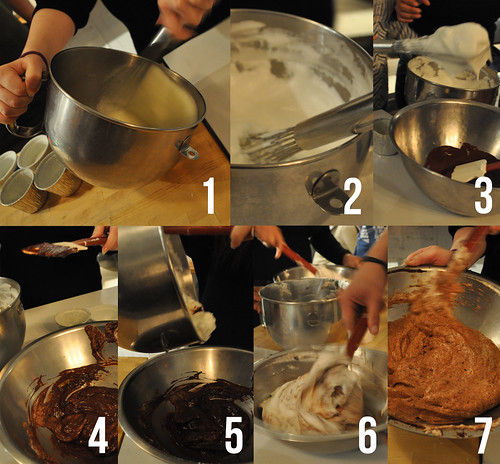
Next, we placed 250 grams of egg whites, 3 grams of cream of tartar (lemon juice can substituted), and a pinch of sugar in a large bowl, {1} whipping (you can also use an electric mixer for this, haha) the egg whites, gradually adding 120 grams of granulated sugar to the mix {2} until we got stiff peaks (evidenced better in 3). This became our meringue.

While we were whipping the whites, Chef Chang had his assistant melt 150 grams of 70% dark chocolate over a double-boiler over simmering water, stirring occasionally. Chef Chang said it was very important that the chocolate still be warm/hot from the double boiler when combining it with the meringue. Same goes for the meringue -- he emphasized that we should not wait too long before combining with the chocolate. Otherwise, the chocolate fails to cohesively meld with the meringue (and instead, yielding chunks of chocolate chips in the mixture), and the meringue risks becoming too stiff.

{1} Similarly to how we transferred the macaron mixture to the piping bag, Chef Chang showed us the same method for transferring the soufflé mix for us to pipe into our ramekins. {2} Only difference is we used the same piping bag without the straight tip, just cutting a half-inch hole at the closed end of the piping bag. We piped straight down (90 degrees) into the ramekins, {3} using an offset spatula to level the tops of the ramekins so that the soufflé mix is evenly lined up within the ramekin. {4} There was one final touch we
had to do before we could put the ramekins into the oven -- we ran our thumbs along the inside edge of each ramekin rim. This is done so that the soufflés can properly rise without sticking to the rim of the ramekins. {5} Our ramekins were ready to be baked on the middle rack of the oven, {6} until they rose, forming a crust on top, but were still "jiggly" in the center, approximately 10-12 minutes, depending on the size of ramekins used.

And voilà! Marcus and I successfully made some pretty awesome soufflés -- they rose and everything :P! Plus, they tasted absolutely delicious, if I do say so myself! Sufficiently moist with an smooth and airy texture -- fluffy as can be and perfectly rich (just the right amount of bittersweet) chocolate. Almost like biting into a cloud, as I've heard someone describe before, only slightly firmer. I left, in awe, of the wonderful soufflés that Marcus and I made at the workshop together. So I guess the near impossible reputation and fastidious nature of the soufflé can be, indeed, conquered.

Findings: I have to say, after all this, DessertTruck Works offers some pretty comprehensive advanced baking workshops, easily accessible by baking novices and experienced baking veterans alike (more emphasis on the novices, of course). Chef Jerome Chang has a no-nonsense approach to the bakery's intensive workshops (whether it be for the fussy macaron or the scrupulous soufflé). His straightforward recipes and succinct explanations (for both background and procedure) during the workshops are key to their success. Chef Chang was able to say exactly why the recipe is written a certain way (e.g., why we use room temperature egg whites, why we butter and sugar ramekins) -- this makes for a more effective understanding of why the said recipe works, and it'll help you remember in the future when you're tasked with executing the recipe on your own. I also liked that it wasn't just a "demonstration" but a very hands-on experience -- your hands will get messy with flour and all sorts of baking tools and goodies.

In summary, I highly recommend the two current workshops (i.e., macaron-baking and soufflé-making) offered at DT Works, especially if you can nab a Groupon deal or two for them! Definitely go accompanied (makes it more fun!), and I promise you'll learn a lot, make great baked goods, and eat deliciously!

Price point: a two-hour macaron-baking class (and a half dozen macarons) for $45, a two-hour chocolate soufflé-making class (and two soufflés -- one baked and one unbaked to take home) for $85; $22 and $39 with Groupon, respectively.

--June 5, 2011 and December 27, 2011

DessertTruck Works
6 Clinton Street
New York, NY 10002
http://www.dt-works.net

Groupon
DessertTruck Works macaron-baking and soufflé-making class deals available here* and here*!

* These deals are no longer available at the moment, but keep your eyes peeled! Sign-up for Groupon, and maybe they will offer the deals again soon. Since taking this class, I've seen Groupon offer the deal one more time, so chances are, they'll be back!

Tuesday, September 6, 2011

Dessert | Ladurée (NYC)


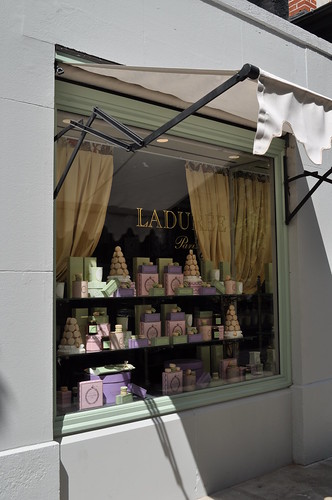
No, this is not a mirage. There's no need to rub those eyes to make sure you're seeing it correctly or to pinch yourself to wake yourself up from a dream. The famed French macaron shop, Ladurée, has finally crossed the Pond and reached the island of Manhattan, where its flagship set up shop over on the Upper East Side earlier last week.


Just a little background about Ladurée before I get into the details of the dainty treats offered by the establishment. Parisian tea salons and their history are intimately tied to the Ladurée family. Back in 1862, Louis Ernest Ladurée, a miller from the southwest region of France, opened a bakery in Paris. During the same time, the Garnier Opera had just begun its construction and the surrounding area was "rapidly developing into one of Paris's most important and elegant business districts, where prestigious names in French luxury goods had already taken up residence." So just as Ladurée's locale in Paris, the Ladurée here in New York City is located on Madison Avenue, where it is famously lined with premier designer flagship stores and haute couture boutiques, making it the ideal area that mimics its original (former) Parisian headquarters.


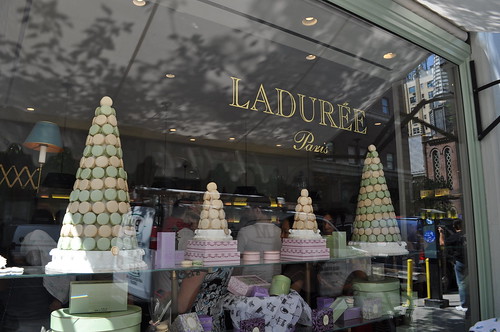
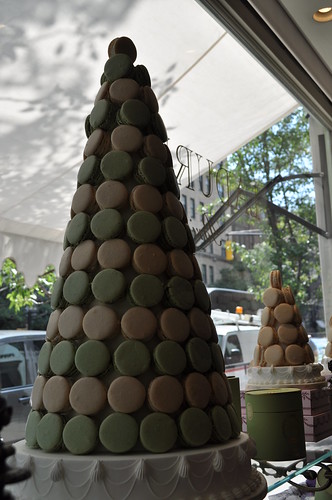
Look at those delicately assembled macaron trees! Beautiful!


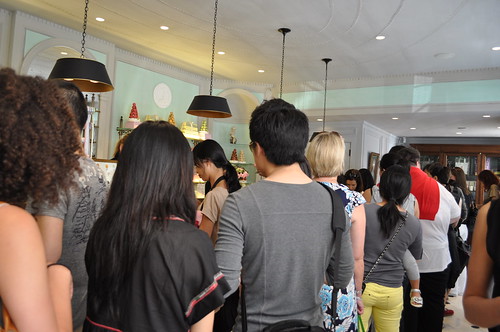
Here is the length of the line when we arrived to Ladurée on a Friday afternoon, around lunch time. It looped through the store about twice, making us luck out because I had heard the lines were going out the door and around the block the first few opening days. We waited a little under a half hour until we reached the counter to place our order for macarons.


So to continue on about the history regarding Ladurée -- in 1871, during Baron Haussmann's "face lift" of Paris, there was a fire that resulted in the transformation of the bakery to a pastry shop. This pastry shop was decorated with the expertise of Jules Cheret, a famous painter and poster artist at the time. Mr. Cheret found his inspiration from the painting techniques used for the ceiling of the Sistine Chapel and the Garnier Opera. The incorporating of these elements in his work for Ladurée, he "added depth and relief to the ceilings and ornamented with cherubic children." Over time, the cafés in the area developed and became more and more luxurious, thereby attracting Parisian high society, eventually becoming the "showcases" of the French capital.

The beginning of the twentieth century was when Mr. Ladurée's wife, Jeanne Souchard, had "the idea of mixing styles: the Parisian café and pastry shop" together gave birth to one of the first tea salons in town. This was also at a time that Parisian women were also changing, where the desire of making new acquaintances came to the surface. Accordingly, the salon de thé (i.e., tea salon) had a "definite advantage" over the cafés: it permitted ladies to gather in freedom.

Since then, David Holder, and his father, Francis Holder (founder of the Holder Group), bought the institution in 1993 where the father and son had plans to promote and enlarge the famous "Maison" of Ladurée. The result -- a new prestigious Ladurée (both a restaurant and a tea room) opened on the Champs-Elysées in September 1997. David Holder's mission for Ladurée is "bring back the great classics" (especially the salon de thé) as well as "to create an environment for gastronomic creativity in Paris." Under his leadership, Ladurée has become a tea salon, pastry shop, restaurant, chocolate shop, and an ice cream parlor in Paris.


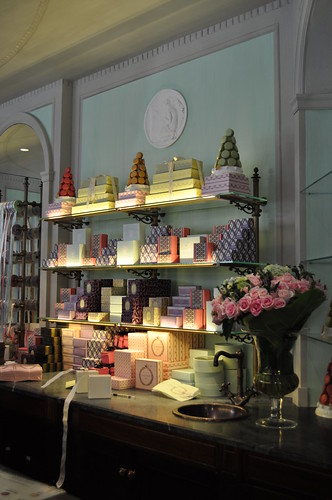
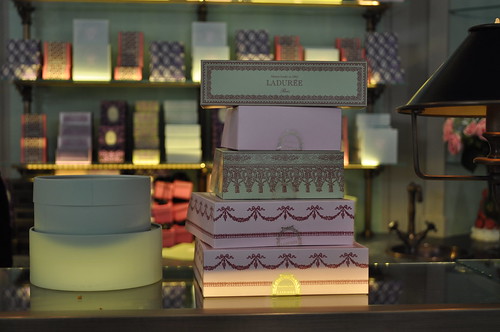
Some of the pastel-laden pastry boxes to hold the dainty treats with which you hope to leave the shop!


Plus, all the ribbon used to tie up those boxes with pretty bows!


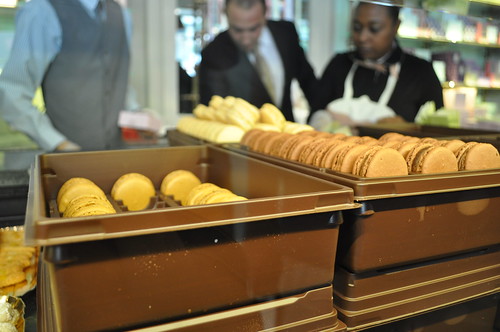
The macaron counter, where it appears the macarons are stored in these special containers, all stacked atop of what seems to be cold stone slabs in order to keep the macaron fillings from melting. What is even more interesting is that the macarons (along with all the other things offered for sale in the shop) are shipped overnight directly from Paris to New York! How incredible is that?! When the rumors were popping up all over the foodie e-universe, there were concerns about the shop and its highly desired goodies. Would the the shop would make the macarons in-store? And if so, how did the company plan on selling these French pastry masterpieces in the States without compromising the practically perfect construction and quality of the ones sold in the Champs-Elysées shop? As macaron enthusiasts know, the baking and construction of these meringue cookies is contingent on so many factors that if one little thing is off (humidity, ingredients, measurements, recipe procedures), the entire cookie suffers. For all we knew, then, the moodiest cookie in the world (as best said by the pastry chef who taught the macaron-baking class I took at the Institute of Culinary Education), especially the ones at the highly-sought after Ladurée, could somehow magically depend (but not at all surprisingly) on French butter and Parisian air. Once the question of imported macarons was settled, the next question rested with whether these macarons from Paris would be everything they are supposed to be. Would the air travel impair the taste/texture/consistency of the macaron? How much more expensive would they be compared to the domestic macarons to which we have become accustomed? Would the import costs dissuade potential customers from purchasing them? Marcus and I were determined to find out.


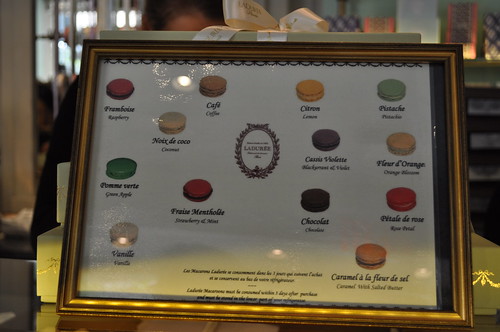
The color-coded menu of thirteen macarons offered at Ladurée -- the flavors listed here are pretty permanent all year round. With each new season, Ladurée pays tribute to its most famous creation, the macaron, by creating a new flavor. The company says "its existing range of macarons is always the starting point when a new one is created, as a variety of colors is as important as the range of flavors and a vital part of their appeal. So a bit more history on the macarons of Ladurée -- at the beginning of the twentieth century, Pierre Desfontaines, second cousin of Mr. Ladurée, first thought of taking two macaron shells and joining them together with a ganache filling. The spirit of this first macaron carries through today, as these pastries are made every morning in Ladurée's "laboratory," where pastry chefs measure out all ingredients precisely and add "a pinch of unique 'know-how' that is essential to the making of such a delicacy." Once cooked and piped, the macarons are put aside for two days before going on sale -- what Ladurée refers to as "the time to achieve a perfect balance between texture and flavor."


A close up of the vessels that hold the beloved macarons.

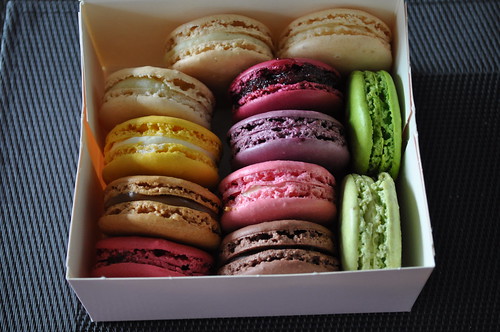
Marcus and I decided to order one of each flavor (thirteen in total, of course), in order to properly assess the shop's full repertoire of flavors available. After getting through the line and arriving home, our macarons made it to our dining table without any macarons melting or becoming crushed.


The box that held twelve of our thirteen macarons (only had capacity for so many).


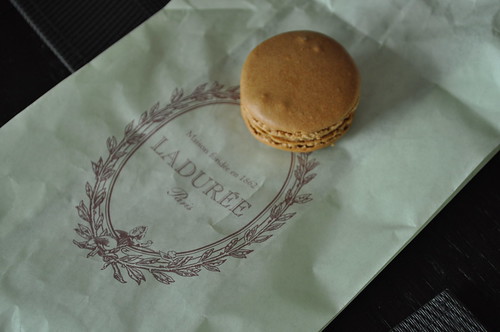
The spillover macaron was placed in this mint green pastry bag.


So here they are -- the colorful spectrum of macarons sold by Ladurée. Here's the flavor rundown (top left, going left to right):
(1) vanille* (vanilla)
(2) noix de coco (coconut)
(3) fleur d'orange (orange blossom)
(4) framboise* (raspberry)
(5) pomme verte (green apple)
(6) citron* (lemon)
(7) cassis violette* (black currant and violet)
(8) caramel à la fleur de sel* (caramel with salted butter)
(9) pétale de rose (rose petal)
(10) fraise mentholée (strawberry and mint)
(11) chocolat* (chocolate)
(12) pistache* (pistachio)
(13) café (coffee) [see previous photo]


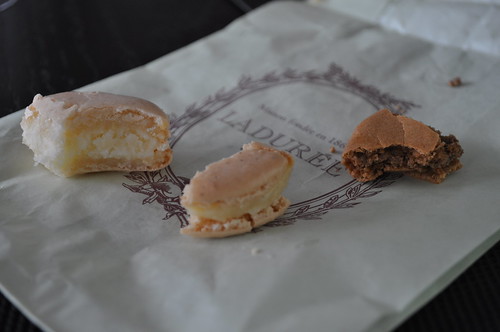
The first ones we tasted were café, vanille, and noix de coco. The first bite into the café proved all the hype Marcus and I kept hearing about Ladurée -- the cookie's texture (as with the rest of the macarons) was airy and had just the right amount of "crumbly." It was everything we thought it would be and more -- there is just that little somethin' about Parisian air that makes all the difference between these imported macarons and the domestic ones Marcus and I have explored throughout the city. For the Goldilocks of macarons, these were "just right!"

As for the flavor of the café, I found it to be bold (in a good way), while Marcus thought it was a bit more subdued in comparison to the vanille, which we had after. The vanille was light and creamy while remaining super fragrant and strong in taste. It was like heaven in a macaron, almost like a vanilla-infused cloud. As for the noix de coco, we both found it to be soft like the vanilla, only with many coconut shavings and a definite coconut taste. The center for these three macarons were ganache. Out of these three, we found vanille took the cake in taste and texture.


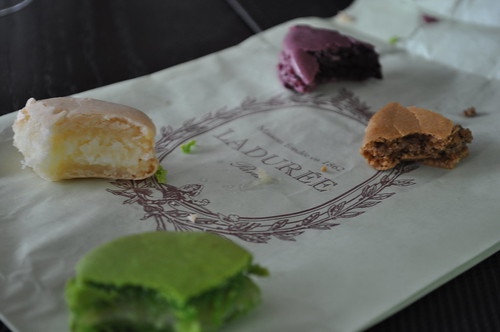
The next one we tasted was the pomme verte, which was very strong and biting in a way that Marcus and I disliked. It felt like I was having straight apple sauce in between the macaron cookies. It was also very overwhelming in apple flavor -- not at all what I expected in a delicate Parisian macaron. A no-go from us on this one.

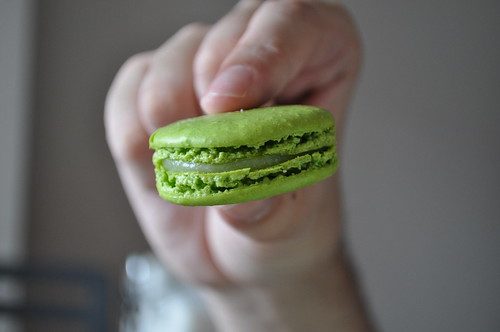
Next, we had pistache, which was just as amazing as the vanille, only with very nutty and grainy buttercream from the fresh pistachios contained within it. Cassis violette had a very strong and concentrated black currant flavor contained in its jelly center, where I could barely make out the violette. This wasn't much of a loss to me seeing as I really like black currant-flavored macarons anyway. This particular macaron would go really well with a nice glass of sparkling wine, kind of like a faux kir royale! Citron was lovely, too, as it was creamy and refreshing with the subtle zing of citrus (not at all sour!) -- what Marcus referred to as a very light-hearted and tart macaron. The caramel à la fleur de sel was next, which we found to be pretty good and pretty on par with similar ones we've had at other macaron shops in the city. We finally got to chocolat, when we both declared it to be the best "chocolate-flavored" macaron we've ever had, where its ganache center tasted like those gourmet chocolate truffles.


When we got to fleur d'orange, we weren't sure what we were tasting until we checked its color against the menu. We found it to be purely texture and mostly light in taste (not much flavor at all). Our friend Jess had previously told us it kind of tastes like honeysuckle to her, so we probably got a subtle hint of that here.

With three more remaining, we went with the fraise mentholée, which after the first bite, had both Marcus and I immediately react "No, no, no!" in unison. It tasted awful to us -- so much so, that Marcus described it "as if I scraped out the contents of a strawberry Pop-Tart with a candy cane and ate it." I couldn't have put it in better words if I tried. So trust us, if you don't want to taste a strawberry-flavored Peppermint Pattie, don't get this. We urge you to please save yourself. Pétale de rose had a similar effect on us -- it tasted like I had stuck a bar of soap in my mouth and began to chew. Not good. I think it's mostly because Americans don't really have physical rose petals (or its infusion of aromatic essence) exhibited in our cuisine. It is probably an acquired taste that I definitely haven't acquired yet.

The last macaron we had was the framboise, and we really enjoyed that one. It had that tart berry flavor and the refreshing crunch of raspberry seeds within its jelly center. It was quite concentrated with flavor, but I like the tart taste of berries, so it was right up my alley.

Findings: I still find it so unbelievable that Ladurée has finally arrived to New York City, let alone all of its culinary goodies are imported directly from Paris. Fortunately for macaron fanatics all around, nothing has been compromised from the overnighting of these macarons across a body of water. Upon hearing that these macarons are shipped directly from Paris, I was concerned the price point would be extravagant to the point where a visit to Ladurée would be either a one-time thing or only for super special occasions. But this was yet another surprise. It was only about a $0.20 mark-up to the prices we had already been paying for these addictive French pastries. What a steal for real-McCoy, authentic Parisian macarons!

Additionally, you can definitely tell the dreamy consistency of the Ladurée macarons are just as airy and light as everyone who has visited the Parisian shop. From my eyes (or more accurately, my taste buds), the cookie part are practically perfect, giving me the audacity to say that they should be the benchmark that every macaron should meet. Only "downside" (if it really is one) is that there are a limited variety of flavors available daily. With the exception of showcasing a new flavor each season, it seems as though the menu is pretty fixed in that regard. Nevertheless, I am sure you will find your favorites and stick to them. Just be wary there may be a line!

Lastly, I would advise you to stay away from the pétale de rose, the fraise mentholée, and the pomme verte. Unless you've become accustomed to those flavors and/or textures before, they are quite shocking and overwhelming in bold flavors that may not appeal widely to the general public's taste buds -- so you've been warned!

All in all, Marcus and I really enjoyed our long-awaited journey through the flavors of Ladurée macarons -- they were everything we dreamed it would be and more. I still need to make it to Paris one day, but a trip to Ladurée will sate my wanderlust for now. The airy meringue along with the array of fruity and buttery fillings are as close as you can get to savoring the character of Parisian air and the savoriness of fresh French butter. Plus, can you really say anything bad about delightful French pastries that are daintily placed into playful, pastel boxes and then wrapped in iridescent ribbons in the prettiest little bows? Yeah, I didn't think so either :P!

Price point: $2.70 for each macaron.

--September 2, 2011

Ladurée (NYC)
864 Madison Avenue
New York, NY 10021
http://www.laduree.com

Monday, April 11, 2011

Cooking Class | Classic French Macarons at ICE

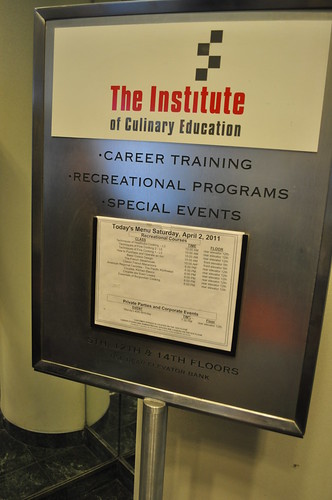
As a Valentine's Day gift to Marcus and as a Christmas gift to Erin, I signed the three of us up for a Classic French Macaron baking class at the Institute of Culinary Education (aka ICE) over at the Flatiron District. How did I hear of this class, you ask?


Well my dear friend Linda, my culinary soul sister, told me about it while back. We got around to discussing how much we love macarons when she mentioned that she and her husband had taken an intense macaron-making class at ICE and how she learned to appreciate the hard labor behind those tiny French pastries that cost about $2-4 a pop. I had been scouting out for availabilities on the website since last August until I was able to find something for April when ICE opened its Spring semester registration in early December. When I had checked back in August, all the macaron classes listed were either sold out or were themed macaron classes (e.g., holiday macarons, savory macarons, etc.), and while the latter would've been really interesting, I wanted my first macaron baking experience to be for the classic kind. That being said, I promised myself I would hold out until I saw the class reappear again, and low and behold, it did!


We arrived about 15 minutes before the scheduled time of 6 PM (did I forget to mention this class is four hours long?!) and received our welcome packet filled with instructions for the class. The class (and all of the macaron classes over at ICE) is run by pastry chef-instructor, Kathryn Gordon, co-author of the upcoming cookbook, Les Petits Macarons: Colorful French Confections to Make at Home. She studied at L’Académie de Cuisine in Maryland and has worked/staged in the renowned pastry kitchens of Rainbow Room, Tavern on the Green, Le Cirque, Le Bernardin, and Osteria del Circo. She used to compete a lot in many pasty competitions, now seldom competing, but she still provides commentary for bread and pastry championships for the Food Network. Before she committed to her calling in the pastry arts, she had a career on Wall Street, which I find really fascinating, as I wonder if I could ever be that bold and move away the bean-counting party of my life. But alas, that is another thought for another day.

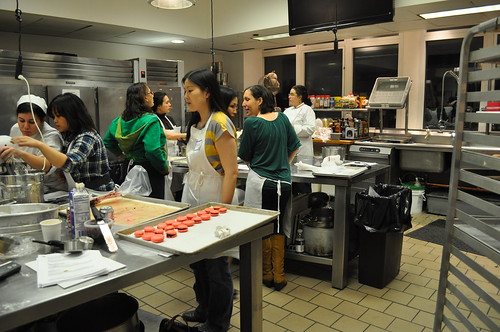
Anyways, we began class with 18-20 or so students sitting around a prep table in one of the kitchen classrooms, where Chef Gordon debriefed us with a brief introduction about French macarons, the ingredients they require (almond flour, egg whites, powdered sugar, and meringue), and the three general techniques to make the cookie part of the macaron (French/ordinary/common/cold, Italian, and Swiss). She referred to French macarons as the "world's moodiest cookie" as well as the "controversial cookie" in the world of Meilleurs Ouvrier de France (aka MOFs, a title of Best Pastry Chef of France).

During class that day, she taught us the Italian method to make meringue for these macarons. It is the strongest of the three methods I mentioned previously and is the same technique used to make buttercream and nougat candy. Chef Gordon told us she finds Italian-based meringues don't spread as much (due to the use of sugar syrup and the way it "cooks" the egg whites as they are beaten by the mixer). The Italian method also has the highest "shine" because the sugar is fully melted into the batter (per the recipe's instructions).

Prior to attending this class, Erin and I had attempted to make French macarons from scratch, and let me tell you how messy, frustrating, and time consuming it got, even when we followed the wise words from Martha Stewart herself. They looked ugly, deflated, and grotesque, and we couldn't figure out why. When Chef Gordon asked if any of us had any experience making French macarons during the debrief, everyone who had reported unfavorable results. All of Chef Gordon's explanations for the problems our classmates ran into were explanations for all the things that went wrong with our macarons. Basically, everything that could go wrong with macarons went wrong with ours!


After the debrief, she paired us up (me with Marcus; Erin with Lauren, another girl from class that day) and sent us to our work stations, stocked with standard KitchenAid mixers, digital scales, a food processor, and any basic kitchen tools we needed. I found it interesting how the outlet plugs hung above the work stations as having electrical wiring along the sides of the kitchen would be much of a safety hazard. Very pragmatic!

Because the recipe is quite long and complex, I won't be able to sum it up here, but I'll give you the highlights of what went on during our four-hour macaron-baking intensive class. Marcus and I got to a late start because one of the members of our class stole our digital scale (those scoundrels!), and we were having trouble with cooking the sugar syrup to the exact temperature required (as it is the key ingredient to the Italian-based meringue). Luckily, Chef Gordon was super helpful and very resourceful (undoubtedly with her past experience in professional pastry kitchens) when we ran into any trouble or had any questions. She understood this mysterious French pastry from its complex core to its delicate exterior--once she saw the problem we were having, she knew exactly how to remedy it (or would just tell us to start over because it was too late to repair). After redoing our meringue, we were able to pipe the macaron cookies onto Silpat, a silicone non-stick baking mat.

A similar thing happened when we were making the pistachio buttercream, what we chose for the fillings of our macarons (which required cooking light corn syrup in the same fashion as the sugar syrup--to a particular temperature, without actually having a thermometer).


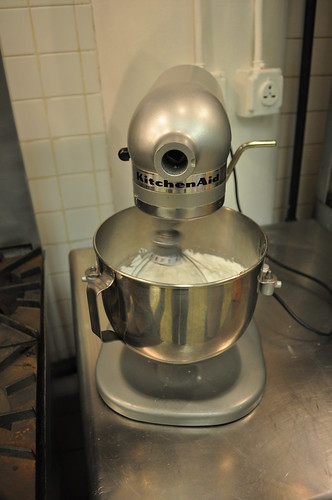
Our friend, Mr. Chrome KitchenAid Mixer, whipping our egg whites for the pistachio buttercream filling. We mixed in butter, heated light corn syrup, and pistachio paste later on in the process.


The rest of the class finishing piping their macarons, while Marcus and I were finishing up our filling.


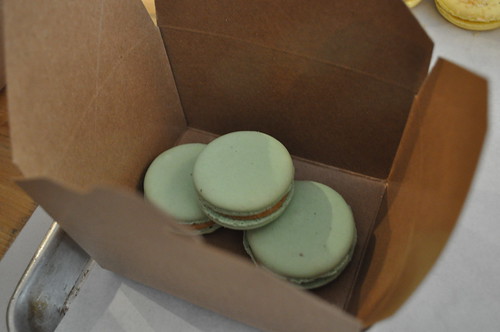
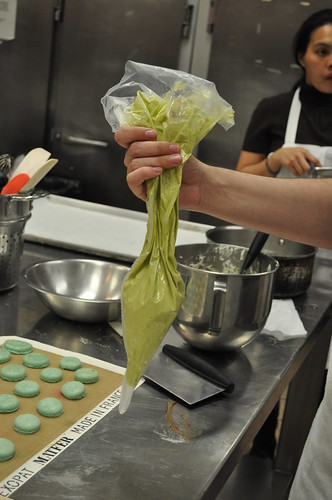
Once we finished our buttercream, our cookies were finally ready! Notice our macarons are slightly tinted green (Marcus's idea) so it could appropriately match our pistachio-flavored filling. Also, it made ours stand out because the rest of the class did white, red, or purple.


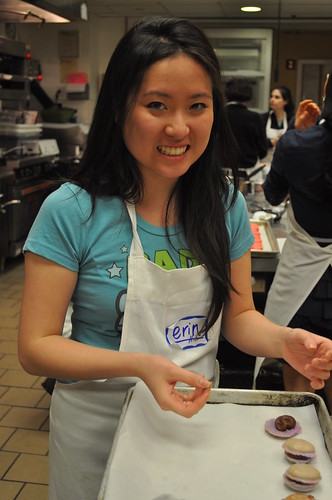
Erin piping her purple macarons with cappuccino ganache.


Our piping bag!


Our pistachio macarons, post-piping!


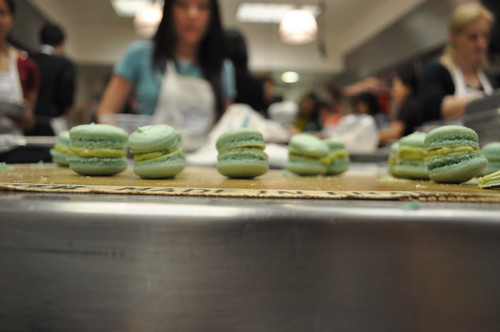
I thought taking a photograph from the side would be interesting--love how it turned out!


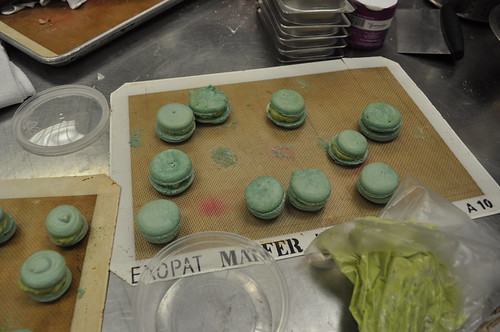
The rest of our post-piped macarons. I snuck a bite of one of our macarons--it was definitely comparable to pistachio macarons I've had before!


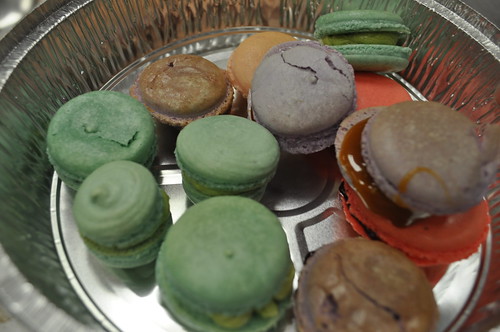
Gathering the rest of the class's macarons to take home, which includes Fleur de Sel caramel macarons, blueberry jam macarons, cappuccino macarons, and of course, pistachio macarons. I have to say that I liked our green ones best, but then again, pistachio always seems to win me over!


Erin's baking partner, Lauren, with me and Erin in the trenches of French macaron baking.

Findings: I found this class really informative about all that is involved with baking French macarons--from the theory behind macaron-making to the numerous approaches to make them at home. The class helped hone our piping skills, overall baking knowledge, and macaron recipe repertoire. It was quite an intense four-hour class--lots of information was packed in that period of time, so it was a tad bit overwhelming, especially for individuals that may not have been familiar with general baking knowledge and/or skills beforehand. I would love to go back for a themed-macaron baking class now that I have a better understanding of how the overall baking process works, so I could be more efficient and learn more about other flavors and fillings!

I highly recommend this class for anyone who has had some exposure to basic baking (even if it's Duncan Hines straight-out-of-the-box)--it's definitely not a class for beginners. It is a bit more advanced than that, and since the recipe is basically thrown at you after the debrief meeting, you have to be fast on your feet and act quickly so you don't fall behind! Chef Gordon was very knowledgeable, and her experience and expertise with these little French goodies is very extensive. She has this ability to identify what's wrong just by looking at it, so trust that you'll be in good hands with this class. At $110 per person, you get four hours of instructions with hands-on baking with experienced chef-instructor Kathryn Gordon as a resource (along with two assistant pastry chefs), and the macarons you make to share in class and take home. Like me, you'll definitely leave the class with a deeper appreciation for this complicated cookie (plus, you can finally understand why bakeries and cafés charge the premium that they do for these French delights).

Thanks again to Linda for recommending this class to us!

Price point: $110 per person for a four-hour baking class.

--April 2, 2011

Institute of Culinary Education
Classic French Macarons recreational baking class
50 West 23rd Street
New York, NY 10010
http://rec.iceculinary.com
http://rec.iceculinary.com/Courses/Detail/834

LinkWithin

Related Posts Plugin for WordPress, Blogger...