Friday, December 9, 2011

In the Kitchen | Mushrooms & White Truffles

So this little undertaking all began when Gilt Taste had an unexpected sale on white truffles (of course, applicable only to the tiny pieces at 70% off) that Lisa stumbled upon. She brought it to my attention, debating whether or not she should even try to get some. It was pretty hard to pass up -- I mean, 1 ounce (28 grams total) came out to be a total of $78 as a result of the sale. When we came to the mutual decision to go for it (we decided to have a very intimate pasta party for which to use these said truffles -- that is, just the two of us, haha), we should have known we had dawdled for too long. They were sold out on the sale! It didn't discourage us, though. With white truffles on the noggin, we decided to splurge. Lisa knew Eataly would have them, so she sent me on a mission to get an ounce's worth of white truffles.

{1} Eataly, the home of fine Italian food! I normally wouldn't really go here, especially now during the holidays, because it's a madhouse laden with so many people and tourists which makes it difficult to maneuver around and shop for whatever it is I may need. But with getting white truffles, I had to make an exception! {2} I was directed to the freshly made pasta counter, where I could find these nuggets of fragrant beauty. At Eataly, they were going for $9.25 per gram (!) and were imported from the famed Piedmont region of Italy. Sitting right next to the white truffles were the black ones, which were going for a fraction of that at $1.50 per gram. The price differential is due to the increased rarity of the white truffles in comparison to the black ones (more on this later). {3} Once the pieces (two, to be exact) that I selected to purchase were finalized with the gentleman behind the counter, he gave me a slip of parchment paper with the product description and the calculated cost written in white wax pencil (also a huge fan of those!). He told me to bring this paper to check-out as I had to pay for the truffles before he could give it to me to take home. Wow, talk about really intense security measures -- they don't mess around when it comes to these truffles (and rightfully so)!

I left the store with this small little package wrapping the two white truffle nuggets inside. Their (pleasantly, depending on who you ask) pungent smell wafted through my shopping bag all the way home. Following the instructions I was given about storage, I put it in my refrigerator in a cold and dry area. The refrigerator now gives off grand whiffs of white truffles every time I open it. Some may not like that, but I'm not complaining here :D!

Just wanted to interject with a little history lesson about white truffles. The white truffle, also referred to as Alba madonna, almost exclusively (there are other places, but very few and far between) from the Piedmont region of northern Italy, most famously in the countryside around the cities of Alba (from where Alba madonna originates) and Asti. White truffles grow symbiotically with oak, hazel, poplar, and beech trees with a peak fruiting period in the fall season (very fleeting period, it seems). An ideal harvest of white truffles (size, flavor, and aroma) is contingent on environmental factors, such as moisture, weather, tree species and age, soil type, proximity to the roots and tree trunk, and area insects. The right combination of these factors will yield a flesh that is pale cream or brown with white marbling. There are pigs, and in recent years, dogs, who forage for them when they are in their prime season.

However, over the last fifteen years, "there are fewer of them, and of lesser quality, every year" thanks to "global warming and the leeching of fungicides into the soil, among other things." John Magazino of Primizie Fine Foods, one of the leading truffle importers in the country, has talked about this general decline, emphasizing that "the market just has to live with that, because truffles can't be faked or formulated." Which brings me to why they are priced so steeply and hard to find. Unlike the white truffle, the "inferior" black (Périgord) truffle can be cultivated, which explains the price differential that I saw at Eataly ($9.25 versus $1.50 per gram!). As such, "there is no other way to get white ones except to set pigs and dogs loose on the hills of Piedmont, snorting with pleasure and excitement at the thought of finding precious fungi that their owners won't allow them to eat." Even French gastronome Jean Anthelme Brillat-Savarin called these truffles the "diamond of the kitchen" in his writings.
So what did we make so that we could enjoy our white truffles to their highest potential? Lisa and I went a little crazy on the mushrooms involved -- after all, truffles are "underground mushrooms" and very much related to the beloved fungi.
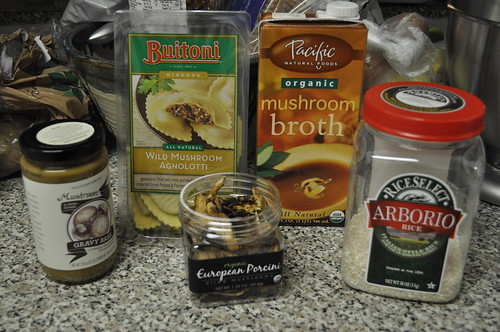
We decided to go with Buitoni's pre-made wild mushroom agnolotti (thanks to Linda for this wonderful recommendation) paired with the mushroom gravy base from Williams-Sonoma to be mixed in with some mushroom broth. This was to be followed with a porcini mushroom risotto, the course of which Lisa took ownership during our mini-cooking party. I got the dried porcinis and arborio rice from Whole Foods.
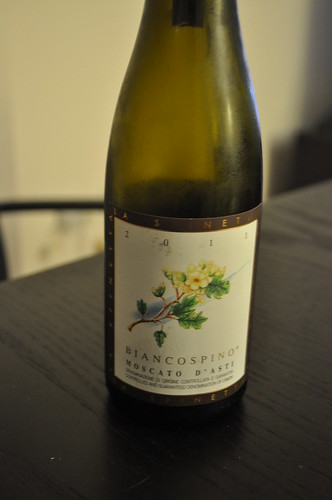
While I was at Eataly, I picked up two bottles of wine -- one for each pasta dish we were going to make. This first bottle (a half bottle, actually) was a Moscato d'Asti produced by La Spinetta from Asti of the Piedmont region in Italy with a 2011 vintage. Moscato d'Asti is a semi-sweet, semi-sparkling wine made from the muscat grape. I thought since this wine (a nice one to start out our meal) is from the Piedmont region, just like our white truffles, that they'd be a good pairing. After doing some subsequent research, I found out that the wine has a floral notes and a grape-y aroma that should mellow the pungent aromatic from the truffle itself, creating a sensation on the tongue that is only made better with the sparkle from the bubbles. So glad that my instincts worked in my favor there (well, maybe except for the possibility of wine pairing better with the porcini mushroom risotto, as the article directly cites and includes that very recipe)!

So I decided we should start with the wild mushroom agnolotti because it is the least time-consuming. Four to six minutes in boiling water with a little extra virgin olive oil until tender and soft. The accompanying sauce I made using the recipe included with the mushroom gravy base -- mix one part gravy base and one part mushroom stock in a small sauce pan until thoroughly combined and to your desired consistency. It was a bit on the watery side, so we added one to two tablespoons of butter for a slightly creamier consistency.

The time finally came -- it was finally time to unwrap the white truffles. Sound the trumpets! Unveil the curtain! Lo and behold -- the "Pearl of Alba" in its earthy and marbled glory!
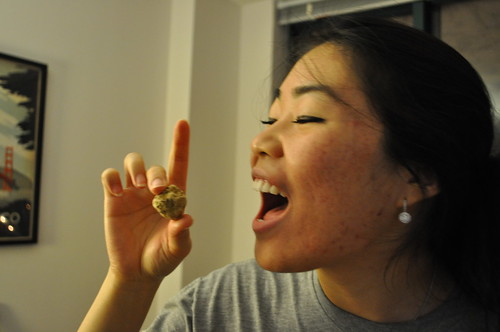
Yup, there's Lisa nearly giving me a heart attack by jokingly attempting to eat the whole white truffle. That would've been a Benjamin down the drain! :P

When I was at Eataly, I asked the person behind the fresh pasta counter how the white truffles should be served and if he had any recommendations for kitchen tools I could pick up in store. He said that they sell a truffle shaver that runs about $30 to $40, but that a cheese grater should be sufficient enough to get the desired texture and taste. The graters they had at Eataly were either too pricey or not to my liking. So when I was at Whole Foods, I saw this red fold-flat grater by Joseph Joseph for sale in the kitchen tool section. It was exactly what I had in mind, plus it's storage-savvy for a city-sized kitchen. It was about $20, which was on the pricier side, but I was willing to pay a premium for it due to its collapsing feature.
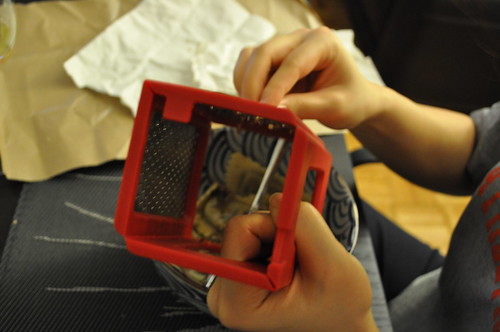
Lisa, delicately grating our first white truffle over the wild mushroom agnolotti with a portabella-porcini mushroom gravy sauce. The aroma was making us hungrier by the second, for sure!
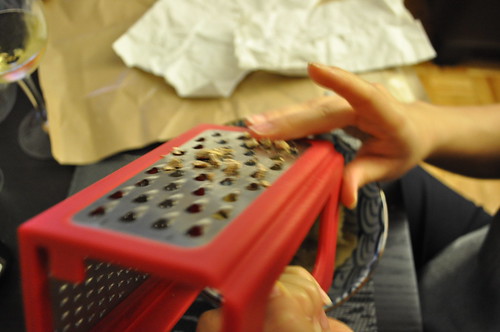
Getting every last shaving in -- nothing will go to waste at $9.25 per gram!

And voilà! Freshly grated white truffle over wild mushroom agnolotti in portabella-porcini mushroom gravy sauce! Talk about mushroom overload, but we didn't care -- we were all for the fungi-filled experience. It was my first time ever making the Buitoni wild mushroom agnolotti, and I was delightfully surprised at how great it tasted given that it was pre-made, pre-packaged pasta! It was bursting with mushrooms in its starchy pillows only with a little cheese for texture and taste. I liked how there wasn't more cheese than there were mushrooms, giving the opportunity for the agnolotti to boast its richly-filled center of mushrooms. The gravy sauce had the ideal consistency -- not overly watery, but not overly thick -- primarily because the mushroom broth leveled out the otherwise creamy thickness, while the butter was a nice addition to give it slightly more depth. The shaved white truffles were explosive with the mushroom-happiness of our starter course -- umami coming at you from all sides and angles! The wine pairing was pretty spot-on as well -- the light, crisp sweetness balanced out the heartiness and richness of the agnolotti.
So yay for truffled mushroom success!
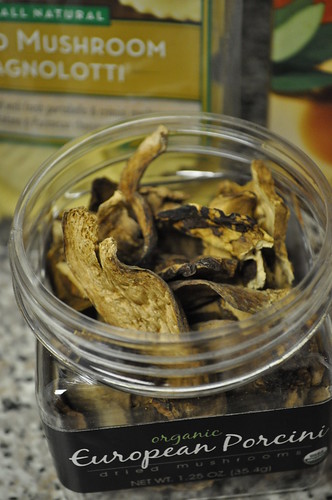
For the risotto, we soaked half the bottle of dried porcinis -- so fragrantly earthy -- in hot water for about 20 minutes, until they became soft and expanded. We saved the mushroom-soaked water to use for risotto absorption liquid. The porcinis then were chopped into small pieces and set aside.

Lisa minced a bunch of garlic cloves and a medium-sized shallot to start the risotto. In a small stockpot, Lisa poured about 2/3 of a carton of low-sodium chicken broth and kept it on medium-low heat, simmering. The minced garlic and chopped shallots were then sautéed together with extra virgin olive oil and a tablespoon of butter in a deep pan/skillet until soft and translucent, followed by adding the chopped porcinis. Once mushrooms were mostly cooked, she added a cup of arborio rice and sautéed until the grains were translucent, about 3 minutes. Next, add in chicken stock 1/2 cup at a time, stirring constantly between each addition and waiting until all chicken stock is absorbed before adding next 1/2 cup. During one addition of stock, instead of using chicken stock, we used 1/2 cup of porcini soaking water for some more flavor. For seasonings throughout, she used chives, a little oregano, basil, parsley, a little lemon pepper, Kosher salt, and freshly ground pepper. When all the chicken stock has been added and the rice is cooked through, she removed the pot off the heat and added a tablespoon of butter.

Here's the finished porcini mushroom risotto, pre-shaved white truffles. Look at those tiny, brown morsels!

The second bottle of wine I picked up from Eataly was a Barolo produced by Casa E di Mirafiore, also from the Piedmont region of Italy, with a 2007 vintage. After doing some initial research, I found that old Barolos are favorable to pair with white truffles. White truffles (particularly the ones we purchased at Eataly) and Barolos share the same soil, or better put, terroir. Terroir is essentially the combination of factors -- including soil, climate, and environment -- that gives a wine its distinctive character. It should be no surprise, then, that Barolos are typically paired with white truffles. From bottles of Barolo that I've seen in wine stores that I frequent often, this one seemed to be reasonably priced around $38, so I figured if we were gonna go all the way with the truffles, we should probably go all the way with the pairing, too -- reasonably, that is.


Shaving our second (and last) white truffle over the porcini mushroom risotto.
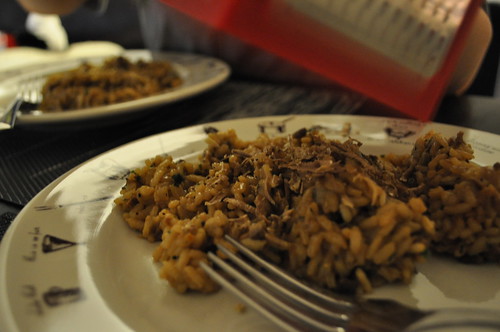

Grating in action!
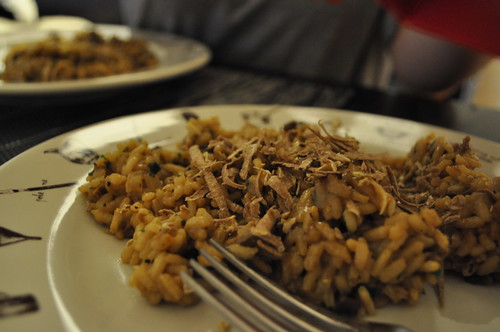

And voilà once more -- porcini mushroom risotto with freshly shaved white truffle. Lisa did a great job with the risotto -- it had an al dente texture with a creamy finish. The mushrooms certainly enriched the dish very much, allowing for the white truffle to mesh well with the existing familial, earthy flavors. The aroma and taste of the white truffle was more concentrated this time around primarily due to the larger size of the second white truffle, and the Barolo did a great job accenting those flavors with a bold, velvety finish and subtle tannins. Smashing success for the risotto, too!

Findings: Given our love of white truffles (Lisa got me hooked!) and our resulting delicious success, we have officially dubbed this to become an annual affair (which I will refer to as the Annual Truffle Supper) during white truffle season! Though it was quite the splurge on the two precious white truffles we used in our two pasta courses, Lisa and I both had a great time together, cooking and enjoying the aromatics and earthy taste of the shaved white truffles -- something we haven't got to do much at all until recently -- making the splurge totally worth it! The Italian wine pairings for our Truffle Supper were also lovely, too, which encourages me to be more attentive when it comes to wine pairings as opposed to just going with the oversimplified rule of thumb (i.e., reds with meats, whites with fish and poultry, etc.). As you can see, the cooking techniques involved and the pairings I made aren't very complex at all -- it's all something feasible in any kitchen as my city kitchen was just fine for us.

Yes, we're crazy -- we're already thinking about next year's Annual Truffle Supper. Lisa and I are planning to do a variation on mac 'n cheese, perhaps with wild mushrooms, topped with shaved white truffles (mmm!). The other course is still up in the air (maybe a raviolo or egg dish), but hey, we have another three seasons to think about it!

Much thanks to Lisa for contributing the glorious white truffles to our dinner! Looking forward to next year already!

Price point: $222 for approximately 24 grams / 1 oz. white truffles, $10.50-$38.50 for each bottle of Italian wine, $10.95 for Williams-Sonoma mushroom gravy base, $4.99 for one package of Buitoni wild mushroom agnolotti (via FreshDirect.com or Food Emporium), $6.99 for 1.25 oz. of dried porcinis.

--December 5, 2011

Eataly
200 Fifth Avenue
New York, NY 10010
http://www.eatalyny.com


Whole Foods Market
10 Columbus Circle
New York, NY 10019
http://www.wholefoodsmarket.com

Williams-Sonoma
http://www.williams-sonoma.com

Tuesday, December 6, 2011

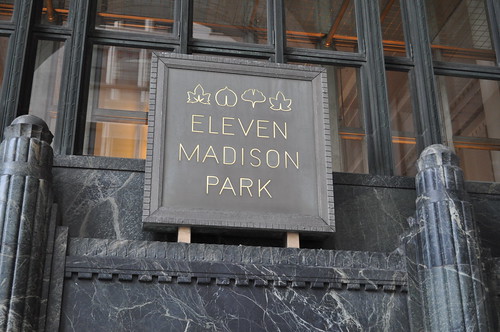
Lunch | Eleven Madison Park, v

So I just wanted to preface this entry with some great news -- I just started a new job this week! I will still be counting proverbial beans, just with another firm down in the Financial District. To celebrate my start of this new chapter, I thought it'd be perfect to do so at Eleven Madison Park (EMP), my all-time favorite restaurant in the city, for lunch. Marcus had never been before, so this would be his first time there, which made me even more psyched about going! We went the day after the last day at my previous company -- I already had the day off, so Marcus decided to play hookie with me. I mean, can you really say no to a lunch at EMP?


I had not been back to EMP since a month or so after the drastic menu change announced in last year's "Fall Restaurant Preview" in The New York Times. At this time, the change was still very new, and both Lisa and I came to the conclusion that while the experience was beyond stellar, the kitchen seemed like it still working on smoothing out some minor kinks. The cuisine didn't seem completely polished or seamless -- it was almost there, and you could certainly tell the restaurant was working very hard towards it, reflecting the awarding of one Michelin star last year. They've grown so much since my first visit there (e.g., jumping from one to THREE Michelin stars!), so I was very much excited and looking forward to seeing what the restaurant has been up to over the past year.


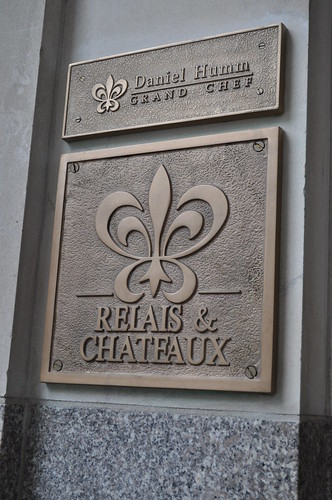
Like The French Laundry, Eleven Madison Park is also a part of Relais & Châteaux, an exclusive collection of 475 of the finest hotels and gourmet restaurants in fifty-five countries. There are three others in New York City (i.e., Jean Georges, Per Se, and Daniel). As I've mentioned before, the organization aims "to spread its unique art de vivre (French for "way of life") across the globe by selecting outstanding properties with a truly unique character." More specifically, its main ambition is: "All around the world, unique in the world." The restaurant is also a part of Traditions & Qualité, a group of Parisian restaurateurs with the aim of promoting gastronomy and a specific art de vivre, compiled in a list entitled "Les Grandes Tables du Monde" (French for "the best/largest tables of the world").


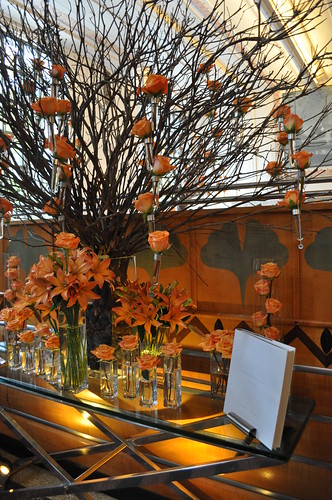
Entryway table with beautiful orange/coral-colored floral arrangements. You can also spot the newly released Eleven Madison Park: The Cookbook displayed!


Marcus and I arrived a few minutes earlier than our noon reservation, so the maître d' courteously asked us to wait in the bar area until the pre-service meeting concluded. We caught a glimpse of the service team preparing for lunch service.


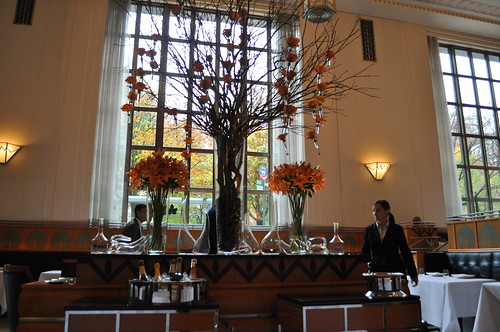
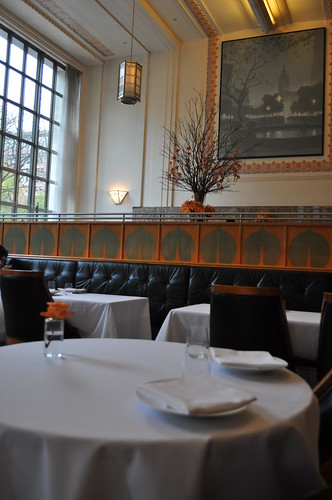
Once we were seated, we sat next to each other, facing a window and one of two focal center pieces in the dining room. I admire it both for its simplicity and intricacy on display.


View of the rear part of the dining room.


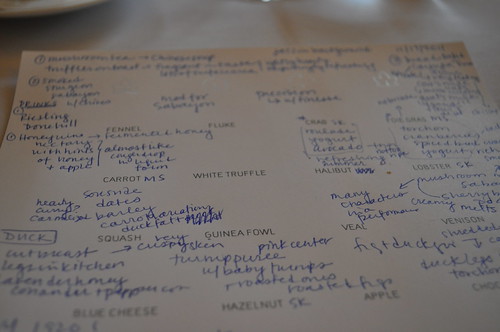
EMP's one-of-a-kind menu format -- a grid, or matrix if you will, of 16 proteins/ingredients. Each line is one course out of the four offered for lunch (256 different combinations for lunch are achievable!), and each word written is the featured protein/ingredient (i.e., focal point) of the course. Where's the description you ask? The lack of descriptions is done purposely to encourage patrons to engage in meaningful conversations with their captains about the restaurant, its menu, and all related things. For lunch, they offer a four-course option and a tasting menu option. Wine pairings are available for both menu offerings along with a white truffle supplement, as they are in season currently.


Elegant and simple flower in vase at our table.


As always, our captain, Brandon, began our meal with some warm gougères filled with cheese. Light, fluffy, and slightly creamy -- they collapsed right into your mouth. We both downed all of them in a matter of minutes.


Marcus went on the unconventional route and decided to try Honey Sun NV Iquilika (i.e., mead, or honey wine, in Xhosa, the official language of South Africa) from Grahamstown produced by Makana Meadery. I found this to be very nectary with a strong honey flavor (expected, of course) and hints of apple. It reminded me of those honey-herbal cough drops/lozenges you have when your throat needs a little soothing. I could savor a few sips, but it would be difficult for me to drink the entire glass. Marcus, on the other hand, really enjoyed it -- guess he ordered well!


I went with a riesling recommended by Brandon, which was light, crisp, and refreshing -- the perfect glass of wine to imbibe during lunch.


The hors d'oeurves, abbreviated in length for lunch, began with a mushroom tea. It reminded me of the flavorful Chinese soups (though, they're more like broths) that my family would have every night with dinner.


Alongside the tea came truffles over brioche toast. These were just delightful -- lightly hearty and fragrant in taste. The truffles had a lot of surface area on the toast, making it surprisingly refreshing. These toasts paired well with the mushroom tea (mushroom-truffle pairing, for the win!).


Next was smoked sturgeon sabayon with chives, potato, lemon, and caviar -- all served delicately in an open egg. This had a creamy intensity, primarily due to the strong flavors from the sturgeon and caviar.During my last visit, Lisa and I found this to be too concentrated, so I expected it to be very fishy in taste -- but it was not that at all. It was polished, delivering the right amount of flavors and tastes.


Preluding our first course was freshly housemade bread made from organic flour by Cayuga Pure served with two types of butter: on the right is made from cow's milk with oats and the other is made from goat's milk with dill, both with a side of fleur de sel. The cow's milk butter was smooth and creamy, while the goat's milk butter was a bit gamey.


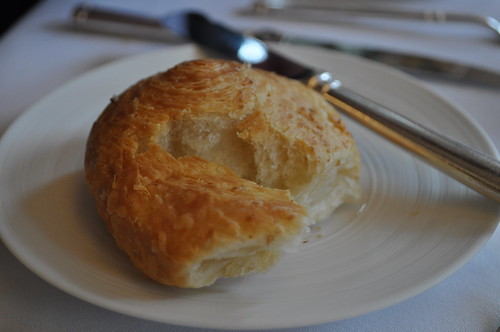
Close-up of the bread. I know what you're thinking -- you're wondering if this is a croissant! Indeed, the bread was buttery, fluffy, and very flaky -- in the same way as the ideal croissant. It had just come out from the oven, served in the cute bread pocket to keep warm. We immediately asked for more bread after we devoured it in mere seconds.


As my first course, I went with the crab -- a roulade of crab with avocado, apple, lime, and yogurt. I found this course to be quite refreshing and redolent of the summer season -- the crab was served chilled at the roulade's center, almost like structured summer crab salad. The avocado was sliced thinly and was not too ripe, making even the most skeptics of the avocado fruit, like Marcus, become less so. Definitely a solid start to multi-course lunch.


Marcus had the foie gras for his first course -- a torchon of foie gras with cranberry, pain d'épices (i.e., spiced bread), almonds, and yogurt. The foie gras was very rich with a smooth finish matching the creaminess from the dollop of yogurt as well as the tartness of the cranberries. In contrast to my crab first course, this had a more autumnal spirit to it -- especially fitting for the increasingly chilly weather we had that day. As this was served without any brioche (just the disk of spiced bread), I thought that the ratio of paté to no heavy starch would be too overwhelming, but the torchon was portioned appropriately for us, the diners, to enjoy without the richness taking over.


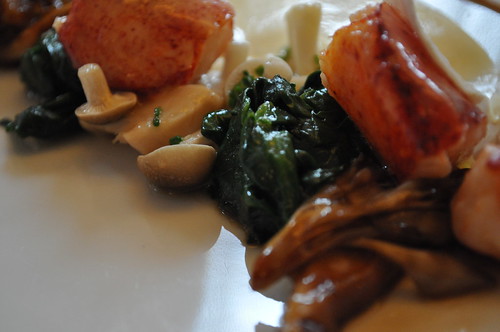
For the second course, I had the lobster, poached with sherry butter, served alongside with a medley of autumn mushrooms, spinach, and a sabayon, which according to my notes, was of mushrooms. Before I even tasted the lobster, this course had me at mushroom medley. No surprise to me at all, this was plated beautifully -- almost too much so that I almost felt bad disturbing the presentation and resulting art as I stole some initial bites. The dish's featured ingredient did not fail to deliver one bit -- the sherry butter in which the lobster was poached gave it a velvety finish, both rich and buttery, and the flavor carried throughout each tenderly soft chunk which melted in my mouth with the creamy sabayon. I liked the inclusion of spinach not just for its added balance to counter the richness of the protein and funghi, but the contrast in color. Green, after all, is the complementary color to red.

The medley of mushrooms gave an earthy flavor to the lobster and complemented the sherry butter very nicely. The medley was also seemingly like a cast of characters in a riveting staged performance -- each kind of mushroom playing a specific role and the amalgamation of the roles together yields this brilliant conveyance of bold, earthy flavors to contrast the refined taste of lobster. Only thing was that I found the maitake (i.e., "hen of the woods" mushrooms) to be slightly oversalted, but otherwise, this was just spectacular!

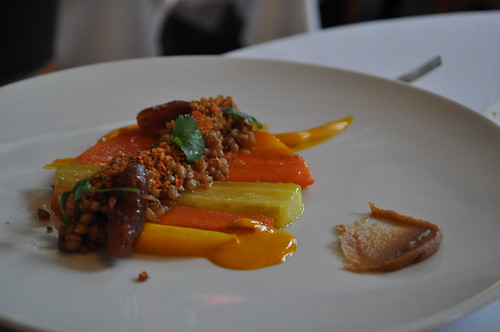
Surprisingly, Marcus went with the carrot as his second course. Before we saw what the carrot course comprised of, I was a little bit hesitant on how the kitchen could possibly make a vegetable like a carrot stand out as the primary ingredient in its composition of flavor, taste, and presentation. I was even more shocked that Marcus chose this for his second course over the other options (halibut, lobster, or additional supplement of white truffle) -- he is almost always hungry for protein (meat or fish) of some sort. After thoroughly asking Brandon about it, he decided to take his word for it and take the plunge.

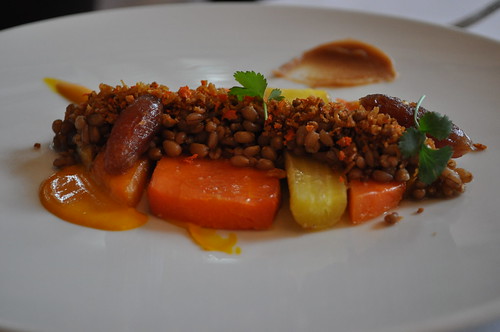
So the mystery finally unveiled itself -- here is the carrot course comprising of variations of carrots roasted in duck fat with dates and wheatberries. Yup, you heard correctly, folks --duck fat! Just like the medley of mushrooms in the lobster course, the variations of carrots in Marcus's second course each added its own personality to the synergy of the dish's composition, with the added savoriness of the glorious duck fat in which it was roasted. I also admired the playful and colorful presentation of this course -- it almost looks like a side-laying fish on the plate. You can probably see it better in the next photograph.

For someone who normally prefers raw carrots over them cooked, I really enjoy the bites I had of this course. Like the foie gras that Marcus had for his first course, the carrot course was also another ode to the fall season with its hearty choice of ingredients -- carrots and wheatberries. The texture of the carrots was caramelized with a blast of savory flavor -- it almost tasted like a subtle curry with all of the spices incorporated. Nicely done here!

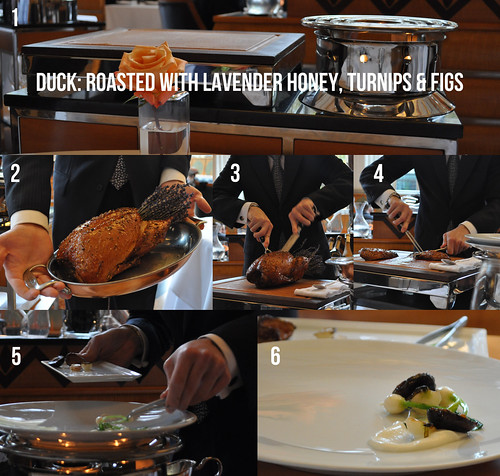
Our next course was meant to be for two. Not officially written in the menu grid presented to us at the start of the meal, the duck is offered by the captain as another option to the existing four options offered for the third course -- with no supplemental costs like with the white truffle offering. Marcus and I weren't as excited about the other dishes (i.e., squash, guinea fowl, veal, and venison) as much as we had been when Brandon told us about the roasted duck. I thought it would be helpful to show, photograph by photograph, how we were served the duck that was roasted with lavender honey and accompanied by turnips (baby turnips, roasted turnips, and a turnip purée) and roasted figs.

{1} Here is the carving table/station that was rolled out. {2} The presentation of the freshly roasted duck -- look at that fresh lavender! {3} The initial carving of the duck breast with the serving plates kept on the heated hot plate flame to ensure they stayed warm. The legs were sent back into the kitchen to be sliced/carved/prepared separately. {4} The skilled slicing of the duck breast. {4} The precise and careful plating of figs, turnips, and turnip purée on warm plates. {5} The accoutrement, plated and ready to go.

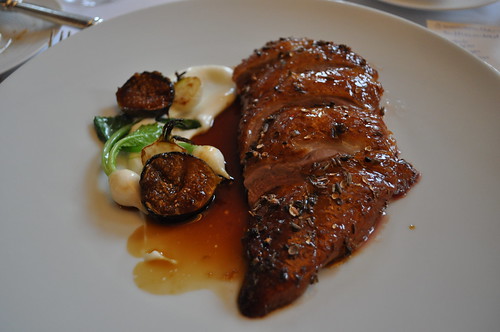
The final presentation of the duck au jus -- each of us had one plate each. Beautifully presented, the skin was incredibly crispy -- you could hear a distinct crunch with each and every bite. The meat itself was just as lovely -- it had pink center giving the duck breast such a succulent taste and tender texture as the spices and herbs were worked in harmoniously. The sweet and concentrated figs along with the contrasting flavor from the turnips (raw, roasted, and puréed) complemented the duck in a very balanced manner. Marcus even went and dared to say this was probably the best duck he has ever had. I could probably say the same -- it certainly rivals the best ducks that I've had, roasted Chinese-style in Toronto, Hong Kong, and San Francisco.

So you remember the remainder of the duck sent back to the kitchen? It reappeared back to our table -- shredded and braised in red wine, all beneath a generously thick layer of foie gras sabayon. Simple put -- heavenly. If the word decadent were to be used properly in context, this would be it. No wonder EMP only serves each of its patrons, who orders the duck, a dainty teacup's worth of this! So rich with savoriness, so much that it was almost too much -- the almost-forbidden combination of the duck's dark meat with foie gras says it all. It was at this point of the meal where Marcus and I both began feeling the onset of a food coma, which we did not learn until later that afternoon how deep the effects of it would be. What we say in response? Totally worth it!


In between the third and fourth courses, Brandon returned to make us EMP's twist on New York City's classic egg cream from the 1920s -- whole milk, orange syrup and oil, cocoa nibs, and seltzer. I love how EMP incorporates the performance aspect of the dining experience (i.e., the assembling and crafting of lunch courses like the duck and the egg cream) into its multi-course line-up. It certainly adds a more seemingly personal I was concerned I wouldn't be able to have any of this (my lactose-intolerant tendencies seem to be highlighted most when whole milk is involved), but I decided to give it a fair shot. I've tried egg creams before, and honestly, I haven't been impressed with any I've had.

The egg cream was a surprisingly refreshing surprise. Countering the bittersweet flavor of the cocoa nibs, the hint of orange from the syrup and oil gave a balanced overtone of citrus flavor. Overall, the egg cream was lightly creamy as the carbonation of the seltzer danced along our tongues. It took us back to what the fountain soda days at the local drive-thru diner would most likely have been like. Still unsure of what this would taste like from my description. Ever eaten an orange Milano cookie from Pepperidge Farm? It is just like that, only in liquid form. A well-chosen, delicious interlude between courses!


I thought it'd be informative to my blog readers to show a glimpse at the notes I diligently take throughout the meals of my restaurant adventures -- yup, it's always this many, haha! I make sure that I write down my initial reactions and thoughts as soon as they occur to me -- otherwise, it just slips through my mind, and what I'll need to recapitulate will be very sparse and vague. Yay for note-taking!


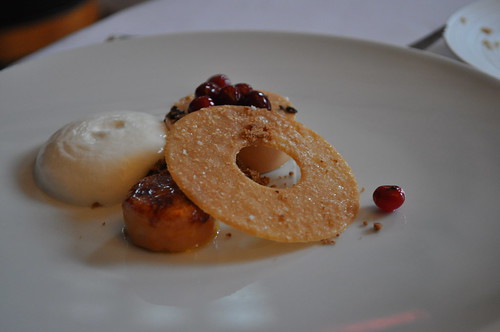
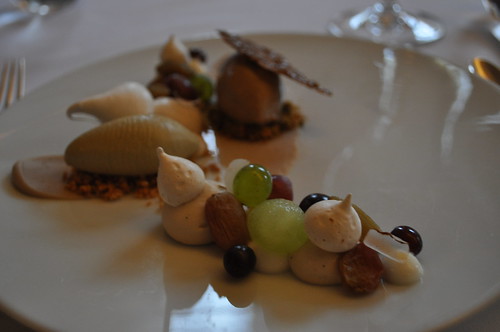
For dessert, the last course, I chose the hazelnut -- a meringue of hazelnut with a medley of grapes, sorbet, chestnuts, and pistachios. This was an "encore" course for me -- I had ordered an almost-identical dessert during my last visit to EMP. Besides me loving hazelnut-driven desserts, I thought that ordering at least once course that was very similar to my most recent meal there would serve as the aspect of the meal that would be relatively more comparable to the others. Just from observing the above photograph, you can tell there was quite a gamut of textures and tastes, all amalgamating to create a loosely constructed (but gorgeously presented) dessert. I liked the tartness from the medley of grapes combined with the rest of the dessert's ingredients.


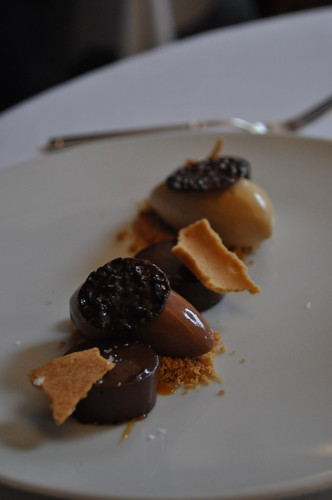
Marcus selected the chocolate -- a (deconstructed) tart with salted caramel, cocoa nibs, chocolate sorbet, and brown butter ice cream. Separately, each element of the dessert was pretty good, but when all of the elements (tastes and textures) are taken in together as a whole, it creates a synergistic result -- the chocolate course tastes better when all the ingredients are mixed in one bite. Lucky for me, as a what I call a ratio eater, this just made my case! A nice bittersweetness and crunch in every bite here, all tied in by the brown butter ice cream.


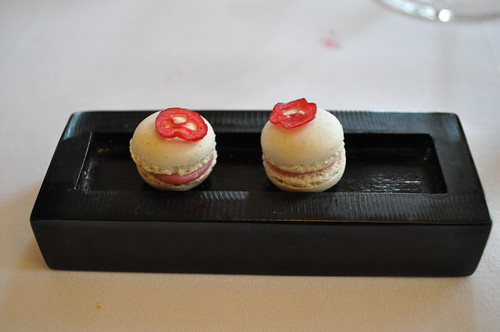
To start the mignardises were cranberry-sage macarons. The meringue of the cookie was very light, and the center was less creamy than I would have imagined. Subtle sweetness from the cranberry flavor all around as well.


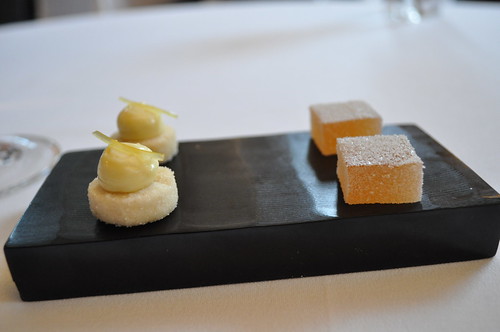
The last of the mignardises were the chamomile shortbread and a plum pâte de fruit. The chamomile shortbread was pretty much a delicately sized tea biscuit with a hint of tartness from the underlying citrus flavor, which I enjoyed very much. The plum pâte de fruit, however, didn't strike my fancy as much. I concluded that I don't like the texture of pâte de fruit -- it is as if it wants to be a fruit roll-up but also jello at the same time. Its culinary identity crisis just wasn't something of which I was very fond. It was also pretty sour, so it didn't do well in the flavor department for me.

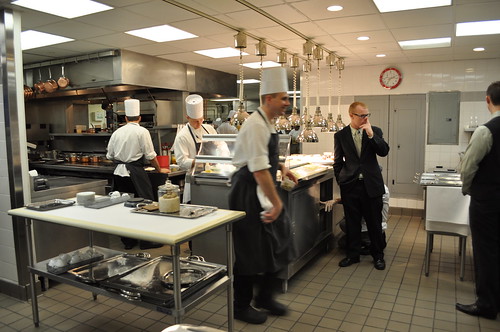
Shortly after finishing up our four-course lunch, EMP's staff invited us back to the kitchen (yay!) for a brief tour and cocktails. I'm a little fuzzy on the exact assemblage (ingredients, technique, etc.) of the kitchen cocktails we had, but I'll do my best!

{1} Liquid nitrogen poured over an apple purée to be come more sorbet like. {2} Grenadine poured into "old-fashioned glasses" along with some brandy (if I recall correctly -- or maybe whiskey?) then to be {4} topped with {3} apple sorbet. {5} Pomegranate purée submerged directly into liquid nitrogen to be "flash frozen" in solid form. {6} low and behold -- the just finished Jack Rose kitchen cocktail, glowing in its semi-frozen glory!

{7} The Jack Rose, ready to imbibe! {8} We were told to lightly tap at the flash-frozen pomegranate orb so that it'll break right over the grenadine and apple purée. Upon tasting the cocktail, it was very fruit-driven and tartly refreshing. And then it hit me -- the alcohol behind it was very concentrated and astringent. Though it was hard for me to finish given the strength of the alcohol content, I really enjoyed the flavors of the cocktail overall.


Inside the kitchen at EMP. It was a nice treat to be invited back to the kitchen -- the stage where everything is prepared with the tightest precision and grace and then sent out to perform on its own. The concoction of the cocktails while you're back there is a nice touch, not only because it tastes amazing, but it includes you as part of the experience. The divide between dining room and kitchen is no longer boldly delineated and segregating. You feel more at home than just a gastronomic spectator.

Findings: So what was our verdict upon leaving Eleven Madison Park? Marcus and I arrived back to our apartment in that euphoric state to which the most pleasant of food comas can bring you -- needless to say, we napped in a deep slumber for a few hours after lunch.

Unsurprisingly, I was once again incredibly impressed (more so than with any of my previous four visits) with the caliber of cuisine (execution, quality of ingredients, presentation, etc.) and the welcoming and eager service team at Eleven Madison Park. Time and time again, the restaurant never ceases to amaze me with making myself and my accompanying guests feel so very welcome and excited to be there with them. I have always left wanting to see what more stops the restaurant can pull, and they always find some way to do just that!

The waitstaff is incredibly attentive, but not in the way where you feel like there is too much hovering and not enough distance. Ingredients and presentation are always of the utmost meticulousness. The dishes and courses prepared by the kitchen appear as if they were plated with the precision of a surgeon -- only instead of white lab coats, you have chef coats. The resulting presentation is like a cohesive performance with each and every component/ingredient acting together with its individual theatricality. Moreso, when the roasted duck arrived to be carved for us right in the dining room, that was a performance in itself. The gentleman who carved it up for us also assembled the accompanying vegetables and accoutrement with the perfectionism and the cautiousness of a bottle ship builder. Same goes for the concoction of the egg cream in the dining room as well as the creation of the Jack Rose cocktails that the kitchen made for us during our pass-through tour. It is not just about the in-and-out turnover for Eleven Madison Park -- it is about the patron's experience and comfort. The restaurant wants you to feel at home, and that's how I truly felt.

Initially, the hype of the restaurant achieving three Michelin stars from the previous year's singular star in just one year had me a little bit doubtful and hesitant about whether I would agree with that after having been there four times over the course of 2009 and 2010. I felt Eleven Madison Park was on that path to culinary achievement, but I didn't realize it would hit that previously uncharted success so soon! I was so proud of the restaurant for achieving such an honorable title that Marcus and I had to see for ourselves if the restaurant had indeed worked out all of those tiny wrinkles in its fine table cloth of cuisine.

And what a humbling experience our lunch was -- you could undoubtedly see that Eleven Madison Park had worked its butt off over the last year to perfect its menu, its presentation, and its overall experience. The restaurant set goals, and it not only met them, but also exceeded them by staying committed to them. The experience at Eleven Madison Park always made my meals there so memorable, and it was nice to know that I could add this fifth visit, this deliciously filling four-course lunch, to the archives of the best meals I've ever had and to my personal history with the restaurant itself. It had become confirmed that rainy afternoon in November: Eleven Madison Park still remains as my all-time favorite restaurant in New York City, as it always stays true to itself -- always meticulous, welcoming, enthusiastic, and humble.

Price point: $74 per person for four-course prix fixe lunch, various costs for wines by the glass.

--November 17, 2011

Eleven Madison Park
11 Madison Avenue
New York, NY 10010
http://www.elevenmadisonpark.com

LinkWithin

Related Posts Plugin for WordPress, Blogger...