Wednesday, September 14, 2011

In the Kitchen | Tako with Sesame Dressing

I have my co-worker, Tanya, to thank for this post -- she was the one who inspired me to take a stab at serving tako (Japanese for "octopus") as a starter course for dinner last night. I absolutely love octopus, so this was an exciting night at our apartment! A couple nights ago, she and her husband picked up some freshly steamed tako from this small Japanese grocery store, Katagiri, which was such a funny coincidence because I pass by that store on my commute back home after work every day. Over the last month since Marcus and I moved to Roosevelt Island, I had been meaning to stop in and check out what the quaint shop had to offer. I wish I had gone in sooner -- they have so many fun goodies that I love in a solid grocery store that specializes in noteworthy Japanese produce and products. The only other place I could compare it to is that it is a much smaller version (but by no means compromised in basics) of Mitsuwa, a Japanese supermarket chain with a location in Edgewater, New Jersey. I think what kept me from stopping in sooner was I feared that it would be a cash only establishment, and I rarely carry cash on my person. Tanya said not to worry as they accept credit cards for purchases over $8. So I was in luck!


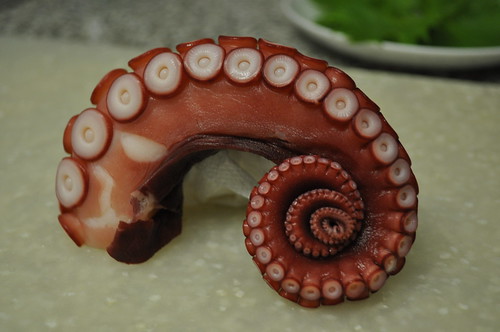
So ever since Tanya told me about the amazing tako she had, I couldn't get my mind off the promise of its tender, slightly chewy texture and its gleaming suction cups that line the tentacle's haunting reddish violet color. It brought me back to Marcus's birthday dinner at 15 East where we had tako yamarakani (i.e., slow-poached octopus) -- quite amazing preparation and presentation there, so remembering that meal made me even want to have it even more last night

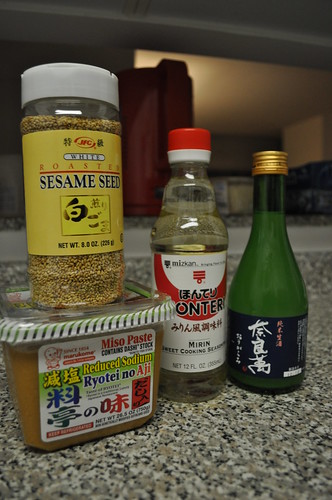
In any case, the recipe I found that fit both mine and Marcus's taste was a result of a Google search for "octopus mirin" (I had some mirin in the cupboard, so I thought that'd be a good starting point) -- I stumbled upon a post from Karolyn over at her blog, FOODjimoto. The ingredients were simple (easy to acquire and few in number): toasted white sesame seeds, miso, mirin (i.e., Japanese sweet cooking rice wine), and sake.


The aggregation of the sesame dressing's ingredients. As I was already going to Katagiri to pick up the steamed tako, I figured I could also pick up the sesame seeds, miso paste (I opted for reduced sodium, thinking I can always add more salt if need be), and perilla (shiso) leaves for garnish.

As for the sake, I initially went to Sherry-Lehmann, the world-renowned (for both its selection and incredible customer service), luxury wine and spirits shop that has been around Manhattan since the Prohibition. However, by the time I got there, it had already closed. And while I love going there to explore its awesome collection of wines, I always feel out of place when I'm there just to pick up something simple like wine or liquor for cooking. For those things, I want it to be a quick in-and-out transaction, so I can be on my way. I do appreciate the amazing customer service at Sherry-Lehmann (I mean how can you not appreciate the concept of one-on-one service via delicatessen tickets?), but it's difficult if I just want it to be a fast stop to pick up one or two mostly mindless items. Luckily, I was able to find another wine shop on my way to Katagiri -- a eclectic wine store called Crush Wine & Spirits. It has a more modern and sleek feel to the shop -- a play on metals against whites with clever uplighting. I'd love to go back to check out its wine selection mainly because my visit wasn't long -- I just asked where the sake was and selected the least expensive bottle since I wasn't planning on drinking any. I ended up with a nonvintage 300 mL bottle of Naraman Origaram Nigori sake. I figured that ought to do the trick.


So Karolyn's recipe called for a tablespoon of toasted white sesame seeds to be finely ground using preferably a suribachi (Japanese for "grinding bowl"), essentially a Japanese mortar and pestle. A spice grinder, coffee grinder or a Magic Bullet would also suffice, but as I didn't have these tools on hand, I attempted to crush the majority of the seeds with my hands. This only partially worked, but I figured the flavor of the sesame was what was really needed, so all was okay.


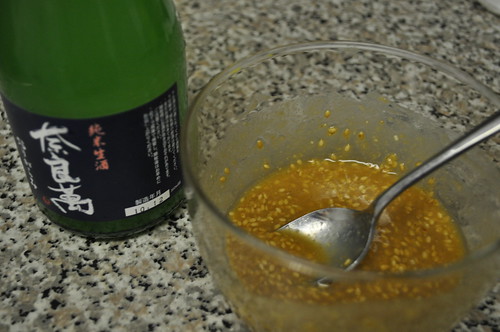
Next, the recipe instructed to add the remaining ingredients and to mix well until combined. The measured amount of remaining ingredients required were as simple as you can get -- a tablespoon each of sugar, mirin, miso, and sake. Once combined, the consistency is somewhat thick, and the taste is a sweet-and-lightly salty one. So easy!


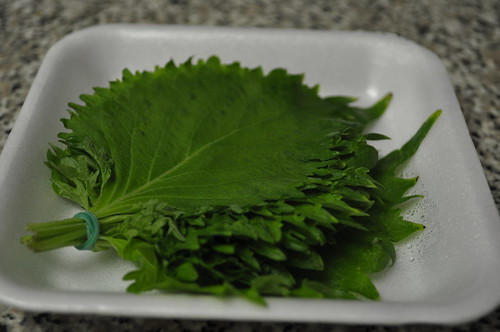
Here are the perilla (shiso) leaves I picked up as garnish for the plating of the tako. The package here contained about ten leaves. I recommend this for any of your garnishing needs, particularly if you're preparing something in the realm of Japanese cuisine. The leaves are both aesthetically pleasing and easy to handle.


I plated the leaves in the shape of a clover.


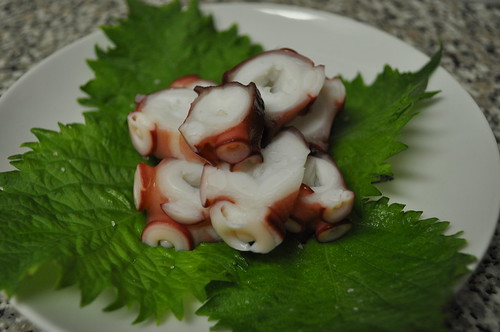
After rinsing and drying it, I cut the pre-steamed tako into 1/4-inch slices and stacked them up like a pyramid over the leaves. I sprinkled some freshly ground sea salt for good measure.


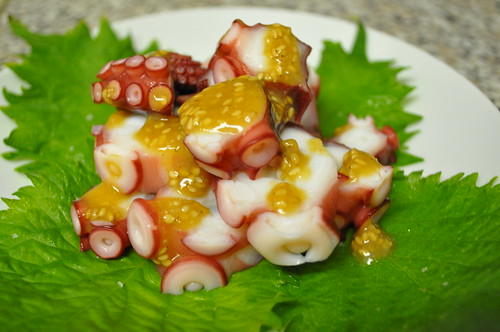
Then, I drizzled the sesame dressing lightly over the tako.


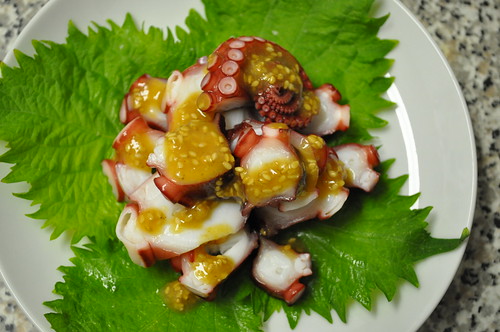
The completed, plated dish!

Findings: There are a few things that I really like about this dish -- first, that it's easy to prepare (I mean, c'mon, the octopus comes freshly steamed in its package, and the dressing takes a matter minutes to concoct), second, that it consists of ingredients that are relatively easy to find, and lastly, that it involves tender octopus! I highly recommend this as a starter dish for small dinner parties -- two tentacle legs should be good for a party of four. It is cool, fresh, light, and refreshing -- the perfect prelude to the main course of any meal or dinner party. The dressing added some depth of sweet and salty flavors to the octopus, which was slightly sweet but mostly texture, along with the delicate gritty crunch of the sesame seeds. I would love to get my hands on a suribachi or just a mortar and pestle to assess the difference of the dressing with finely ground sesame seeds -- I assume it makes the dressing more smooth and cohesive in consistency. Nevertheless, the combination really hit the spot, and I'm already craving for more.

Thanks again to Karolyn from FOODjimoto for this amazing recipe!

Price point: almost 1/4-pound of steamed tako tentacle for $4.83 at $23 per pound, $1.59 for a package of fresh perilla (shiso) leaves for garnish, $11.99 for a 300 mL bottle of sake.

--September 13, 2011

FOODjimoto
"Octopus with Sesame Dressing" recipe from June 2011 blog post archive

Katagiri Co.
224 East 59th Street
New York, NY 10022
http://www.katagiri.com

Crush Wine & Spirits
153 East 57th Street
New York, NY 10022
http://www.crushwineco.com

Tuesday, September 6, 2011

Dessert | Ladurée (NYC)


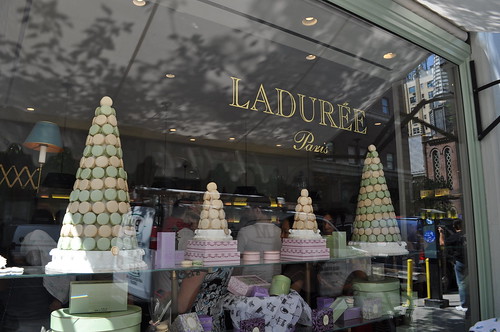
No, this is not a mirage. There's no need to rub those eyes to make sure you're seeing it correctly or to pinch yourself to wake yourself up from a dream. The famed French macaron shop, Ladurée, has finally crossed the Pond and reached the island of Manhattan, where its flagship set up shop over on the Upper East Side earlier last week.
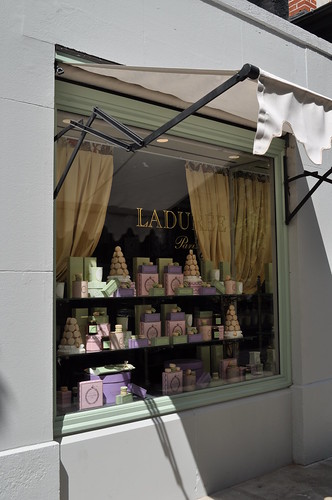

Just a little background about Ladurée before I get into the details of the dainty treats offered by the establishment. Parisian tea salons and their history are intimately tied to the Ladurée family. Back in 1862, Louis Ernest Ladurée, a miller from the southwest region of France, opened a bakery in Paris. During the same time, the Garnier Opera had just begun its construction and the surrounding area was "rapidly developing into one of Paris's most important and elegant business districts, where prestigious names in French luxury goods had already taken up residence." So just as Ladurée's locale in Paris, the Ladurée here in New York City is located on Madison Avenue, where it is famously lined with premier designer flagship stores and haute couture boutiques, making it the ideal area that mimics its original (former) Parisian headquarters.
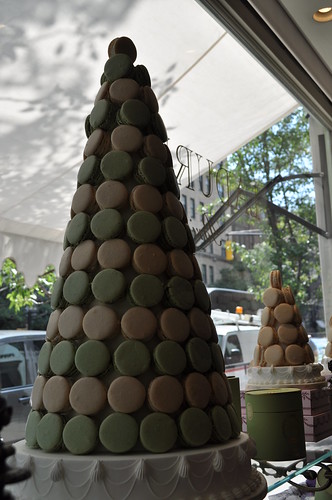

Look at those delicately assembled macaron trees! Beautiful!
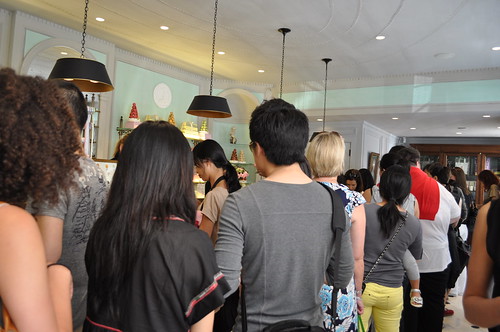

Here is the length of the line when we arrived to Ladurée on a Friday afternoon, around lunch time. It looped through the store about twice, making us luck out because I had heard the lines were going out the door and around the block the first few opening days. We waited a little under a half hour until we reached the counter to place our order for macarons.
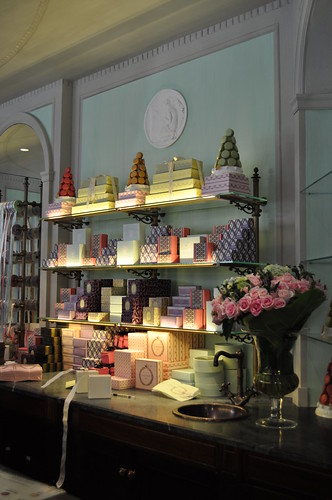

So to continue on about the history regarding Ladurée -- in 1871, during Baron Haussmann's "face lift" of Paris, there was a fire that resulted in the transformation of the bakery to a pastry shop. This pastry shop was decorated with the expertise of Jules Cheret, a famous painter and poster artist at the time. Mr. Cheret found his inspiration from the painting techniques used for the ceiling of the Sistine Chapel and the Garnier Opera. The incorporating of these elements in his work for Ladurée, he "added depth and relief to the ceilings and ornamented with cherubic children." Over time, the cafés in the area developed and became more and more luxurious, thereby attracting Parisian high society, eventually becoming the "showcases" of the French capital.

The beginning of the twentieth century was when Mr. Ladurée's wife, Jeanne Souchard, had "the idea of mixing styles: the Parisian café and pastry shop" together gave birth to one of the first tea salons in town. This was also at a time that Parisian women were also changing, where the desire of making new acquaintances came to the surface. Accordingly, the salon de thé (i.e., tea salon) had a "definite advantage" over the cafés: it permitted ladies to gather in freedom.

Since then, David Holder, and his father, Francis Holder (founder of the Holder Group), bought the institution in 1993 where the father and son had plans to promote and enlarge the famous "Maison" of Ladurée. The result -- a new prestigious Ladurée (both a restaurant and a tea room) opened on the Champs-Elysées in September 1997. David Holder's mission for Ladurée is "bring back the great classics" (especially the salon de thé) as well as "to create an environment for gastronomic creativity in Paris." Under his leadership, Ladurée has become a tea salon, pastry shop, restaurant, chocolate shop, and an ice cream parlor in Paris.
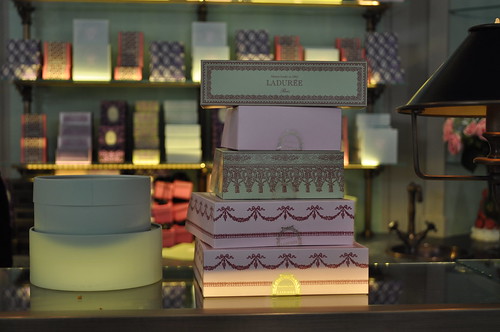

Some of the pastel-laden pastry boxes to hold the dainty treats with which you hope to leave the shop!


Plus, all the ribbon used to tie up those boxes with pretty bows!


The macaron counter, where it appears the macarons are stored in these special containers, all stacked atop of what seems to be cold stone slabs in order to keep the macaron fillings from melting. What is even more interesting is that the macarons (along with all the other things offered for sale in the shop) are shipped overnight directly from Paris to New York! How incredible is that?! When the rumors were popping up all over the foodie e-universe, there were concerns about the shop and its highly desired goodies. Would the the shop would make the macarons in-store? And if so, how did the company plan on selling these French pastry masterpieces in the States without compromising the practically perfect construction and quality of the ones sold in the Champs-Elysées shop? As macaron enthusiasts know, the baking and construction of these meringue cookies is contingent on so many factors that if one little thing is off (humidity, ingredients, measurements, recipe procedures), the entire cookie suffers. For all we knew, then, the moodiest cookie in the world (as best said by the pastry chef who taught the macaron-baking class I took at the Institute of Culinary Education), especially the ones at the highly-sought after Ladurée, could somehow magically depend (but not at all surprisingly) on French butter and Parisian air. Once the question of imported macarons was settled, the next question rested with whether these macarons from Paris would be everything they are supposed to be. Would the air travel impair the taste/texture/consistency of the macaron? How much more expensive would they be compared to the domestic macarons to which we have become accustomed? Would the import costs dissuade potential customers from purchasing them? Marcus and I were determined to find out.
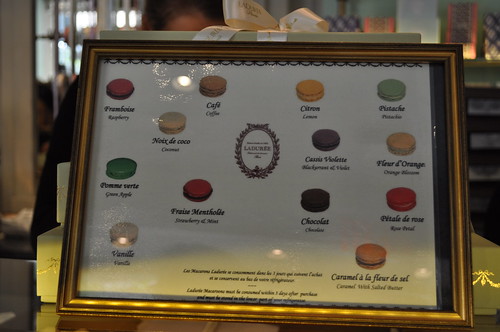

The color-coded menu of thirteen macarons offered at Ladurée -- the flavors listed here are pretty permanent all year round. With each new season, Ladurée pays tribute to its most famous creation, the macaron, by creating a new flavor. The company says "its existing range of macarons is always the starting point when a new one is created, as a variety of colors is as important as the range of flavors and a vital part of their appeal. So a bit more history on the macarons of Ladurée -- at the beginning of the twentieth century, Pierre Desfontaines, second cousin of Mr. Ladurée, first thought of taking two macaron shells and joining them together with a ganache filling. The spirit of this first macaron carries through today, as these pastries are made every morning in Ladurée's "laboratory," where pastry chefs measure out all ingredients precisely and add "a pinch of unique 'know-how' that is essential to the making of such a delicacy." Once cooked and piped, the macarons are put aside for two days before going on sale -- what Ladurée refers to as "the time to achieve a perfect balance between texture and flavor."
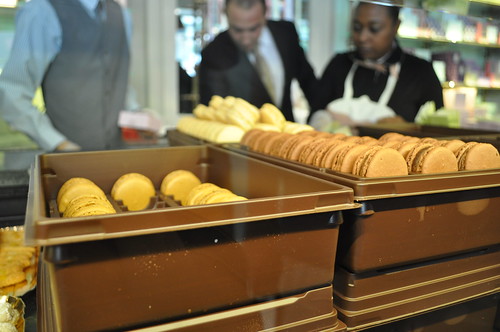

A close up of the vessels that hold the beloved macarons.

Marcus and I decided to order one of each flavor (thirteen in total, of course), in order to properly assess the shop's full repertoire of flavors available. After getting through the line and arriving home, our macarons made it to our dining table without any macarons melting or becoming crushed.


The box that held twelve of our thirteen macarons (only had capacity for so many).
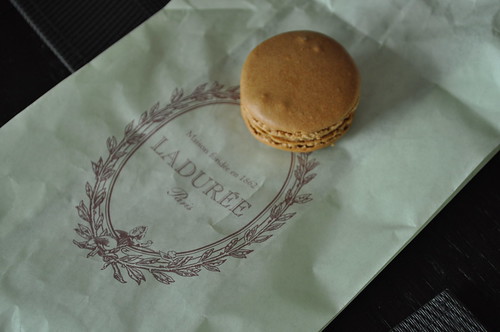

The spillover macaron was placed in this mint green pastry bag.
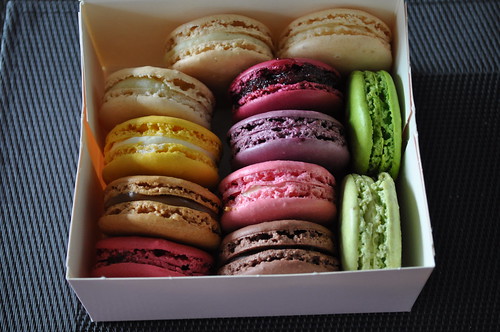

So here they are -- the colorful spectrum of macarons sold by Ladurée. Here's the flavor rundown (top left, going left to right):
(1) vanille* (vanilla)
(2) noix de coco (coconut)
(3) fleur d'orange (orange blossom)
(4) framboise* (raspberry)
(5) pomme verte (green apple)
(6) citron* (lemon)
(7) cassis violette* (black currant and violet)
(8) caramel à la fleur de sel* (caramel with salted butter)
(9) pétale de rose (rose petal)
(10) fraise mentholée (strawberry and mint)
(11) chocolat* (chocolate)
(12) pistache* (pistachio)
(13) café (coffee) [see previous photo]
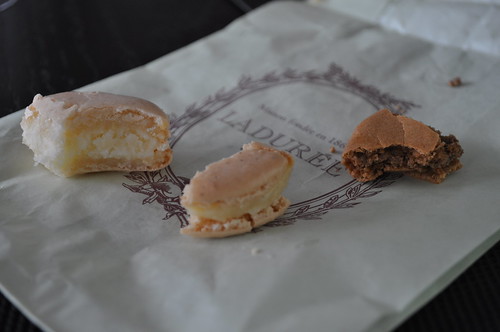

The first ones we tasted were café, vanille, and noix de coco. The first bite into the café proved all the hype Marcus and I kept hearing about Ladurée -- the cookie's texture (as with the rest of the macarons) was airy and had just the right amount of "crumbly." It was everything we thought it would be and more -- there is just that little somethin' about Parisian air that makes all the difference between these imported macarons and the domestic ones Marcus and I have explored throughout the city. For the Goldilocks of macarons, these were "just right!"

As for the flavor of the café, I found it to be bold (in a good way), while Marcus thought it was a bit more subdued in comparison to the vanille, which we had after. The vanille was light and creamy while remaining super fragrant and strong in taste. It was like heaven in a macaron, almost like a vanilla-infused cloud. As for the noix de coco, we both found it to be soft like the vanilla, only with many coconut shavings and a definite coconut taste. The center for these three macarons were ganache. Out of these three, we found vanille took the cake in taste and texture.
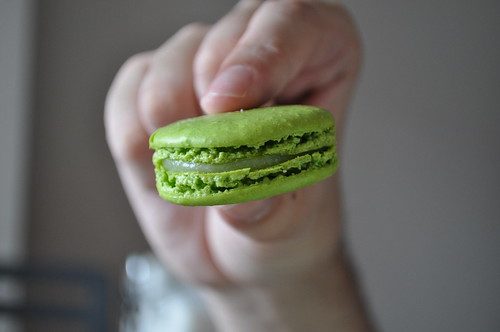

The next one we tasted was the pomme verte, which was very strong and biting in a way that Marcus and I disliked. It felt like I was having straight apple sauce in between the macaron cookies. It was also very overwhelming in apple flavor -- not at all what I expected in a delicate Parisian macaron. A no-go from us on this one.

Next, we had pistache, which was just as amazing as the vanille, only with very nutty and grainy buttercream from the fresh pistachios contained within it. Cassis violette had a very strong and concentrated black currant flavor contained in its jelly center, where I could barely make out the violette. This wasn't much of a loss to me seeing as I really like black currant-flavored macarons anyway. This particular macaron would go really well with a nice glass of sparkling wine, kind of like a faux kir royale! Citron was lovely, too, as it was creamy and refreshing with the subtle zing of citrus (not at all sour!) -- what Marcus referred to as a very light-hearted and tart macaron. The caramel à la fleur de sel was next, which we found to be pretty good and pretty on par with similar ones we've had at other macaron shops in the city. We finally got to chocolat, when we both declared it to be the best "chocolate-flavored" macaron we've ever had, where its ganache center tasted like those gourmet chocolate truffles.
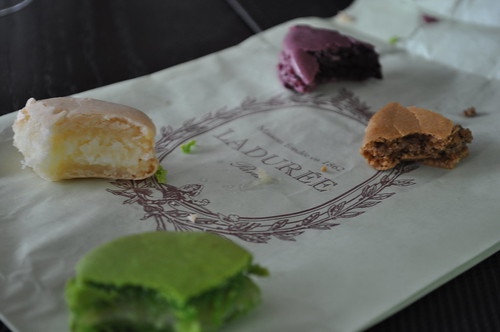

When we got to fleur d'orange, we weren't sure what we were tasting until we checked its color against the menu. We found it to be purely texture and mostly light in taste (not much flavor at all). Our friend Jess had previously told us it kind of tastes like honeysuckle to her, so we probably got a subtle hint of that here.

With three more remaining, we went with the fraise mentholée, which after the first bite, had both Marcus and I immediately react "No, no, no!" in unison. It tasted awful to us -- so much so, that Marcus described it "as if I scraped out the contents of a strawberry Pop-Tart with a candy cane and ate it." I couldn't have put it in better words if I tried. So trust us, if you don't want to taste a strawberry-flavored Peppermint Pattie, don't get this. We urge you to please save yourself. Pétale de rose had a similar effect on us -- it tasted like I had stuck a bar of soap in my mouth and began to chew. Not good. I think it's mostly because Americans don't really have physical rose petals (or its infusion of aromatic essence) exhibited in our cuisine. It is probably an acquired taste that I definitely haven't acquired yet.

The last macaron we had was the framboise, and we really enjoyed that one. It had that tart berry flavor and the refreshing crunch of raspberry seeds within its jelly center. It was quite concentrated with flavor, but I like the tart taste of berries, so it was right up my alley.

Findings: I still find it so unbelievable that Ladurée has finally arrived to New York City, let alone all of its culinary goodies are imported directly from Paris. Fortunately for macaron fanatics all around, nothing has been compromised from the overnighting of these macarons across a body of water. Upon hearing that these macarons are shipped directly from Paris, I was concerned the price point would be extravagant to the point where a visit to Ladurée would be either a one-time thing or only for super special occasions. But this was yet another surprise. It was only about a $0.20 mark-up to the prices we had already been paying for these addictive French pastries. What a steal for real-McCoy, authentic Parisian macarons!

Additionally, you can definitely tell the dreamy consistency of the Ladurée macarons are just as airy and light as everyone who has visited the Parisian shop. From my eyes (or more accurately, my taste buds), the cookie part are practically perfect, giving me the audacity to say that they should be the benchmark that every macaron should meet. Only "downside" (if it really is one) is that there are a limited variety of flavors available daily. With the exception of showcasing a new flavor each season, it seems as though the menu is pretty fixed in that regard. Nevertheless, I am sure you will find your favorites and stick to them. Just be wary there may be a line!

Lastly, I would advise you to stay away from the pétale de rose, the fraise mentholée, and the pomme verte. Unless you've become accustomed to those flavors and/or textures before, they are quite shocking and overwhelming in bold flavors that may not appeal widely to the general public's taste buds -- so you've been warned!

All in all, Marcus and I really enjoyed our long-awaited journey through the flavors of Ladurée macarons -- they were everything we dreamed it would be and more. I still need to make it to Paris one day, but a trip to Ladurée will sate my wanderlust for now. The airy meringue along with the array of fruity and buttery fillings are as close as you can get to savoring the character of Parisian air and the savoriness of fresh French butter. Plus, can you really say anything bad about delightful French pastries that are daintily placed into playful, pastel boxes and then wrapped in iridescent ribbons in the prettiest little bows? Yeah, I didn't think so either :P!

Price point: $2.70 for each macaron.

--September 2, 2011

Ladurée (NYC)
864 Madison Avenue
New York, NY 10021
http://www.laduree.com

Monday, September 5, 2011

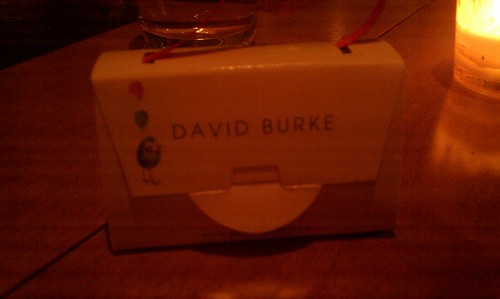
Dinner | David Burke Kitchen


Since our dinner at Takashi back in June, Lisa and I were finally schedule some best friend face time over dinner at David Burke Kitchen a couple weeks ago.


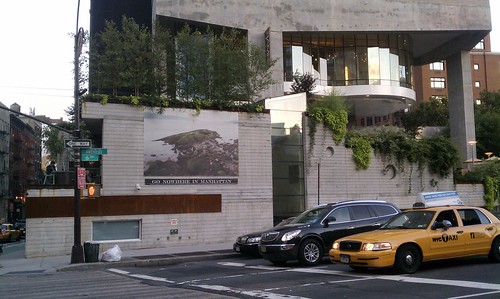
Chef David Burke and The James Hotel partnered once again (first venture being at the hotel's Chicago location with Chef Burke's steakhouse) to open David Burke Kitchen at SoHo's The James New York earlier this year. David Burke Kitchen focuses on "wholesome hearty modern American food" that is locally sourced and "presented in the creative and whimsical style that is Chef Burke's trademark" -- what the restaurant refers to, on its website, as "an urban farmhouse." The restaurant's space was designed by James Beard Award-winner Thomas Schlesser (Best Restaurant Design in 2009 for Chicago's Publican), whose inspiration was drawn from the surrounding SoHo neighborhood -- "blending the cool, industrial simplicity of an airy loft with the rustic warmth of a country barn."

There are three different spaces within the restaurant. When you first enter, a staircase leads up to the glass-enclosed Treehouse Bar, where guests can enjoy artisanal cocktail, homemade sweet-and-savory snacks, as well as an array of other appetizers. The Bar offers banquettes and counter seating that look over Sixth Avenue, offering a "bird's eye view of the city street below."


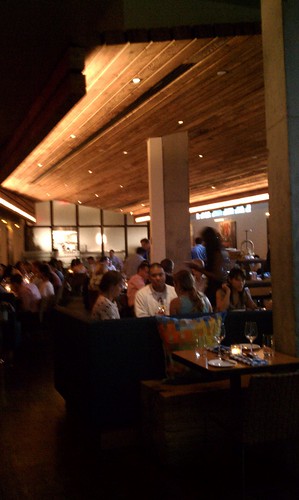
As you walk further in, down the stairs, the loft-like main dining room (seen above) features "exposed beams and views through glass walls into the kitchen and wine cave." There is also an outdoor space with in the Urban Garden one level up from the restaurant's main dining room.


To perpetuate the farmhouse theme, the cloth napkins had the classic blue gingham pattern, echoing the ones we can imagine farmers wearing during a hard day's work. I thought that was a great subtle touch.


Even the drinks menu has an organic feel to it, as you can almost feel the natural grain lines of the wood just by eying it. Love the weather vane logo, too -- very rustic!


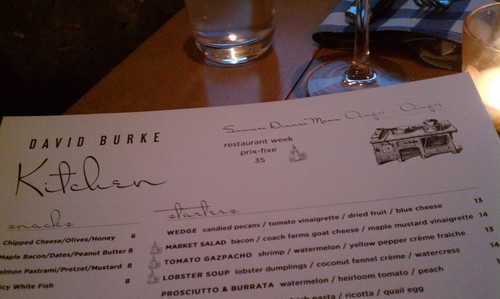
Another thing to note that as David Burke Kitchen aims to be a farm-to-table, locally sourced restaurant, its menu boasts the week's dates atop to emphasize this commitment to this mission.


Fresh butter was served on a weathered glass slab.


Olive bread is always a good start to a wonderful meal.


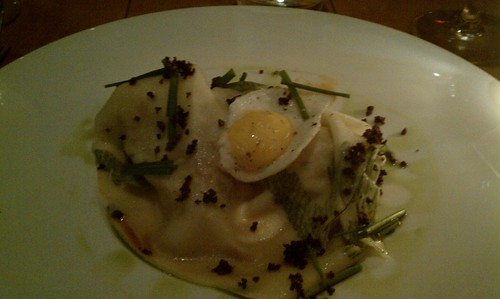
To start, I opted for the duck meatball lasagna with herbed striped pasta, ricotta, and quail egg. Oh man, this was incredibly good. The pasta was delicately soft -- fresh in taste, thin in texture -- making for an awesome complement to the heartiness and juiciness from the duck meatballs that were wrapped in the lasagna's interior, as the ricotta held these ingredients together very well. If it's one thing that Chef Burke does well, it's meat-pasta-cream dishes. Please do not leave David Burke Kitchen without having this. It is undoubtedly a must-order!


Lisa went with the tomato gazpacho with shrimp, watermelon, and yellow pepper crème fraîche. It was shocking to me that the inherent chilliness from this particular gazpacho (i.e., what usually draws me away from ordering/having chilled soups of all sorts) is what actually gave the soup its robust depth and flavor. What a refreshing surprise it was -- the chunks of shrimp mixed in with the thick gazpacho, the hint of watermelon, and the creamy (and zingy) crème fraîche certainly made for a winning combination to savor the last few weeks of summer we had ahead of us since the dinner.


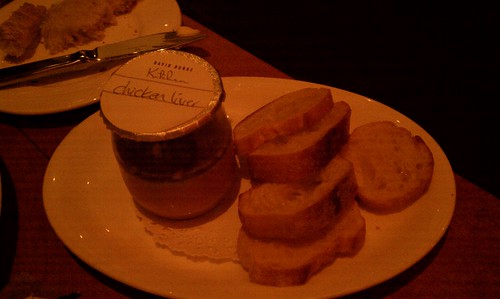
Along with our starters, Lisa wanted us to order from the jar section of the menu -- particularly the chicken liver / pistachio one. Each miniature jar contains a paté combination inside it, ready to be spread on fresh crostini.


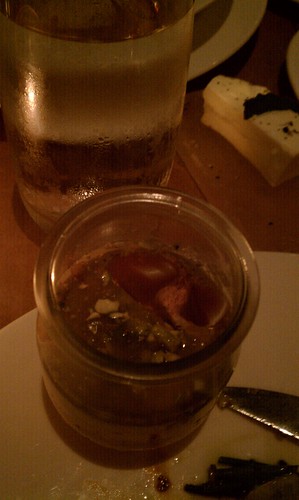
A closer look at the chicken liver / pistachio jar. While Lisa totally fell in love with this jar, I felt it was just okay, mostly because I found it to be a little gamy and also because I have never really warmed up to the taste of chicken liver. The nuttiness from the pistachio almost made of for it, but I could only have a bite or two of it before having to call it in. So if you're a lover of chicken liver patés, the one Chef Burke dreamed up here will do wonders for your taste buds! Otherwise, beware of gaminess coming your way.


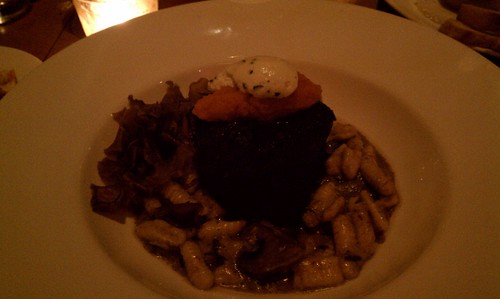
For my main course, I went with the short rib and cavatelli with wild mushrooms and truffle cream. The truffle cream was generously dolloped on top of the short rib meat right after our server brought it out to me from the kitchen, which was a nice detail that rounded out the perfect main course. Warm, tender, and flavorful short rib meat over a well-seasoned bed of al dente cavatelli and earthy mushrooms -- what more can you expect from Chef Burke in a wonderfully crafted main course of short rib? The truffle cream had a nice hint of that delicious goodness that all foodies dream of hitting their taste buds, with the added awesome creamy texture that melts right into the cavatelli, the short rib, and the sauce in which it was all braised. Only problem here was that I wish I had more room in my stomach to be able to eat it all. Definitely dying to go back to David Burke Kitchen for this!


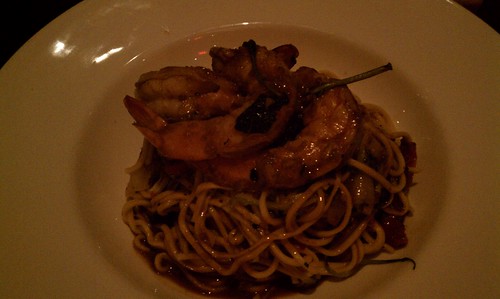
Lisa had the pressed head-on prawns over spicy spaghetti, zucchini, and basil. The spaghetti sauce here was really zesty and punchy in flavor while the pasta itself was perfectly al dente. Very good seafood pasta dish, as the prawns were cooked to the ideal temperature. What I liked most is that the pasta was not drowning in sauce -- always key.


Lisa and I left so full (of amazingly delicious food), so we opted not to order dessert this time. However, as a little parting gift, the restaurant gave us little box bags of chocolate brittle.

Findings: I was very pleasantly surprised by the culinary venture Chef Burke has collaborated on over at The James New York -- David Burke Kitchen really has some strong menu items to show-off the restaurant's well-rounded farm-to-table creations that Chef Burke has so brilliantly put together given the current season's harvest. The duck meatball lasagna and the short rib and cavatelli was to die for -- I'm still having haunting dreams about how badly my stomach is wishing for it to make another appearance in an upcoming meal. What Chef Burke has done here is crafted modern dishes using rustically sourced ingredients in a very urban setting. This dichotomy (i.e., city and country) is balanced well at David Burke Kitchen, and I highly recommend casual dinners there. As with Chef Burke's other restaurants, the menu at David Burke Kitchen is playful in its descriptions and categories (e.g., snacks, jars, etc.). Portions are generous for an establishment o of haute cuisine, so I recommend going hungry, with the intention of having at least two courses.

Price point: $13-16 for each starter, $7 for each jar, $29-32 for each main.

--August 17, 2011

David Burke Kitchen
The James New York Hotel
23 Grand Street
New York, NY 10013
http://www.davidburkekitchen.com
Tuesday, August 30, 2011

Market Eats | Brooklyn Flea

Over Independence Day weekend, Angela suggested making a visit over to the Brooklyn Flea over in Fort Greene. I knew the food scene there would be interesting to check out, so I was definitely game (Marcus, too). After some initial perusals of some vendor shops, food was calling for us. There were so many food stands to choose from. Marcus made his initial assessment, leading us to Asiadog.


Asiadog offers hot dogs with Asian-inspired toppings. Co-founders Steve Porto and Melanie Campbell, along with their love of NYC, "wanted to push the limits of one of its most popular street foods by adding their own personal touch with super-fresh ingredients." The pair's mixed Asian backgrounds (Mel is half Chinese/half Australian while Steve is half Korean/half Italian) inspired their celebration of "NYC's diversity by incorporating flavors found in China, Korea, Vietnam, Japan, etc." through their fun, playful fare. They began their little venture back in 2008 while in the backyard of a friend's bar "with the basic principles of good food, good friends, and good fun." Asiadog has come a long way in the past three years, with a "brick-and-mortar" shop in Nolita as well as store fronts appearing at Brooklyn Flea and Central Park SummerStage.


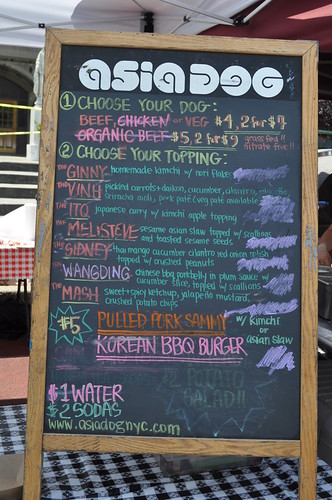
The chalkboard menu with all of Asiadog's eclectic Asian-inspired dogs as well as its signature burger and pulled pork "sammy." After much debate of which two Marcus and I would try, we were finally decided.


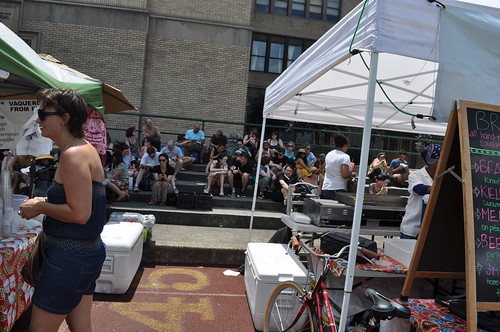
We brought our hot dogs over to the concrete steps behind the front line of food stands, where it seemed most market-goers snuck out to chow down on some street grub.


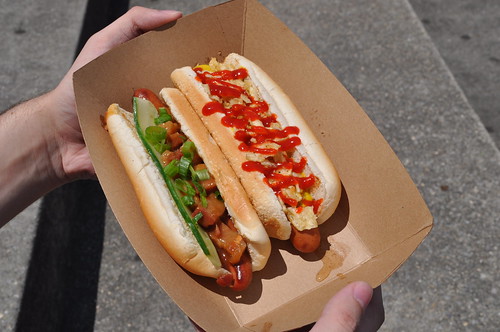
Marcus and I shared the wangding (left) and the mash (right).

The wangding was a beef hot dog with Chinese barbecue pork belly in plum sauce and a cucumber slice, topped with scallions. This was amazing -- probably the most interesting and delicious hot dog-topping combination I've ever had. The pork belly was really tender (no troubling chewiness), and the plum sauce gave it a little more depth of flavor. The cucumber was a nice addition for good measure -- entirely clean, crisp, and juicy, which added a cooling contrast to the heartiness of the hot dog and porkbelly.

The mash was a beef hot dog topped with sweet and spicy ketchup, jalapeño mustard, and crushed potato chips. If you're, at best, a handler of mild spice alone, I wouldn't recommend this. The spicy ketchup paired with mustard (with jalapeños, no less) is not just kicky -- it's more like multi-faceted kicks coming at you all at once.


We were such fans of the wangding that we had a double encore of them, only this time, we opted to try the organic beef hot dogs. With a $2 differential per hot dog, Marcus and I didn't really see the appeal in opting for the organic one if only just for health reasons. In all honesty, we thought the organic one tasted a little bit different (couldn't put our finger on what it was), causing us prefer the original beef hot dog we had in our first round of hot dogs. Nevertheless, the flavors were consistent and very satisfying for our famished stomachs.


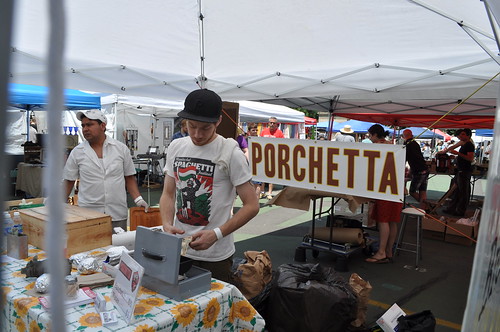
Marcus was still hungry, so he made a stop at Porchetta, the eponymous street food enterprise created by Sara Jenkins and Matt Lindemulder in 2008. Porchétta (pronounced as por-ketta in Italian) is of Roman cuisine, comprised of roasted pork with crispy skin that is highly seasoned with aromatic herbs and spices, garlic, sage, rosemary, and wild fennel pollen. In other words, it is "slow-cooked Italian fast food." In fact, it is "traditional street food of Central Italy" usually sold from a cart or truck (sliced to order and served in a sandwich), where the the porchétta is typically made from a whole roast pig, boned out and stuffed with the liver, heart, and other entrails mixed with savory herbs and then slow roasted in a wood oven.

In the case of Porchetta, Ms. Jenkins and Mr. Lindemulder wanted "to bring this classic food of their childhood" to the streets of New York City. But, instead of whole pigs used in the traditional Italian fashion, the duo "sources whole loins with the belly and skin still attached, in the same cut the mad butcher of Chianti, Dario Cecchini, taught Ms. Jenkins to use." Their version of porchétta is slowly roasted at various levels of humidity and dry heat yielding "meltingly soft and juicy" pork loin. Porchetta's mission: to "offer up the sandwich with a little bit of everything, or pork three ways" (or as Mr. Lindemulder likes to say -- "fatty belly, crispy skin, lean loin, and of course, plenty of aromatics").


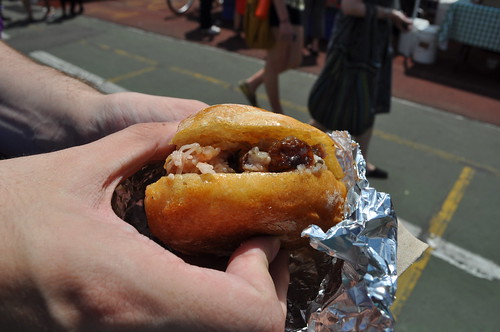
While the pork loin is especially selected and sourced (differently than it is in Italy) from Niman ranch (where the pigs are raised humanely with no growth hormone or antibiotics), the pork is kept warm, sliced, and assembled to order just like they do in Italy. And the verdict of the porchetta sandwich we ordered? The pork loin didn't disappoint -- it certainly lived up to Mr. Lindemulder's word. It was undoubtedly crispy on its skin, lean on the loin, succulent from the fatty belly, and hauntingly aromatic as a result. Only letdown was the bread was a little tough and difficult to chew, but I'm attributing that to being traveling vendor at an open market with limited supplies and equipment. I would love to stop by the joint's brick-and-mortar shop in the East Village to give the bread a fairer chance.


To soothe the craving of our sweet tooth (or is it teeth?), we made a necessary at The Good Batch, which offered ice cream sandwiches at its vendor stand. The Good Batch began with "a simple mission: bake pure, not overly sweet, delicious food." Chef Anna Gordon, the founder and pastry chef behind The Good Batch, was influenced by the many Dutch people in her life, all of who eagerly requested that she make fresh stroopwafels for them -- one day, she finally decided to take the plunge "to get the texture and taste fully saluted by her Dutch counterparts," taking her "several months, dozens of batches, and countless taste testings" to create the classic stroopwafel! So ever since the first "good batch" in early 2009, Chef Gordon has been "satisfying sweet tooths in and around Brooklyn" with the "same mission, same passion, and new creations" ever since!


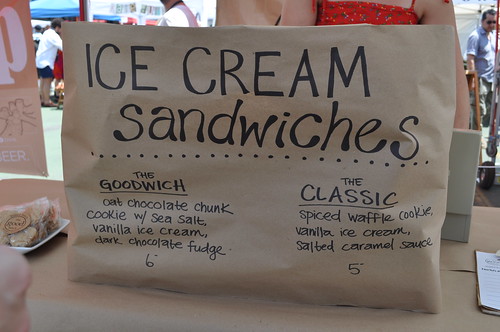
There were two offerings -- the Goodwich consisting of oat chocolate chunk cookies with sea salt, vanilla ice cream, and dark chocolate fudge at the center and the Classic consisting of two spiced waffle cookies (best known as stroopwafels in Dutch) pressed together with vanilla ice cream and salted caramel sauce in the middle. While the Goodwich was super tempting, it was very similar to the Chipwich (one of my all-time favorite childhood desserts, especially the ones with the chocolate chips entirely coating the ice cream center!), Marcus and I felt the Classic was unique from other ice cream sandwiches we've had in the past.


Here is the Classic ice cream sandwich from The Good Batch! The cookie ends, as I've already mentioned, are stroopwafels -- Dutch spiced waffle cookies with a caramel filling. The history of the cookie (thanks to The Good Batch for the background!) dates back to early 18th century in Gouda, when bakers combined bakery scraps to make a treat that would eventually become the country's most beloved cookie. However, handmaking these treats are no easy task. Their yeast-based dough is pressed in a special iron, then immediately cut into a perfect circle and carefully split in half for the hot caramel filling. Right out of the oven the cookie is chewy and aromatic. The traditional method of enjoy the stroopwafel is to place it over a hot beverage so that it heats the caramel within the cookie.

So our verdict on the Classic? Marcus and I were pleased with the ice cream at the center but were a little bit on-the-fence about the stroopwafel. I've never had one before, so I think my expectations for its taste differed from its actual taste. It was heavier and thicker than the light, crispy, and wafer-like texture I was expecting. The salt caramel sauce was hard to taste, too. I would love to try this again on another occasion as well as the Goodwich, which sounds very good.


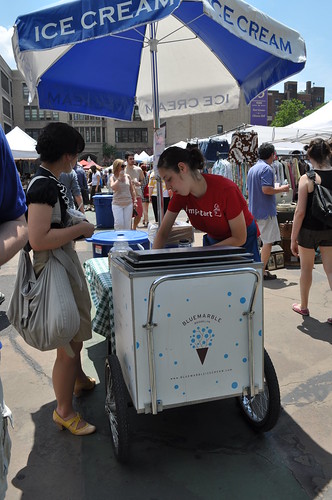
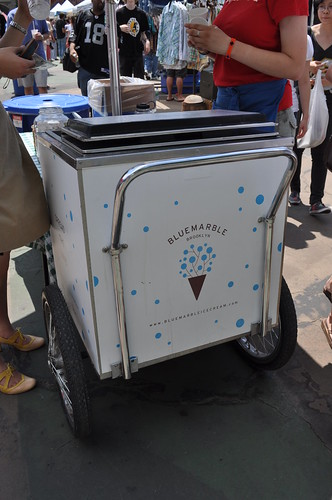
Our last stop was at Blue Marble Ice Cream, co-founded by Alexis Miesen and Jennie Dundas. "Borrowing its name from Earth's playful moniker," Blue Marble prides itself on its premium ice cream, as its dairy ingredients are sourced from "happy, healthy cows" of local New York State farmers. The ice cream maker, "convinced that nature doesn't need much help to be delicious," keeps its flavors "simple and elemental instead of clouding them with sugary and preservative-packed mix-ins (i.e., avoiding the use of artificial coloring/flavoring and corn syrup).


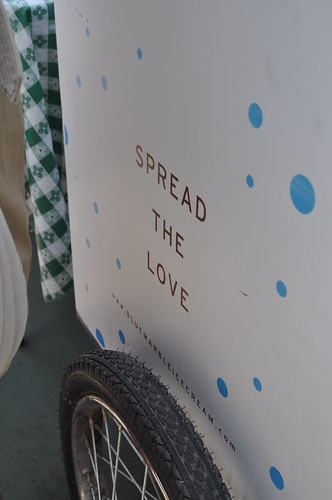
Thought the tag line "Spread the Love" was cute here.


Waiting for our ice cream to be scooped.


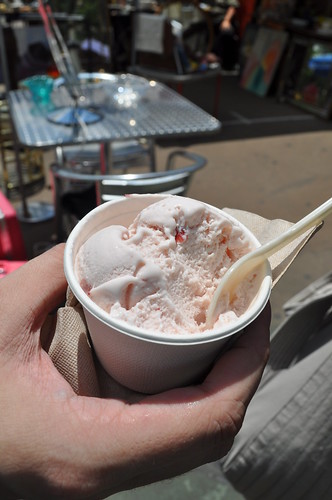
I kept it simple that day and ordered a scoop of strawberry -- the classic favorite that brings back memories of my pink-laden childhood days (where strawberry ice cream reigned superior). Creamy and fresh goodness right here -- Blue Marble undoubtedly upheld its aim to create "simple and elemental" ice cream. Loved the chunks of strawberry infused in the fresh cream. I would definitely be up for another trip to Brooklyn to hit up Blue Marble's actual shop to try other seasonal flavors!

Findings: I enjoyed our market eats over at the Brooklyn Flea -- the market definitely offers a wide array of varying cuisines and street food fare. Among the most unique and creative, Asiadog is definitely up there, drawing influences from Asian cuisine as hot dog toppings. While I enjoyed Porchetta and The Good Batch, I would definitely want to return to them (either at the market or elsewhere) to give a better, more informed assessment on their offerings. On the other hand, Blue Marble was impressive, offering pure flavors and good ol' simple ice cream -- the kind you remember from those days your parents would take you out for a special treat. All in all, I recommend making the trek out to Fort Greene to check out the food vendor lineup with the chances of discovering some new and delicious things. I'll definitely be hitting it up again this fall for People's Pops and Kumquat Cupcakery (among others) for sure!

Price point: two Asiadogs for $7, two organic Asiadogs for $9, $10 for a porchetta sandwich from Porchetta, $5 for each Classic ice cream sandwich from The Good Batch, $3 for a single scoop of Blue Marble ice cream.

--July 2, 2011

Brooklyn Flea
176 Lafayette Avenue
Brooklyn, NY 11238
http://www.brooklynflea.com

open Saturdays, 10 AM - 5 PM
rain or shine through November 19, 2011

Asiadog
66 Kenmare Street
New York, NY 10012
http://www.asiadognyc.com
available on Saturdays at Brooklyn Flea, 11 AM - 5 PM
for other locations throughout the week, check here

Porchetta
110 East 7th Street
New York, NY 10009
http://www.porchettanyc.com

The Good Batch
http://www.thegoodbatch.com
every Saturday at Brooklyn Flea
for other locations, check here

Blue Marble Ice Cream

196 Court Street
Brooklyn, NY 11201
http://www.bluemarbleicecream.com
available every Saturday at Brooklyn Flea, 12-5 PM
plus various other locations during the week

LinkWithin

Related Posts Plugin for WordPress, Blogger...