Tuesday, September 27, 2011

Feasts & Affairs | Outstanding in the Field 2011

It's that time of year again -- that is, when Outstanding in the Field (OITF) makes its annual stop in the Big Apple for its farm dinners featuring guest chefs from the area. After last year's event at La Plaza Cultural with the husband-and-wife chefs from Print., I was very much looking forward to this year's extravaganza, so much that Linda, Jess, and I bought our tickets back in March (five months in advance!) when tickets are quickly sold out shortly after. New York City was fortunate to have two farm dinners hosted by OITF this year -- one at Queens Farm (featuring Chef Marcus Samuelsson of Red Rooster) and one at Brooklyn Grange Farm (featuring Chef Dan Kluger of ABC Kitchen), both located in Queens. OITF has held dinners at Queens Farm in the past, so Linda suggested we sign-up for the Brooklyn Grange dinner as it is essentially a rooftop farm overlooking the boroughs of Manhattan and Queens. She had me at rooftop.


So after (im)patiently waiting five months until we were on the M train over to 36th Street in Queens, we were finally there, ready to be swept away by the amazing powers of the local, the organic, and the sustainable. Now, if you remember my not-so-great review of ABC Kitchen earlier this year, you will understand my initial apprehension about this collaborated dinner with OITF. I desperately wanted for the dinner to be as amazing as it was last year, not at the expense of shifty service and mediocre locavore fare. However, I knew I trusted the judgment of the folks at OITF -- you wouldn't be running a successful, 12-year running culinary enterprise such as this if they didn't know what they were doing. So with my concerns pushed aside, I did my best to clear my mind of any preconceptions I had about ABC Kitchen upon arriving at Brooklyn Grange that night -- and I'm really glad that I did. I wanted to give the restaurant another chance to show me they were serious about its commitment to "offering freshest organic and local ingredients possible" and showcasing them to their highest flavor potential.


Clever postcard directing us to the rooftop where Brooklyn Grange Farm resides.


Almost there!


Once we took the elevator up a few stories followed by two flights of stairs, we finally reached the rooftop farm of Brooklyn Grange, where we saw the long tables where all the farm dinner guests would be dining.


Traditionally, OITF has set the "long table" at farms, at gardens, on mountaintops, in sea caves, on island, and at ranches -- wherever its tours would take the table. Only problem at Brooklyn Grange is that most of the space is used to cultivate garden and farm produce alike, so with the tight arrangement of vegetation, the placement of one long table to accommodate the hundred or so guests wasn't feasible. To compromise, the tables were broken up into three long-ish tables along vacant rows of soil.


As I've written before, the mission of OITF is "to reconnect diners to the land and the origins of their food and to honor the local farmers and food artisans who cultivate it," and as a "restaurant without walls," each and every dinner hosted by the organization ensures the "consistent theme of honoring the people whose good work brings nourishment to the table." With that being said, the ingredients for these farm meals are almost all local (many times, as in the case here, sourced within inches of your seat at the table!) and generally prepared by a celebrated chef of the region (which, in our case, is Chef Kluger of ABC Kitchen). To read more about OITF, please see my post on last year's dinner in NYC (aka, my first OITF experience) as well as the organization's history section of its website!


Once we arrived to Brooklyn Grange Farm, we were directed to walk over towards the other end of the roof for hors d'oeuvres and "bubbles" (what Linda likes to call sparkling wine).


Brooklyn Grange is a commercial organic farm located on a rooftop in the Long Island City part of Queens. The farm grows vegetables in the city and sell them to local people and businesses, whereby its goal is "to improve access to very good food, to connect city people more closely to farms and food production, and to make urban farming a viable enterprise and livelihood." The farm measures about one acre (i.e., approximately 500 feet long and 70 feet wide) and is comprised of roughly 1.2 million pounds of soil and over 20,000 linear feat of green roofing material.


As for the wine paired with our meal that night, Shinn Estate Vineyard, a winery located on Long Island.


We started off with a 2007 sparkling brut from Shinn Estate Vineyards. It was a nice crisp and light sparkling wine that paired well with the hors d'oeuvres. As a vineyard that is committed to being biodynamic, Shinn Estate's wines are all organic with an unusually precise harvesting process that involves the moon phases. Interesting approach, I must say!


As part of our hors d'oeuvres (i.e., the first course), we had a roasted eggplant toast with peppers and lemon, where the bread for the toast was supplied by Sullivan Street Bakery. This was a nice starter, as the assortment of colorful peppers mixed in with the eggplant showcased what the flavors of the summer season. I thought the bread was a little bit chewy and hard, making it difficult to eat what was supposed to be "finger food," causing the toast contents to easily fall off I guess I was expecting the bread to be crisp and toasty, but given the conditions of having to prepare a five-course dinner not only outside but on a rooftop for a good number of people with limited kitchen appliances and supplies, I'm sure it was pretty difficult to top the toasts while maintaining a loose, crispy texture.


The kitchen also served herb pizza with spinach and goat cheese from Lynnhaven Farm of Pine Bush, New York. I'm not gonna lie -- I was wary of the goat cheese on here. The gaminess of it almost always turns me away from any given dish, but it really worked its magic on me here. The pizza had a nice layer of smokiness to it with the spinach in the limbo stage between raw and totally soggily cooked. The goat cheese was what pulled it all really nicely together with its soft, creamy, and rustically elegant earthiness. The gaminess was mostly non-existent -- a big relief to me so I could fully enjoy the herb pizza. Linda mentioned that she and Jon pick up this goat cheese at the farmers' market at Union Square on Saturdays, and that it's really that awesome -- I may have to start doing that, too! Overall, I really relished in how the mere simplicity of the ingredients (quality ones, too, of course) could deliver such a profound reaction among all of us. It was a dish that could have easily been prepared at home that would have that mysterious panache given behind the scenes by the chef himself/herself in a restaurant setting.


Last of the first course was roasted squash with Parmesan and lemon. This is another example of how the quality of the ingredients used (i.e., fittingly selected to be served during the peak of their season). Something as simple as summer squash can be dressed to the nines with a casual sprinkling of Parmesan and a squeezed spritz of lemon juice. Succulent, juicy, and boldly crunchy -- all I can succinctly say about the roasted squash. Love the bamboo serving toothpicks!


This was one of the tables made by the farmers at Brooklyn Grange.


Group photograph in our fancy schmancy specs -- Lynnette, Linda, me, Jess, and John!


After munching on our first course, Katy Oursler, the Director of OITF's Private Events, and Jim Denevan, the founder of OITF, came out to say a few words to the farm dinner guests. They briefly touched upon how the goal of OITF in its initial days was to bring the farmer to the forefront of the dining experience, so the chef(s) can step back a little and share the spotlight with the individual(s) who provided high quality ingredients to impressively showcase the chef's culinary imagination on a plate. They also mentioned how this was the first time that they held one of OITF's dinners on a rooftop!


Mr. Denevan then turned it over to one of Brooklyn Grange's head farmer and co-founder, Ben Flanner. Another loss to the financial services industry to the food world, as Mr. Flanner was formerly a trained engineer with a background in finance before becoming an urban farmer. He gave all of the OITF dinner guests that night a brief overview about Brooklyn Grange, its history, and its inner workings. So you must be wondering why the farm called "Brooklyn" Grange would be located in Queens? I mean, there is already a farm by that obvious name (i.e., Queens Farm over in the Glen Oaks neighborhood), but that's not the real reason why it's called "Brooklyn" Grange. When the individuals behind the farm began their company in 2009, they thought they had a site in Brooklyn ready to be transformed into the urban farm they envisioned. As everyone had been living in Brooklyn at the time (and thus, had put together the business plan there), Brooklyn Grange made sense. However, the initial site had fallen through in 2010, and the team had to begin looking for a new site, leading them to the farm's current home on Northern Boulevard in Queens (the Long Island City region). And at that point, the company had been chartered as an LLC under that name, and fundraisers and events alike had supported Brooklyn Grange. So to avoid any confusion, they kept the name, and here she stands in Queens!

Once they found the space here, it took an unheard of two weeks (wow!) to put the deal together in 2010 during April/May. Since then, Mr. Flanner has been developing a green roof system with soil on this very roof along with a few beehives as well. Working with an oblong rectangle as the potential farming plot on a rooftop, the folks at Brooklyn Grange have come to find that sun-loving crops (almost intuitive in this situation). Ultimately, the aim of Brooklyn Grange is to take advantage of "unused" rooftop space to grow and yield amazing produce and ingredients. The space also makes for a very ripe place for sunset dinners.


Mr. Flanner sharing more about Brooklyn Grange with the guests that night.


Part of the rooftop farm.


To keep track of the farm's crops, numbers have been stenciled along the walls of the rooftop.


View of the city from Brooklyn Grange.


More crops.


ABC Kitchen's menu for OITF that night!


View of the "rooftop kitchen" used by the team from ABC Kitchen.


Preparing for the courses ahead!


Other half of guests on a farm tour.


And in true OITF fashion, after a tour of the featured site, everyone settles in -- "farmers, producers, culinary artisans, and diners" take their seats along the "long table."


View of the table from where we were sitting.


Table setting and menu!


Artisan bread from Sullivan Street Bakery in a playful brown paper bag with a foldover opening.


Marcus and me at Brooklyn Grange for OITF.


The first wine served during our dinner was a 2010 rosé from Shinn Estate Vineyards, which I found to be on the heavier side for rosés, but still light enough to enjoy over the second course that we awaited shortly after we were seated.


The first dish within the second course was heirloom tomatoes from Brooklyn Grange with chilies and basil, all mixed with a housemade vinaigrette. Sweet, juicy, and refreshing -- this assortment of heirloom tomatoes embodied everything a breezy summer day would be if it was personified into food. I don't think I've ever had tomatoes this lovely served salad style. The sweetness of the fruity tomatoes just blew me away. The basil definitely blended well into the dish as well, with those zesty chilies in good measure.


The next dish within the second course was an arugula salad with strawberries from Mountain Sweet Berry Farm, Lynnhaven Farm goat cheese, mint, and lime. Lynnhaven shocked me here once again with its amazing goat cheese that went incredibly well with the tart and seed-happy strawberries. The mint and arugula rounded out the heavy flavors from the goat cheese and strawberries. All in all, great summer salad combination!


Lynnette's new plate from Anthropologie!


The last part of our second course was grilled housemade chicken and pork pistachio sausage served over Brooklyn Grange warm field greens, crispy prosciutto, sherry vinaigrette , chives, and cheddar-style cheese.


You can see the pistachios right inside the sausage -- what utter deliciousness we had here! Definitely top favorites of the night -- the pistachios inside the sausage itself and crispy prosciutto were enough to whisk me away into the night! The soft nutty flavor from the pistachios mixed in with the crunchy saltiness from the prosciutto with the sharpness of the cheddar made for a wonderfully crafted dish to bid farewell to the fleeting summer days ahead (at that point in time, that is) and to welcome in the imminent fall season blowing our way. The meat was lean and juicy filled with the hale flavors of chicken and pork. Besides, crispy prosciutto is almost like bacon, which always makes everything better.


My attempt at some decent plating on my dish, haha.


Ms. Oursler brought out Lynn Fleming of Lynnhaven Farm. She briefly talked about her farm and the products it sells at farmer's markets in New York State as well as New York City, which includes the famed goat cheese, feta, ricotta, as well as goat meat. Ms. Fleming emphasized her farm's commitment to humane treatment of the goats, both in the production of cheese as well as the butchering process. As previously mentioned, her farm sourced the goat cheese used in the herb pizza as well as the arugula salad.


For the third course, the first dish comprised of grilled broccoli rabe with ginger and scallions. Normally not a fan of the bitterness of broccoli rabe, but the preparation here (and the sourced broccoli rabe itself) allowed for a softer, velvety taste. This, along with the below dish, was paired with a 2010 chardonnay from Shinn Estate Vineyards.


The second dish within the third course was the steamed halibut with Maxwell's Farm goldbar zucchini and nasturtium vinaigrette, topped with toasted pumpernickel chili bread crumbs. My other favorite that night, the halibut had the silkiest of textures that swam lightly in the custard colored nasturtium (Latin for "nose twister," most likely due to the common reaction from mustard oil in its leaves) vinaigrette. The chef even garnished it with a couple nasturtium flowers over the fish. It was pleasantly fragrant, in both scent and taste. And those toasted pumpernickel chili bread crumbs punctuated the dish to its ultimate potential -- these very flavorful pumpernickel crumbs that take the cake over any mediocre crouton. The goldbar zucchini from Maxwell's Farm was a delicious addition of color and vegetable to the meat/sauce heavier dish. Surprisingly delightful and sweet in taste, boasting the same effect the heirloom tomatoes had on me.


Another attempt at plating!


Ms. Oursler later brought out Bill Maxwell of Maxwell's Farm located in Warren County, New Jersey, who supplied the goldbar zucchini in the steamed halibut dish. Along with zucchini, Mr. Maxwell's farm also grows tomatoes along with many other produce.


For the fourth course, ABC Kitchen served sautéed corn with manchego cheese, jalapeño peppers, and lime. From the looks of it, I thought this was going to be overly shaven with cheese, but like with many of the courses that night, this course humbled my preconceptions into an unexpectedly warm and spicy side of corn that melted in my mouth.


Along with the sautéed corn, the kitchen also served cold fried chicken battered with summer ale beer, served with a potato and whole grain mustard salad. I found it a bit odd for fried chicken to be served cold, but I gave it a shot. I found it to be just okay overall -- I suppose it was a better idea in theory than it was in execution, though the batter was pretty good. The potato salad was too mustardy for my liking, and the potatoes were not very soft. However, the wine that was served with this was probably my favorite wine served during the dinner. It was a 2008 Wild Boar Doe from Shinn Estate Vineyards -- talk about a play on words! Boar Doe = Bordeaux! So cleverly cute! It was also fittingly delicious and outstanding Bordeaux -- here, a blend of cabernet franc, merlot, petit verdot, and cabernet sauvignon.


As a condiment for the cold fried chicken, the kitchen served a hot sauce butter with orange peppers, habenero peppers, quinoa, and lemon zest. The habaneros spoke for themselves upon first taste, giving the chicken a playful kick.


Watching the sunset from Brooklyn Grange rooftop.


Diners, skyline, and sunset -- can't get much better than this!


Our last course consisted of two desserts. This one was the peach and blackberry crostada with crème fraîche. As a group, we found it to be just okay (mainly because the crostada that Linda makes is out of this world -- I will need to bribe her someone to make it again!), probably because the crostada crust wasn't loose and crispy enough. Unfortunately, it was a tad soggy. Loved the presentation though!


The second dessert dish was glazed donuts with a pink currant glaze and a chocolate glaze with cacao nibs. Again, dessert was a bit disappointing, but with so many beautifully orchestrated preceding courses, this was an afterthought to an otherwise fabulous night in Long Island City, Queens.


Mason jar candles are always present at OITF!


The chefs of ABC Kitchen who worked hard to put together our dinner that night came out at the end to receive a gracious and welcoming round of applause from all the guests! I think there was a miscommunication to me on my part -- I didn't realize Chef Kluger wasn't able to make it to New York City that night due to the flight delays caused by Hurricane Irene. So his sous chef, Ross Mendoza, had taken the lead in the kitchen at OITF that night, bringing the guests a wonderfully prepared meal. No hurricane can stop a team of precise and passionate chefs!

Findings: It was no surprise that Outstanding in the Field had worked its magic once again in New York City -- OITF was able to assemble, craft, and organize an astounding dinner with the joint collaboration of famed chefs, regional farmers, and local culinary artisans for the anxiously hungry guests that night. As OITF's aim, at these farm dinners, there is no mystery where the ingredients (comprising the courses during the meal) had come from. Chefs are no longer compelled to stand behind the heavy swinging doors in the kitchen, and farmers are no longer kept in a professional capacity as a supplier. Chef, farmer, and diner are all peers, sitting at a long communal table, where the exchange of ideas, thoughts, and inspirations can flourish into many possibilities. Here, the farmers' bounty, the chef's creation, and the diner's gastronomic gratification share a common denominator -- individuals that are passionate about food and the movement behind sustainable dining and locally-sourced ingredients. Chef Kluger and his chefs from ABC Kitchen certainly demonstrated this commitment to such a cause, as a team and as a restaurant. All of my negative feelings for ABC Kitchen subsided once the five courses unraveled before me at this OITF dinner at Brooklyn Grange. Embracing simplicity and letting the ingredients speak for themselves (with a little help from the chefs at ABC Kitchen, of course) worked wonders that night.

There is something magical about the dinners and the resulting experiences that follow these dinners hosted by OITF -- there is a certain je ne sais quoi that it brings to the table (literally) and to the night sky just as the meal is coming to a close. Some may say that the price point here is a little bit much, but to me, it is worth every last penny. It serves as a lovely reminder, once a year, just how far a locavore meal can take you and just how captivating it is to eat produce when it is at its seasonal peak.

So as I've said last year (and expect to say for years to come), I am very much looking forward to next year's dinner, where I know to expect nothing less than an impressive orchestra of exciting flavors, inspiring individuals, and stimulating dinner guests.

Price point
: $220 for a locally supplied 5-course dinner with wine pairing by local vineyard.

--August 30, 2011

Outstanding in the Field
P.O. Box 2413
Santa Cruz, CA 95063
http://www.outstandinginthefield.com


Brooklyn Grange
*
37-18 Northern Blvd
Queens, NY 11101
http://www.brooklyngrangefarm.com

ABC Kitchen
35 East 18th Street
New York, NY 10003
http://www.abckitchennyc.com

Shinn Estate Vineyards*
Mattituck, NY 11952
http://www.shinnestatevineyards.com


Maxwell's Farm*

Changewater, NJ 07831
https://www.facebook.com/pages/Maxwells-Farm/176937079025293?sk=info


Lynnhaven Farm*

Pine Bush, NY 12566
http://www.lynnhavennubians.com

Mountain Sweet Berry Farm

Roscoe, NY 12776

Flying Pigs Farm
Shushan, NY 12873
http://www.flyingpigsfarm.com

Paffenroth Gardens

Warwick, NY 10990

Eckerton Hill Farm
Hamburg, PA 19526

Cato Corner Farm
Colchester, CT 06415
http://www.catocornerfarm.com

Four Story Hill Farm
Honesdale, PA 18431

Phillips Farms
Milford, NJ 08848
http://www.phillipsfarms.com

Windfall Farm

Montgomery, NY 12549
http://windfallfarm.blogspot.com

Migliorelli Farm

Tivoli, NY 12583
http://www.migliorelli.com

*
from what I recall, farmer(s) from these farms were in attendance at this OITF farm dinner!

Wednesday, September 14, 2011

In the Kitchen | Tako with Sesame Dressing

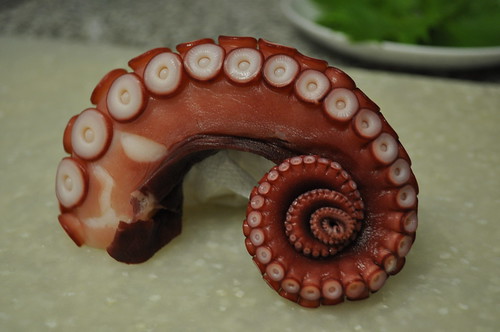
I have my co-worker, Tanya, to thank for this post -- she was the one who inspired me to take a stab at serving tako (Japanese for "octopus") as a starter course for dinner last night. I absolutely love octopus, so this was an exciting night at our apartment! A couple nights ago, she and her husband picked up some freshly steamed tako from this small Japanese grocery store, Katagiri, which was such a funny coincidence because I pass by that store on my commute back home after work every day. Over the last month since Marcus and I moved to Roosevelt Island, I had been meaning to stop in and check out what the quaint shop had to offer. I wish I had gone in sooner -- they have so many fun goodies that I love in a solid grocery store that specializes in noteworthy Japanese produce and products. The only other place I could compare it to is that it is a much smaller version (but by no means compromised in basics) of Mitsuwa, a Japanese supermarket chain with a location in Edgewater, New Jersey. I think what kept me from stopping in sooner was I feared that it would be a cash only establishment, and I rarely carry cash on my person. Tanya said not to worry as they accept credit cards for purchases over $8. So I was in luck!


So ever since Tanya told me about the amazing tako she had, I couldn't get my mind off the promise of its tender, slightly chewy texture and its gleaming suction cups that line the tentacle's haunting reddish violet color. It brought me back to Marcus's birthday dinner at 15 East where we had tako yamarakani (i.e., slow-poached octopus) -- quite amazing preparation and presentation there, so remembering that meal made me even want to have it even more last night

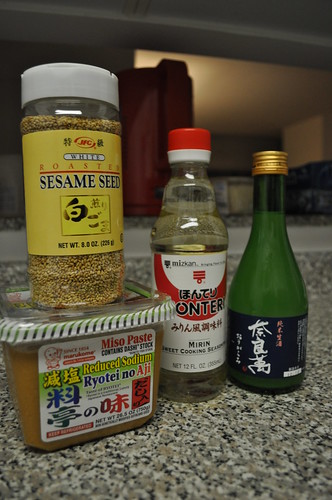
In any case, the recipe I found that fit both mine and Marcus's taste was a result of a Google search for "octopus mirin" (I had some mirin in the cupboard, so I thought that'd be a good starting point) -- I stumbled upon a post from Karolyn over at her blog, FOODjimoto. The ingredients were simple (easy to acquire and few in number): toasted white sesame seeds, miso, mirin (i.e., Japanese sweet cooking rice wine), and sake.


The aggregation of the sesame dressing's ingredients. As I was already going to Katagiri to pick up the steamed tako, I figured I could also pick up the sesame seeds, miso paste (I opted for reduced sodium, thinking I can always add more salt if need be), and perilla (shiso) leaves for garnish.

As for the sake, I initially went to Sherry-Lehmann, the world-renowned (for both its selection and incredible customer service), luxury wine and spirits shop that has been around Manhattan since the Prohibition. However, by the time I got there, it had already closed. And while I love going there to explore its awesome collection of wines, I always feel out of place when I'm there just to pick up something simple like wine or liquor for cooking. For those things, I want it to be a quick in-and-out transaction, so I can be on my way. I do appreciate the amazing customer service at Sherry-Lehmann (I mean how can you not appreciate the concept of one-on-one service via delicatessen tickets?), but it's difficult if I just want it to be a fast stop to pick up one or two mostly mindless items. Luckily, I was able to find another wine shop on my way to Katagiri -- a eclectic wine store called Crush Wine & Spirits. It has a more modern and sleek feel to the shop -- a play on metals against whites with clever uplighting. I'd love to go back to check out its wine selection mainly because my visit wasn't long -- I just asked where the sake was and selected the least expensive bottle since I wasn't planning on drinking any. I ended up with a nonvintage 300 mL bottle of Naraman Origaram Nigori sake. I figured that ought to do the trick.


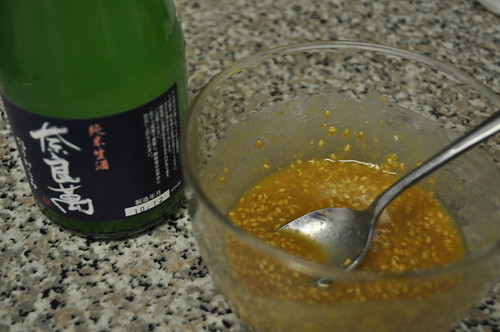
So Karolyn's recipe called for a tablespoon of toasted white sesame seeds to be finely ground using preferably a suribachi (Japanese for "grinding bowl"), essentially a Japanese mortar and pestle. A spice grinder, coffee grinder or a Magic Bullet would also suffice, but as I didn't have these tools on hand, I attempted to crush the majority of the seeds with my hands. This only partially worked, but I figured the flavor of the sesame was what was really needed, so all was okay.


Next, the recipe instructed to add the remaining ingredients and to mix well until combined. The measured amount of remaining ingredients required were as simple as you can get -- a tablespoon each of sugar, mirin, miso, and sake. Once combined, the consistency is somewhat thick, and the taste is a sweet-and-lightly salty one. So easy!


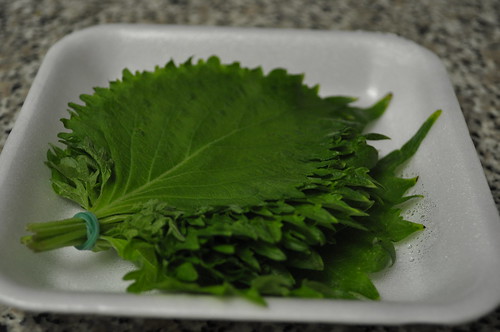
Here are the perilla (shiso) leaves I picked up as garnish for the plating of the tako. The package here contained about ten leaves. I recommend this for any of your garnishing needs, particularly if you're preparing something in the realm of Japanese cuisine. The leaves are both aesthetically pleasing and easy to handle.


I plated the leaves in the shape of a clover.


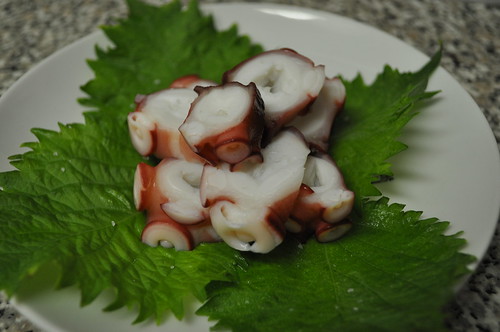
After rinsing and drying it, I cut the pre-steamed tako into 1/4-inch slices and stacked them up like a pyramid over the leaves. I sprinkled some freshly ground sea salt for good measure.


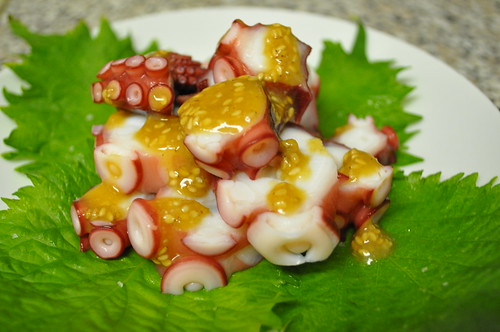
Then, I drizzled the sesame dressing lightly over the tako.


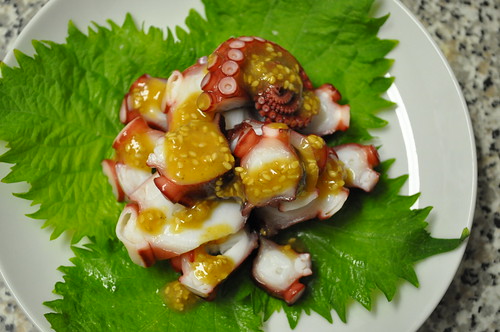
The completed, plated dish!

Findings: There are a few things that I really like about this dish -- first, that it's easy to prepare (I mean, c'mon, the octopus comes freshly steamed in its package, and the dressing takes a matter minutes to concoct), second, that it consists of ingredients that are relatively easy to find, and lastly, that it involves tender octopus! I highly recommend this as a starter dish for small dinner parties -- two tentacle legs should be good for a party of four. It is cool, fresh, light, and refreshing -- the perfect prelude to the main course of any meal or dinner party. The dressing added some depth of sweet and salty flavors to the octopus, which was slightly sweet but mostly texture, along with the delicate gritty crunch of the sesame seeds. I would love to get my hands on a suribachi or just a mortar and pestle to assess the difference of the dressing with finely ground sesame seeds -- I assume it makes the dressing more smooth and cohesive in consistency. Nevertheless, the combination really hit the spot, and I'm already craving for more.

Thanks again to Karolyn from FOODjimoto for this amazing recipe!

Price point: almost 1/4-pound of steamed tako tentacle for $4.83 at $23 per pound, $1.59 for a package of fresh perilla (shiso) leaves for garnish, $11.99 for a 300 mL bottle of sake.

--September 13, 2011

FOODjimoto
"Octopus with Sesame Dressing" recipe from June 2011 blog post archive

Katagiri Co.
224 East 59th Street
New York, NY 10022
http://www.katagiri.com

Crush Wine & Spirits
153 East 57th Street
New York, NY 10022
http://www.crushwineco.com

Tuesday, September 6, 2011

Dessert | Ladurée (NYC)


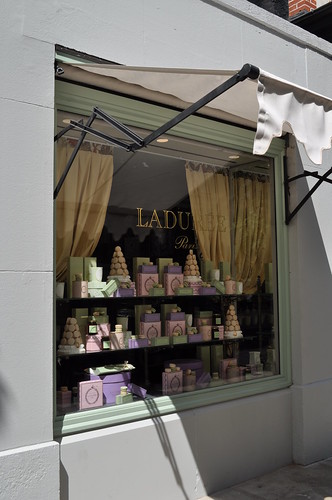
No, this is not a mirage. There's no need to rub those eyes to make sure you're seeing it correctly or to pinch yourself to wake yourself up from a dream. The famed French macaron shop, Ladurée, has finally crossed the Pond and reached the island of Manhattan, where its flagship set up shop over on the Upper East Side earlier last week.


Just a little background about Ladurée before I get into the details of the dainty treats offered by the establishment. Parisian tea salons and their history are intimately tied to the Ladurée family. Back in 1862, Louis Ernest Ladurée, a miller from the southwest region of France, opened a bakery in Paris. During the same time, the Garnier Opera had just begun its construction and the surrounding area was "rapidly developing into one of Paris's most important and elegant business districts, where prestigious names in French luxury goods had already taken up residence." So just as Ladurée's locale in Paris, the Ladurée here in New York City is located on Madison Avenue, where it is famously lined with premier designer flagship stores and haute couture boutiques, making it the ideal area that mimics its original (former) Parisian headquarters.


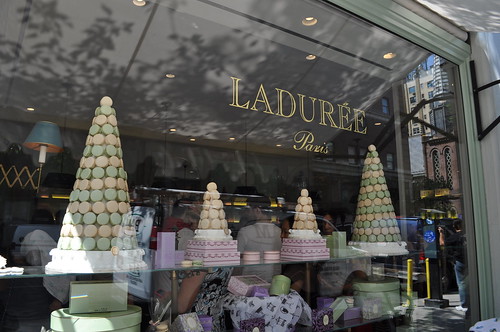
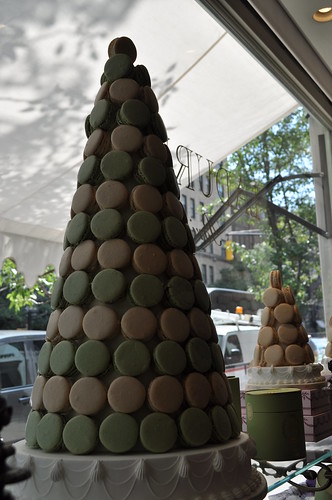
Look at those delicately assembled macaron trees! Beautiful!


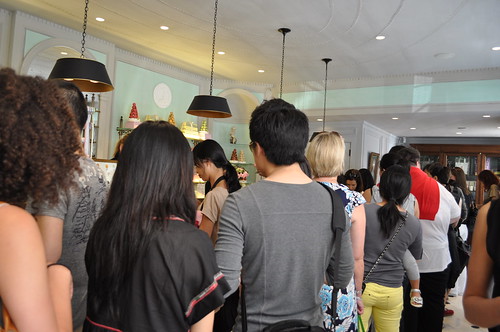
Here is the length of the line when we arrived to Ladurée on a Friday afternoon, around lunch time. It looped through the store about twice, making us luck out because I had heard the lines were going out the door and around the block the first few opening days. We waited a little under a half hour until we reached the counter to place our order for macarons.


So to continue on about the history regarding Ladurée -- in 1871, during Baron Haussmann's "face lift" of Paris, there was a fire that resulted in the transformation of the bakery to a pastry shop. This pastry shop was decorated with the expertise of Jules Cheret, a famous painter and poster artist at the time. Mr. Cheret found his inspiration from the painting techniques used for the ceiling of the Sistine Chapel and the Garnier Opera. The incorporating of these elements in his work for Ladurée, he "added depth and relief to the ceilings and ornamented with cherubic children." Over time, the cafés in the area developed and became more and more luxurious, thereby attracting Parisian high society, eventually becoming the "showcases" of the French capital.

The beginning of the twentieth century was when Mr. Ladurée's wife, Jeanne Souchard, had "the idea of mixing styles: the Parisian café and pastry shop" together gave birth to one of the first tea salons in town. This was also at a time that Parisian women were also changing, where the desire of making new acquaintances came to the surface. Accordingly, the salon de thé (i.e., tea salon) had a "definite advantage" over the cafés: it permitted ladies to gather in freedom.

Since then, David Holder, and his father, Francis Holder (founder of the Holder Group), bought the institution in 1993 where the father and son had plans to promote and enlarge the famous "Maison" of Ladurée. The result -- a new prestigious Ladurée (both a restaurant and a tea room) opened on the Champs-Elysées in September 1997. David Holder's mission for Ladurée is "bring back the great classics" (especially the salon de thé) as well as "to create an environment for gastronomic creativity in Paris." Under his leadership, Ladurée has become a tea salon, pastry shop, restaurant, chocolate shop, and an ice cream parlor in Paris.


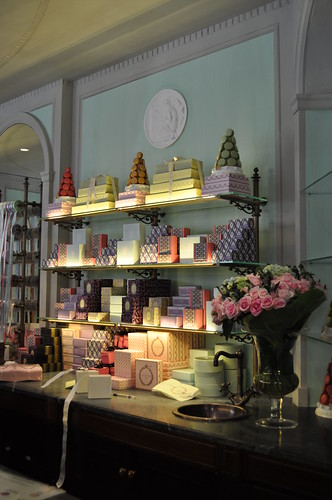
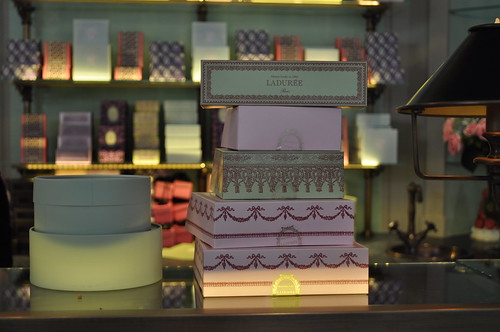
Some of the pastel-laden pastry boxes to hold the dainty treats with which you hope to leave the shop!


Plus, all the ribbon used to tie up those boxes with pretty bows!


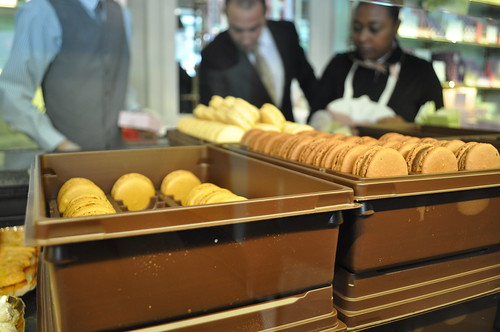
The macaron counter, where it appears the macarons are stored in these special containers, all stacked atop of what seems to be cold stone slabs in order to keep the macaron fillings from melting. What is even more interesting is that the macarons (along with all the other things offered for sale in the shop) are shipped overnight directly from Paris to New York! How incredible is that?! When the rumors were popping up all over the foodie e-universe, there were concerns about the shop and its highly desired goodies. Would the the shop would make the macarons in-store? And if so, how did the company plan on selling these French pastry masterpieces in the States without compromising the practically perfect construction and quality of the ones sold in the Champs-Elysées shop? As macaron enthusiasts know, the baking and construction of these meringue cookies is contingent on so many factors that if one little thing is off (humidity, ingredients, measurements, recipe procedures), the entire cookie suffers. For all we knew, then, the moodiest cookie in the world (as best said by the pastry chef who taught the macaron-baking class I took at the Institute of Culinary Education), especially the ones at the highly-sought after Ladurée, could somehow magically depend (but not at all surprisingly) on French butter and Parisian air. Once the question of imported macarons was settled, the next question rested with whether these macarons from Paris would be everything they are supposed to be. Would the air travel impair the taste/texture/consistency of the macaron? How much more expensive would they be compared to the domestic macarons to which we have become accustomed? Would the import costs dissuade potential customers from purchasing them? Marcus and I were determined to find out.


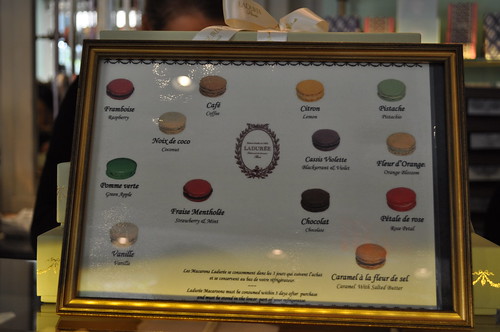
The color-coded menu of thirteen macarons offered at Ladurée -- the flavors listed here are pretty permanent all year round. With each new season, Ladurée pays tribute to its most famous creation, the macaron, by creating a new flavor. The company says "its existing range of macarons is always the starting point when a new one is created, as a variety of colors is as important as the range of flavors and a vital part of their appeal. So a bit more history on the macarons of Ladurée -- at the beginning of the twentieth century, Pierre Desfontaines, second cousin of Mr. Ladurée, first thought of taking two macaron shells and joining them together with a ganache filling. The spirit of this first macaron carries through today, as these pastries are made every morning in Ladurée's "laboratory," where pastry chefs measure out all ingredients precisely and add "a pinch of unique 'know-how' that is essential to the making of such a delicacy." Once cooked and piped, the macarons are put aside for two days before going on sale -- what Ladurée refers to as "the time to achieve a perfect balance between texture and flavor."


A close up of the vessels that hold the beloved macarons.

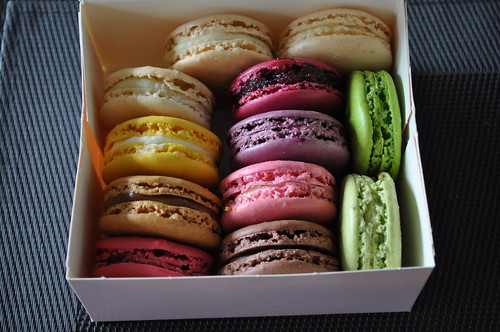
Marcus and I decided to order one of each flavor (thirteen in total, of course), in order to properly assess the shop's full repertoire of flavors available. After getting through the line and arriving home, our macarons made it to our dining table without any macarons melting or becoming crushed.


The box that held twelve of our thirteen macarons (only had capacity for so many).


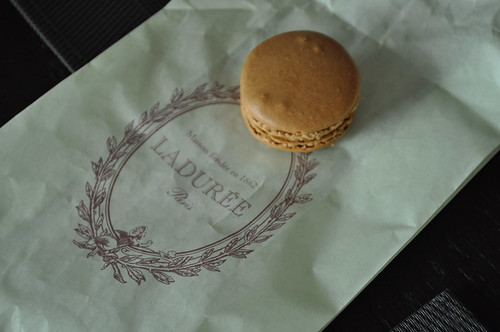
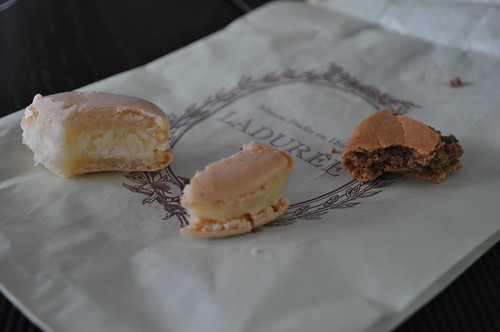
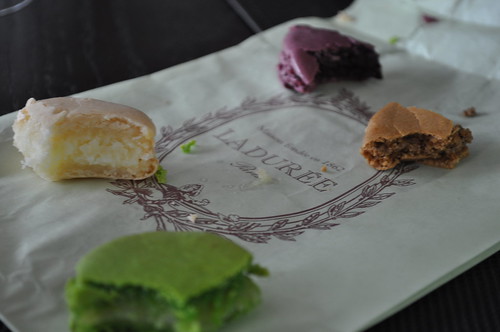
The spillover macaron was placed in this mint green pastry bag.


So here they are -- the colorful spectrum of macarons sold by Ladurée. Here's the flavor rundown (top left, going left to right):
(1) vanille* (vanilla)
(2) noix de coco (coconut)
(3) fleur d'orange (orange blossom)
(4) framboise* (raspberry)
(5) pomme verte (green apple)
(6) citron* (lemon)
(7) cassis violette* (black currant and violet)
(8) caramel à la fleur de sel* (caramel with salted butter)
(9) pétale de rose (rose petal)
(10) fraise mentholée (strawberry and mint)
(11) chocolat* (chocolate)
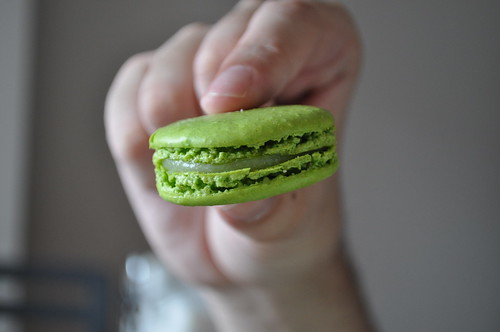
(12) pistache* (pistachio)
(13) café (coffee) [see previous photo]


The first ones we tasted were café, vanille, and noix de coco. The first bite into the café proved all the hype Marcus and I kept hearing about Ladurée -- the cookie's texture (as with the rest of the macarons) was airy and had just the right amount of "crumbly." It was everything we thought it would be and more -- there is just that little somethin' about Parisian air that makes all the difference between these imported macarons and the domestic ones Marcus and I have explored throughout the city. For the Goldilocks of macarons, these were "just right!"

As for the flavor of the café, I found it to be bold (in a good way), while Marcus thought it was a bit more subdued in comparison to the vanille, which we had after. The vanille was light and creamy while remaining super fragrant and strong in taste. It was like heaven in a macaron, almost like a vanilla-infused cloud. As for the noix de coco, we both found it to be soft like the vanilla, only with many coconut shavings and a definite coconut taste. The center for these three macarons were ganache. Out of these three, we found vanille took the cake in taste and texture.


The next one we tasted was the pomme verte, which was very strong and biting in a way that Marcus and I disliked. It felt like I was having straight apple sauce in between the macaron cookies. It was also very overwhelming in apple flavor -- not at all what I expected in a delicate Parisian macaron. A no-go from us on this one.

Next, we had pistache, which was just as amazing as the vanille, only with very nutty and grainy buttercream from the fresh pistachios contained within it. Cassis violette had a very strong and concentrated black currant flavor contained in its jelly center, where I could barely make out the violette. This wasn't much of a loss to me seeing as I really like black currant-flavored macarons anyway. This particular macaron would go really well with a nice glass of sparkling wine, kind of like a faux kir royale! Citron was lovely, too, as it was creamy and refreshing with the subtle zing of citrus (not at all sour!) -- what Marcus referred to as a very light-hearted and tart macaron. The caramel à la fleur de sel was next, which we found to be pretty good and pretty on par with similar ones we've had at other macaron shops in the city. We finally got to chocolat, when we both declared it to be the best "chocolate-flavored" macaron we've ever had, where its ganache center tasted like those gourmet chocolate truffles.


When we got to fleur d'orange, we weren't sure what we were tasting until we checked its color against the menu. We found it to be purely texture and mostly light in taste (not much flavor at all). Our friend Jess had previously told us it kind of tastes like honeysuckle to her, so we probably got a subtle hint of that here.

With three more remaining, we went with the fraise mentholée, which after the first bite, had both Marcus and I immediately react "No, no, no!" in unison. It tasted awful to us -- so much so, that Marcus described it "as if I scraped out the contents of a strawberry Pop-Tart with a candy cane and ate it." I couldn't have put it in better words if I tried. So trust us, if you don't want to taste a strawberry-flavored Peppermint Pattie, don't get this. We urge you to please save yourself. Pétale de rose had a similar effect on us -- it tasted like I had stuck a bar of soap in my mouth and began to chew. Not good. I think it's mostly because Americans don't really have physical rose petals (or its infusion of aromatic essence) exhibited in our cuisine. It is probably an acquired taste that I definitely haven't acquired yet.

The last macaron we had was the framboise, and we really enjoyed that one. It had that tart berry flavor and the refreshing crunch of raspberry seeds within its jelly center. It was quite concentrated with flavor, but I like the tart taste of berries, so it was right up my alley.

Findings: I still find it so unbelievable that Ladurée has finally arrived to New York City, let alone all of its culinary goodies are imported directly from Paris. Fortunately for macaron fanatics all around, nothing has been compromised from the overnighting of these macarons across a body of water. Upon hearing that these macarons are shipped directly from Paris, I was concerned the price point would be extravagant to the point where a visit to Ladurée would be either a one-time thing or only for super special occasions. But this was yet another surprise. It was only about a $0.20 mark-up to the prices we had already been paying for these addictive French pastries. What a steal for real-McCoy, authentic Parisian macarons!

Additionally, you can definitely tell the dreamy consistency of the Ladurée macarons are just as airy and light as everyone who has visited the Parisian shop. From my eyes (or more accurately, my taste buds), the cookie part are practically perfect, giving me the audacity to say that they should be the benchmark that every macaron should meet. Only "downside" (if it really is one) is that there are a limited variety of flavors available daily. With the exception of showcasing a new flavor each season, it seems as though the menu is pretty fixed in that regard. Nevertheless, I am sure you will find your favorites and stick to them. Just be wary there may be a line!

Lastly, I would advise you to stay away from the pétale de rose, the fraise mentholée, and the pomme verte. Unless you've become accustomed to those flavors and/or textures before, they are quite shocking and overwhelming in bold flavors that may not appeal widely to the general public's taste buds -- so you've been warned!

All in all, Marcus and I really enjoyed our long-awaited journey through the flavors of Ladurée macarons -- they were everything we dreamed it would be and more. I still need to make it to Paris one day, but a trip to Ladurée will sate my wanderlust for now. The airy meringue along with the array of fruity and buttery fillings are as close as you can get to savoring the character of Parisian air and the savoriness of fresh French butter. Plus, can you really say anything bad about delightful French pastries that are daintily placed into playful, pastel boxes and then wrapped in iridescent ribbons in the prettiest little bows? Yeah, I didn't think so either :P!

Price point: $2.70 for each macaron.

--September 2, 2011

Ladurée (NYC)
864 Madison Avenue
New York, NY 10021
http://www.laduree.com

Monday, September 5, 2011

Dinner | David Burke Kitchen


Since our dinner at Takashi back in June, Lisa and I were finally schedule some best friend face time over dinner at David Burke Kitchen a couple weeks ago.


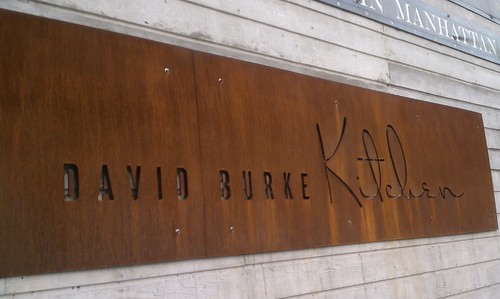
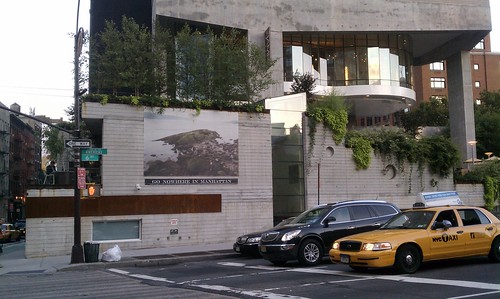
Chef David Burke and The James Hotel partnered once again (first venture being at the hotel's Chicago location with Chef Burke's steakhouse) to open David Burke Kitchen at SoHo's The James New York earlier this year. David Burke Kitchen focuses on "wholesome hearty modern American food" that is locally sourced and "presented in the creative and whimsical style that is Chef Burke's trademark" -- what the restaurant refers to, on its website, as "an urban farmhouse." The restaurant's space was designed by James Beard Award-winner Thomas Schlesser (Best Restaurant Design in 2009 for Chicago's Publican), whose inspiration was drawn from the surrounding SoHo neighborhood -- "blending the cool, industrial simplicity of an airy loft with the rustic warmth of a country barn."

There are three different spaces within the restaurant. When you first enter, a staircase leads up to the glass-enclosed Treehouse Bar, where guests can enjoy artisanal cocktail, homemade sweet-and-savory snacks, as well as an array of other appetizers. The Bar offers banquettes and counter seating that look over Sixth Avenue, offering a "bird's eye view of the city street below."


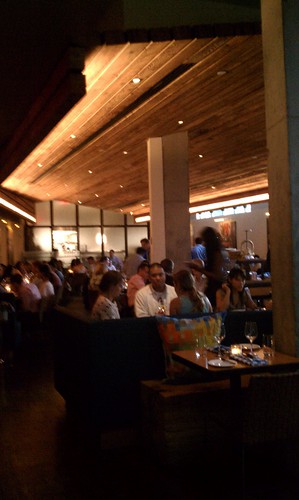
As you walk further in, down the stairs, the loft-like main dining room (seen above) features "exposed beams and views through glass walls into the kitchen and wine cave." There is also an outdoor space with in the Urban Garden one level up from the restaurant's main dining room.


To perpetuate the farmhouse theme, the cloth napkins had the classic blue gingham pattern, echoing the ones we can imagine farmers wearing during a hard day's work. I thought that was a great subtle touch.


Even the drinks menu has an organic feel to it, as you can almost feel the natural grain lines of the wood just by eying it. Love the weather vane logo, too -- very rustic!


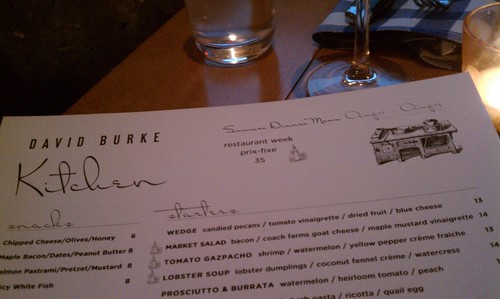
Another thing to note that as David Burke Kitchen aims to be a farm-to-table, locally sourced restaurant, its menu boasts the week's dates atop to emphasize this commitment to this mission.


Fresh butter was served on a weathered glass slab.


Olive bread is always a good start to a wonderful meal.


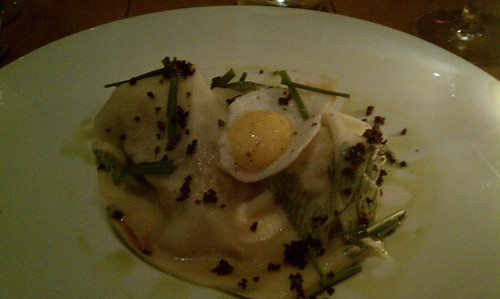
To start, I opted for the duck meatball lasagna with herbed striped pasta, ricotta, and quail egg. Oh man, this was incredibly good. The pasta was delicately soft -- fresh in taste, thin in texture -- making for an awesome complement to the heartiness and juiciness from the duck meatballs that were wrapped in the lasagna's interior, as the ricotta held these ingredients together very well. If it's one thing that Chef Burke does well, it's meat-pasta-cream dishes. Please do not leave David Burke Kitchen without having this. It is undoubtedly a must-order!


Lisa went with the tomato gazpacho with shrimp, watermelon, and yellow pepper crème fraîche. It was shocking to me that the inherent chilliness from this particular gazpacho (i.e., what usually draws me away from ordering/having chilled soups of all sorts) is what actually gave the soup its robust depth and flavor. What a refreshing surprise it was -- the chunks of shrimp mixed in with the thick gazpacho, the hint of watermelon, and the creamy (and zingy) crème fraîche certainly made for a winning combination to savor the last few weeks of summer we had ahead of us since the dinner.


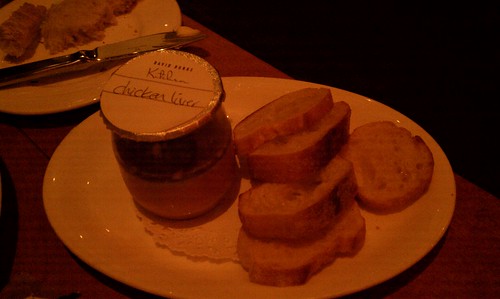
Along with our starters, Lisa wanted us to order from the jar section of the menu -- particularly the chicken liver / pistachio one. Each miniature jar contains a paté combination inside it, ready to be spread on fresh crostini.


A closer look at the chicken liver / pistachio jar. While Lisa totally fell in love with this jar, I felt it was just okay, mostly because I found it to be a little gamy and also because I have never really warmed up to the taste of chicken liver. The nuttiness from the pistachio almost made of for it, but I could only have a bite or two of it before having to call it in. So if you're a lover of chicken liver patés, the one Chef Burke dreamed up here will do wonders for your taste buds! Otherwise, beware of gaminess coming your way.

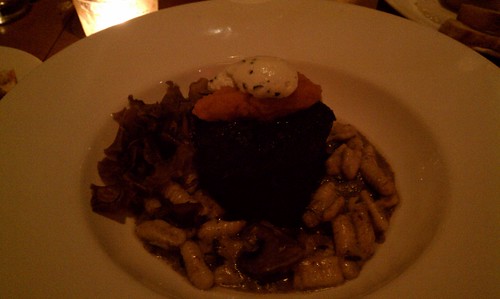
For my main course, I went with the short rib and cavatelli with wild mushrooms and truffle cream. The truffle cream was generously dolloped on top of the short rib meat right after our server brought it out to me from the kitchen, which was a nice detail that rounded out the perfect main course. Warm, tender, and flavorful short rib meat over a well-seasoned bed of al dente cavatelli and earthy mushrooms -- what more can you expect from Chef Burke in a wonderfully crafted main course of short rib? The truffle cream had a nice hint of that delicious goodness that all foodies dream of hitting their taste buds, with the added awesome creamy texture that melts right into the cavatelli, the short rib, and the sauce in which it was all braised. Only problem here was that I wish I had more room in my stomach to be able to eat it all. Definitely dying to go back to David Burke Kitchen for this!


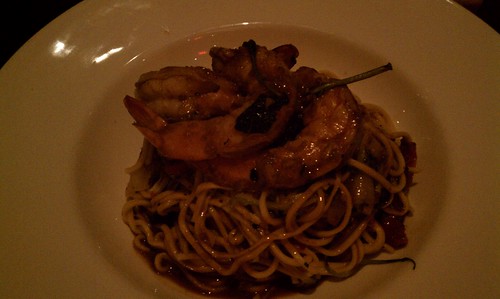
Lisa had the pressed head-on prawns over spicy spaghetti, zucchini, and basil. The spaghetti sauce here was really zesty and punchy in flavor while the pasta itself was perfectly al dente. Very good seafood pasta dish, as the prawns were cooked to the ideal temperature. What I liked most is that the pasta was not drowning in sauce -- always key.


Lisa and I left so full (of amazingly delicious food), so we opted not to order dessert this time. However, as a little parting gift, the restaurant gave us little box bags of chocolate brittle.

Findings: I was very pleasantly surprised by the culinary venture Chef Burke has collaborated on over at The James New York -- David Burke Kitchen really has some strong menu items to show-off the restaurant's well-rounded farm-to-table creations that Chef Burke has so brilliantly put together given the current season's harvest. The duck meatball lasagna and the short rib and cavatelli was to die for -- I'm still having haunting dreams about how badly my stomach is wishing for it to make another appearance in an upcoming meal. What Chef Burke has done here is crafted modern dishes using rustically sourced ingredients in a very urban setting. This dichotomy (i.e., city and country) is balanced well at David Burke Kitchen, and I highly recommend casual dinners there. As with Chef Burke's other restaurants, the menu at David Burke Kitchen is playful in its descriptions and categories (e.g., snacks, jars, etc.). Portions are generous for an establishment o of haute cuisine, so I recommend going hungry, with the intention of having at least two courses.

Price point: $13-16 for each starter, $7 for each jar, $29-32 for each main.

--August 17, 2011

David Burke Kitchen
The James New York Hotel
23 Grand Street
New York, NY 10013
http://www.davidburkekitchen.com

LinkWithin

Related Posts Plugin for WordPress, Blogger...