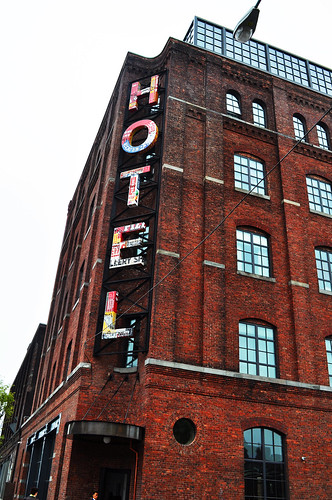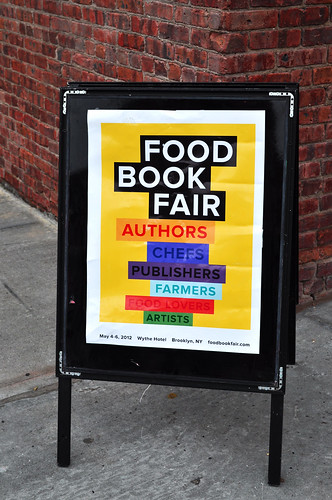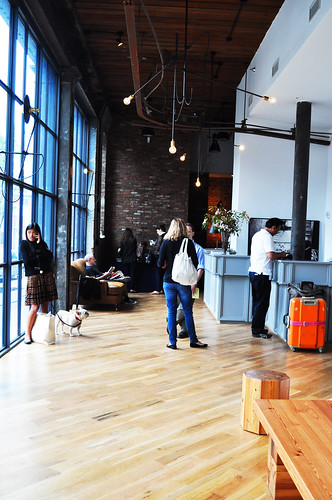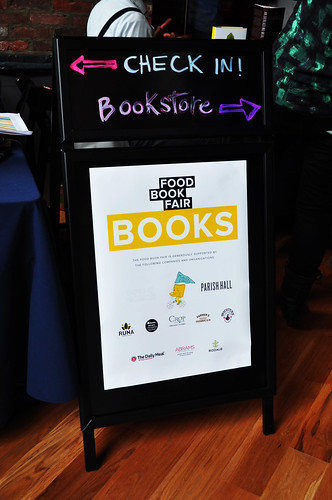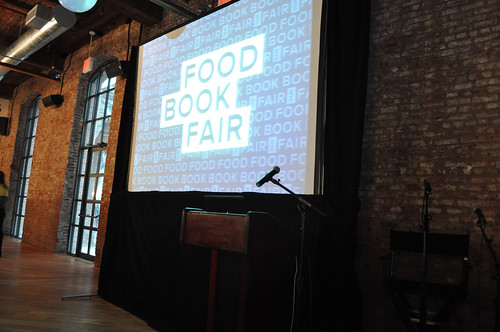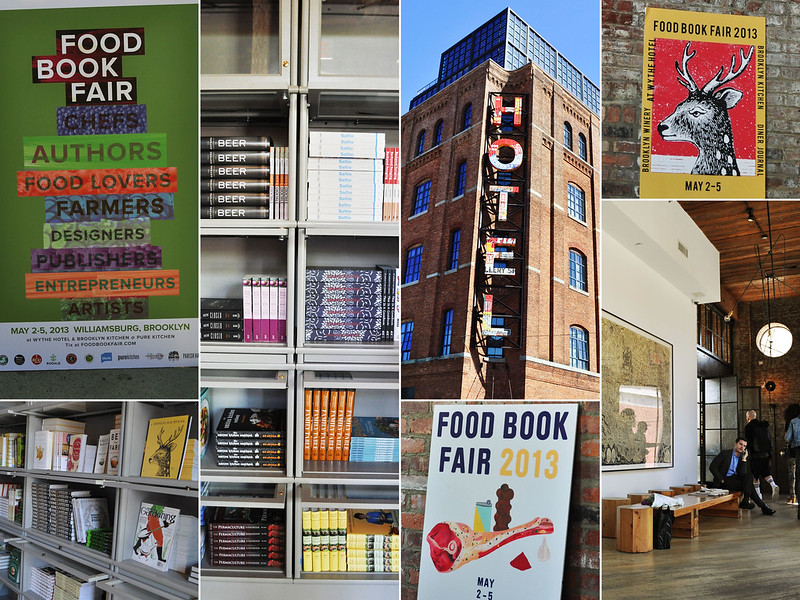
{1,3,5} The 2013 FBF and its main meeting ground at the Wythe Hotel. {4,7} Limited edition posters designed for the 2013 FBF by Diner Journal. {2,6} The curated cookbook shop housed in the library nook of the Wythe Hotel run by Word Bookstore of Brooklyn.
{1,2,8} Pure Kitchen and The Brooklyn Kitchen were sponsors of the FBF this year, generously hosting and supplying for cooking demonstrations and select panel discussions.
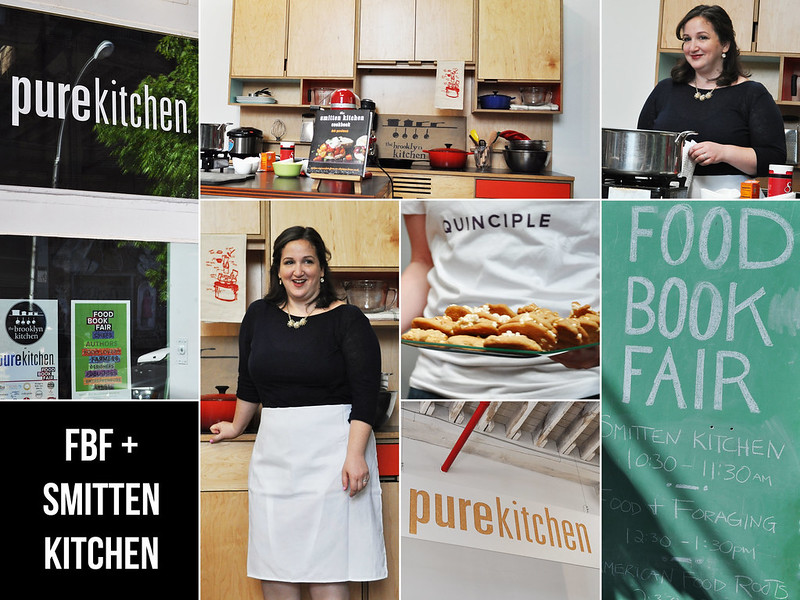
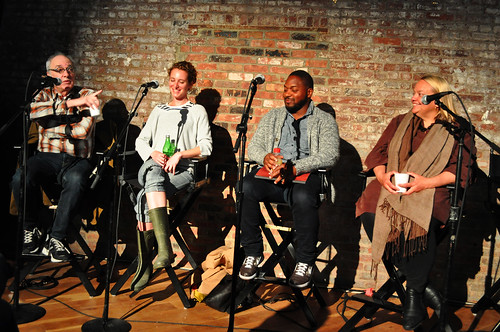
{6} One of the events I was so excited to attend was "FBF + Smitten Kitchen" where {4} Deb Perelman, blog creator and cookbook author of Smitten Kitchen, was invited to discuss her passion for cooking and writing. {3} During this event, she had demonstration of a recipe {5} for buttered popcorn cookies from her cookbook. Here are some of the highlights of the discussion and audience Q&A:
- Her recipe for buttered popcorn cookies was inspired by a close friend who admitted that she didn't like popcorn because of the artificial butter scent that is so pervasive in movie theaters. Ms. Perelman rose to the challenge of attempting to put it in cookies to see if she'd like it.
- The base for her buttered popcorn cookies use the same base of a solid chocolate chip cookie, using popcorn instead of chocolate chocolates.
- When asked how long it takes for her to master a recipe, she told the audience that it depends -- sometimes she can get really detail-oriented and other times the level of complication can affect this as well.
- Ms. Perelman's "must-have accoutrement" in a city kitchen: a big dutch oven (can start with a 5-quart sized one for 6-7 servings), 12-inch cast iron skillet (stove-to-oven safe, as it can be used as a roasting pan in oven), small saucepans (as useful substitutes for a microwave), handmixer (though stand mixer is nice, this will do), immersion blender (instead of an upright blender, as a space saver), one big and one small knife, and a good bread knife. She interjected with a comment that you can tell that she doesn't take sponsorships because of this commentary.
- She likes to use table salt for baking recipes as it is more consistent in weight and dissolution.
- One of her favorite all-time recipes is a real red velvet cake -- essentially an everyday chocolate cake, substituting buttermilk with red wine. This was inspired by a reader.
- She considers herself a obsessive cook -- especially when it comes to research and satisfying her curiosity.
- On writing a book versus writing a blog: she finds it more natural to blog than it was for her to write a cookbook.
- The "epitome" of Smitten Kitchen: a cauliflower pesto that comes out with a couscous-like texture as well as the huevos rancheros recipe (like a breakfast casseroles, plus she really likes salsa with eggs).
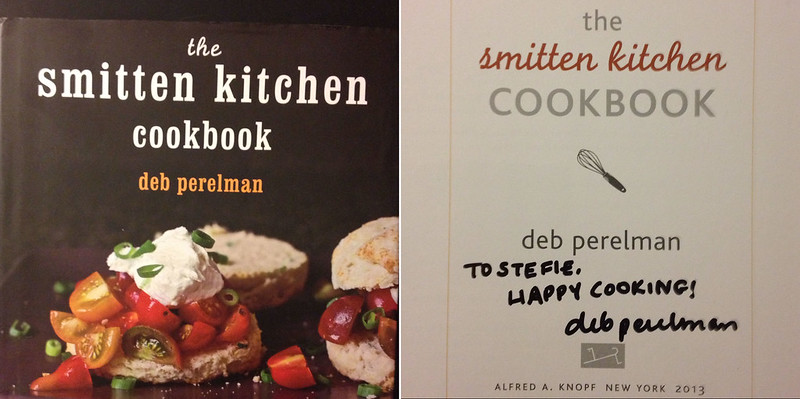
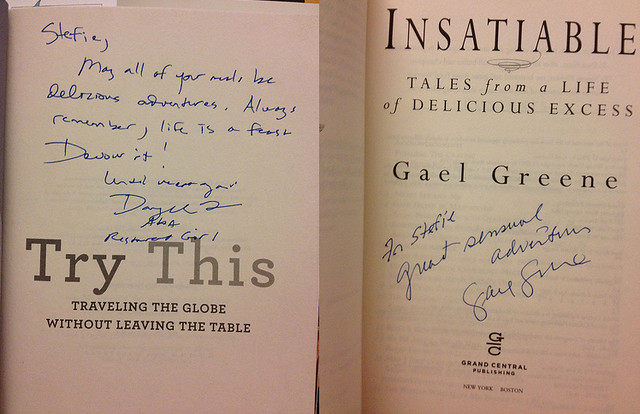
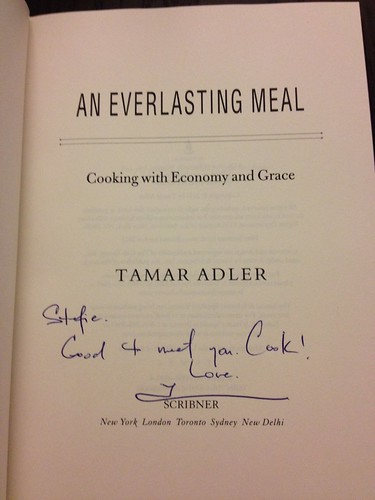
...and of course, I got my copy of The Smitten Kitchen Cookbook signed by hers truly! :)
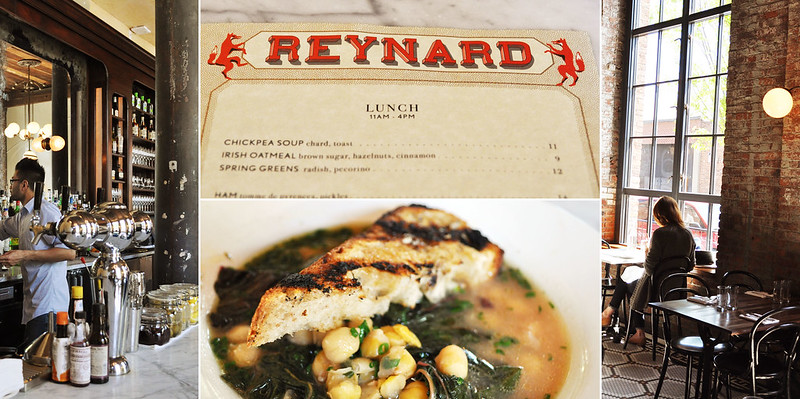
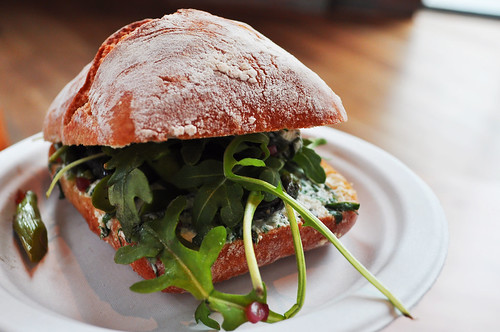
{1-3} In between events, I popped into Reynard, the restaurant inside the Wythe Hotel. I didn't want to stuff up on too much, especially given the next event that I had on my list (see below). What struck my curiosity was the chickpea soup with swiss chard, spring onion, and toast. It was incredibly flavorful and bold, and that grilled toast made it even better. I only wish I had more to soak up the remaining broth that I ended up slurping dry.
The next program I attended as the "FBF Coffee Crawl" of Williamsburg with the four premier locations curated by New York Times contributor Oliver Strand and illustrator Lars K. Huse (from the UK), where we got the behind-the-scenes look at roasting, brewing, buying, and sampling some of the best coffee that Brooklyn has to offer.
{1} The first stop at at Toby's Estate Coffee, a roastery and cafe.
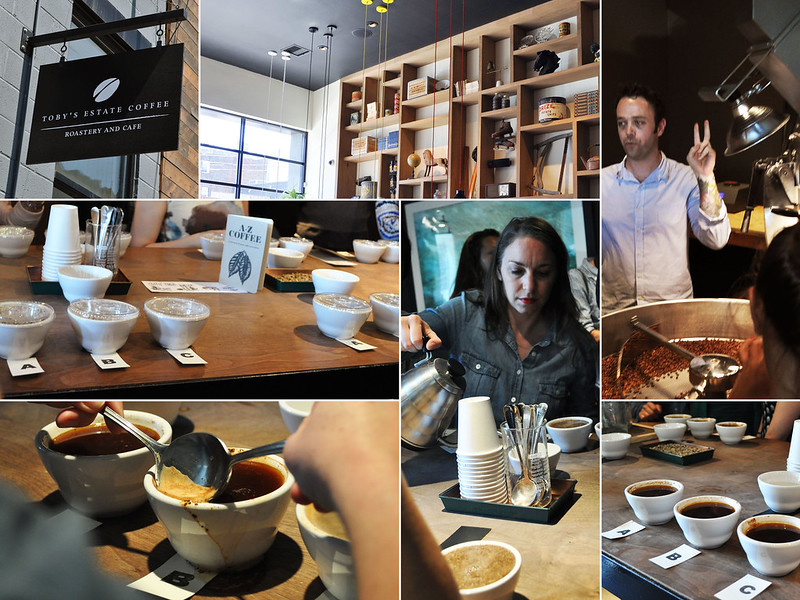
{2} At Toby's we got to experience a cupping first hand -- i.e., a universal way of tasting coffee. This is how Toby's evaluates what coffee beans to buy for its patrons. Cupping takes preparation out of the equation, allowing the coffee beans to be compared on an equal platform. {4} At this particular cupping, we got to taste two kinds of coffee with one kind two ways: (A, C) an Ethiopian Yirgacheffe coffee, one aged for a couple days and another aged that morning; and (B) a Colombian Bajo Mirador coffee. We got to smell the freshly grounded coffees before {5} they poured hot water over the grounds for a precise brew. Coffee (A) was super aromatic and fresh, while Coffee (C) was a little more subdued, but still fragrant. Coffee (B) was a little more robust and pungent. {6} After the brew time was up, the baristas carefully scooped out the steeped beans out of the cups. We each got our own spoons and learned how to properly taste coffee at a cupping. By this time, the coffee will have sat at a more tepid temperature, whereby getting a spoonful of coffee and quickly slurping to get the optimally rounded taste throughout the palate. {3} We also got to learn a lot about the roasting process as Toby's roasts its beans right there in the shop. The head roaster walked us through roasting a batch of beans.
{1-3} Next stop was to Blue Bottle Coffee Co. on North 6th Street. One of the team members that trains and educates all Blue Bottle baristas (it has a very thorough training process of six weeks) led us through three different ways to brew coffee. Instead of different origins and roasts, Blue Bottle had us compare preparation methods of the same variety of coffee -- Kirezi, a single origin coffee from Rwanda.
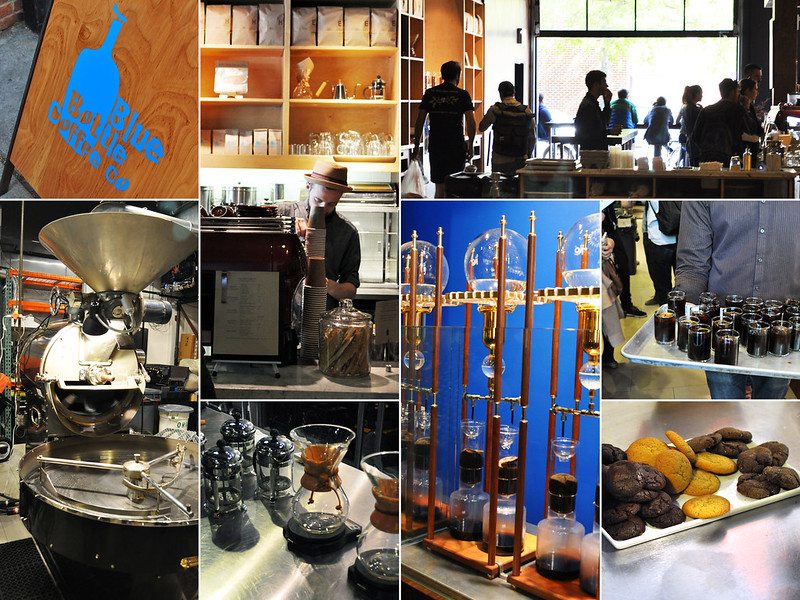
{5-6}The first preparation we sampled was the Kyoto-style iced coffee (also known as Japanese cold brew), which brewed between 12-18 hours in Oji cold drip brewers. Because of the fine grind of the coffee, the Oji can extract more from the coffee. In this preparation, coffee is never heated -- it remains cold during the entire process, and for this reason, the resulting product gets more sweetness as well as high levels of caffeine from the coffee. {4} We also saw the German roaster that Blue Bottle uses for roasting its wholesale beans, {7} as we waited for the next two preparations of coffee using Chemex and French press. {8} For dessert, they served saffron snickerdoodles with Tahitian vanilla, ginger molasses cookies, and double chocolate cookies with Mast Brothers Chocolate.
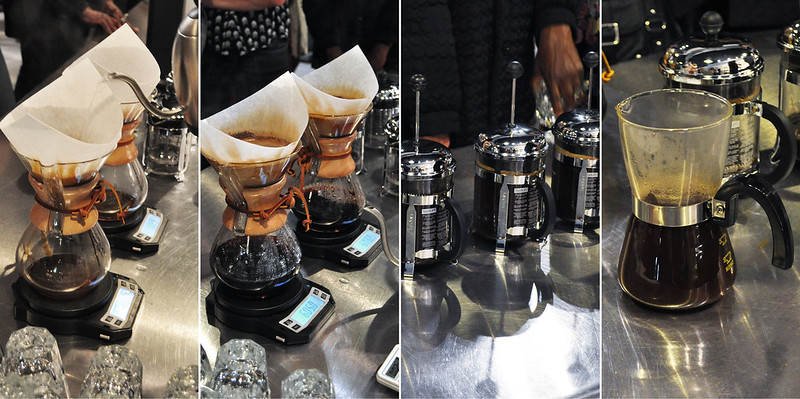
{1-2}Blue Bottle showed us how to brew coffee using a Chemex, an apparatus invented during the 1940s resulting from a shortage of metal during wartime. The result of using this brew method is clean and provides a nice clarity to it. The Chemex is actually on display at the MoMA not only for its functionality but for its beautiful design. Also referred to as the Bloom method, the Chemex best brews coffee when the water is around 185 to 195 degrees Fahreinheit, especially when using a swan neck kettle. You slowly pour two parts water to one part coffee by monitoring the scale. As we learned with the Kyoto-style iced coffee, the longer the brew time, the more resulting caffeine. I thought the coffee brewed using a Chemex was very smooth, capturing the essence of the ground coffee in an elegant manner. {3-4}The French press has a perforated metal plate which best brews coffee with an infusion process of four minutes. The resulting brew was a little more concentrated in flavor as there's no paper filter involved in the brew method as well as a tad bit more grainy.
{1,4,6} The third stop was to Sweetleaf Espresso, where we sampled two different shots of espressos, essentially two types of coffees prepared the same way. I learned that espresso is a type of preparation, not a roast (i.e., there's no such thing as an espresso bean), and each espresso needs a dedicated grinder as it can't be switched out to accommodate another espresso. {2} With that being said, Sweetleaf is one of the few places that offers two different espressos. Mr. Strand outright said that there's no financial reason to do this -- only a true belief in exhibiting flavors.

{5} The first espresso was Stickball Seasonal, a blend of coffee from Guatemala and El Salvador by Ritual Coffee Roasters of San Francisco. It had a nice chocolate, nuttiness to it that brought about a little sweetness on the finish. {3} The other espresso was Rwanda Kirege, a single-origin espresso by Heart Roasters of Portland, Oregon. This had hints of orange and fig as well as a little bitter notes of black tea. A noteworthy analogy made by Mr. Strand when asked about using at-home espresso machines to make espresso is that it's like playing baseball at Yankees Stadium versus at a local field at Central Park. It'll do the job, but it's just not the same. It's worth it to just leave it to the knowledgeable baristas that have access to the best machinery and high quality coffee roasts.
Once we downed our espressos, we skipped back to the Wythe Hotel, where we had the last flight of eight coffees waiting for us at Reynard. Mr. Huse and the head of the coffee program at Reynard walked us through the blends of coffee that they had for us that afternoon.
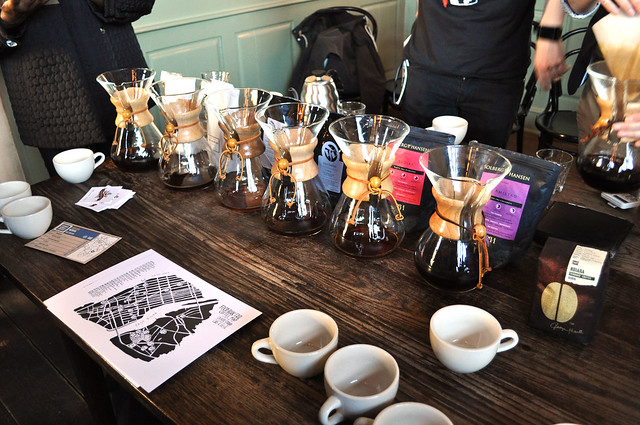
Most of the coffees here were from Norway, where Mr. Huse had worked and learned greatly about the art of roasting and brewing. We were so fortunate to have sampled some of the best coffee available these days (though getting these in the U.S. with the high Norwegian taxes and import duties makes them even more costly), which included coffee by Kaffa, Tim Wendelboe, and Solberg & Hansen. The only non-Norwegian coffee offered was by George Howell's Terroir Coffees which is based in Boston. Most of us were definitely crazy wired by this point, but we still pushed to taste these last cups. Even as a coffee amateur, I could definitely tell that these coffees were in an echelon of greatness all on its own. It is worth noting that these coffees do not go well with milk, a mistake many patrons make at Reynard when ordering from the rotating menu of selections brewed via Chemex. Among my favorites from this flights were the Finca Tamana by Tim Wendelboe and Ndiara, a Kenyan coffee by George Howell's Terroir Coffees.
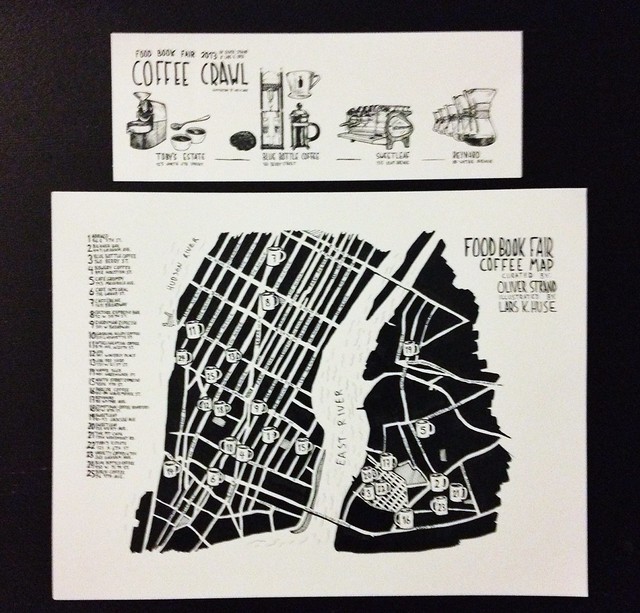
Each attendee got a copy of some illustrations by Mr. Huse -- "FBF Coffee Crawl" illustrations of each coffee stop based on brewing apparatuses, as well as a full-blown Food Book Fair Coffee Map of New York City curated by Mr. Strand.
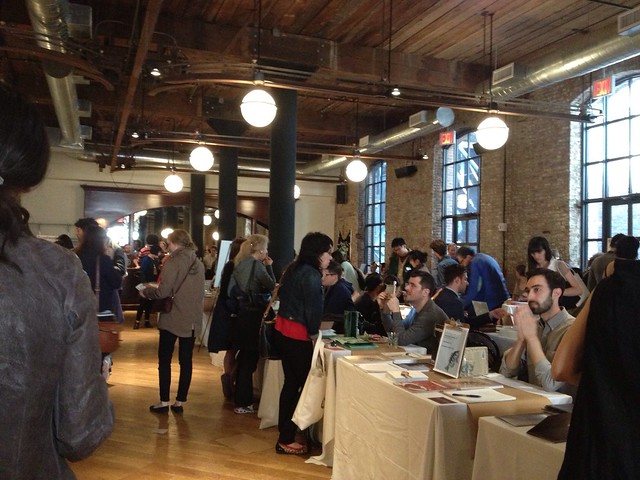
The next day, I stopped by at the "Foodieodicals" event, where food and periodicals (ha-ha, get it?!) meet -- essentially a magazine fest of creative food publishing, where attendees can meet-and-greet with editors and writers of these amazing works.
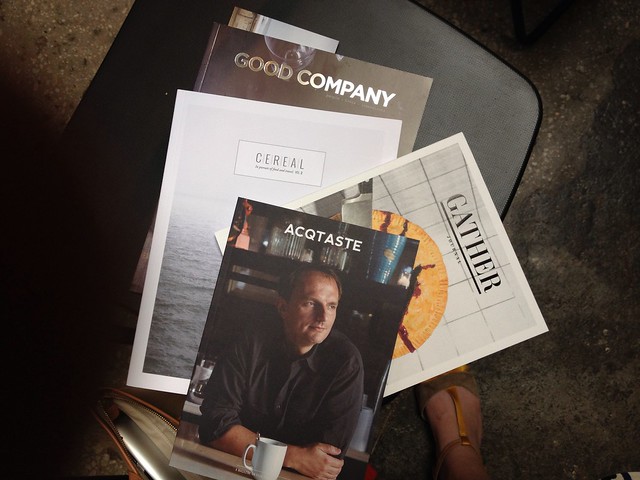
I was so psyched to not only have picked up the latest, fresh copies of Cereal, Gather, Acquired Taste, and Good Company, but I also got to meet and chat a little bit with the creative heads behind each of them!
{1} Later in the afternoon, I had the fantastic chance to attend a cooking demonstration at Pure Kitchen featuring Caitlin Freeman, the head pastry chef of Blue Bottle Coffee Co. and author of the recent Modern Art Desserts. The cooking demo walked us through her most famous creation at the Blue Bottle café at the San Francisco Museum of Modern Art (SF MoMA) -- the Mondrian cake, which also happens to grace the cover of her cookbook.
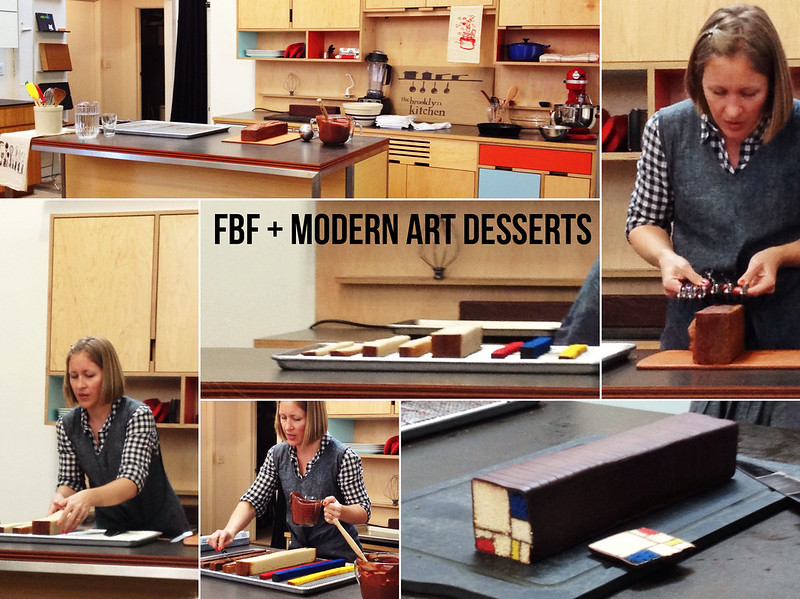
{2} Mrs. Freeman walked us through how to cut the necessary cake into the required pieces using an adjustable dough divider and a really sharp knife. {3} Once she cut out one 2"-by-2" rectangular prism, two 1"-by-1"s, and two 1/2"-by-1"s, {4} she brought out the pre-cut colored pieces (that came from three separately baked cakes of their respective colors) and {5} began to glaze them with chocolate ganache. After glazing all of the rectangular prisms of cake, she reconstructed them in a particular arrangement, simultaneously using the chocolate as the distinct Mondrian "lines" and as the glue to hold it all together. She wrapped the cake tightly with parchment paper so she could release any bubbles that were floating in the ganache glue. This would go back into the fridge, and once it set, it would be unwrapped and the exterior would be reglazed to perfection and marked with a nice texture using the same dough divider. {6} Returning back to the fridge, the cake would set and be ready to be taken out after a couple hours, to be served at room temperature, with a quarter-inch slice to reveal the cross-sectioned Mondrian hiding within the cake!
Here are some highlights during the demo and audience Q&A:
- She was inspired by a painting of cakes by Wayne Thiebaud at the SF MoMA during her time as a photography student. She fell in love with the painting and wanted to "live" it because it didn't appear too sweet, pastel, or fussy -- kind of like an "anti-wedding cake."
- She was the creator of Miette, a bakery in Oakland, which she decided to sell around the time she got married to James Freeman, the guy behind Blue Bottle Coffee Co. (funny enough, she met her husband at the farmers' market as their vendor booths were right next to each other), and soon enough, she took became the head pastry chef at Blue Bottle.
- When Blue Bottle opened its Café inside the SF MoMA, it was as if she were being reunited with the painting she fell in love with years ago. She then began to make Thiebaud cakes, mimicking them to a T, which led to the Café creating desserts reflecting art only display at the Museum. She finally found a way to turn an art gallery into a kitchen (and vice versa).
- Soon enough, the idea of the Mondrian cake came about, something she cheekily added that she'll never ever make something as "Instagrammable" as this in her baking career ever again.
- She was never a big fan of food coloring normally, but the Mondrian cake is all about the deep pigments of the colored pieces of cake. With that being said, she also had to find a cake that not only tasted good but could withstand the precise cuts needed to disassemble and reassemble its parts. She borrowed Rose Levy Beranbaum's white velvet cake as the base. The chef from whom she borrowed this recipe actually wrote the Foreword to Mrs. Freeman's cookbook.
- The chocolate ganache used at the Museum is made using Recchiuti Chocolate (a SF-based confection company), while the one used in our demonstration used Mast Brothers Chocolate.
- Although the SF MoMA plans to close for the next three years in lieu of a major renovation, she wouldn't think of making the Mondrian cake anywhere else.
- Looking toward the future, she likes that she can use art as her way to create a new dessert, as a way of playing with her career as a pastry chef.
- Another example of a SF MoMA artwork turned into dessert is her take on Richard Avedon's photograph of Ronald Fischer, a beekeeper. She wanted to convey the same sense of unease and feeling of being boxed in as the original photograph does to its observers.
- In between major steps of the recipe demonstration, she said she's going to pull a Julia Child and do a "presto-change-o" and magically appear with completed steps without the normal amount of time lapsing.
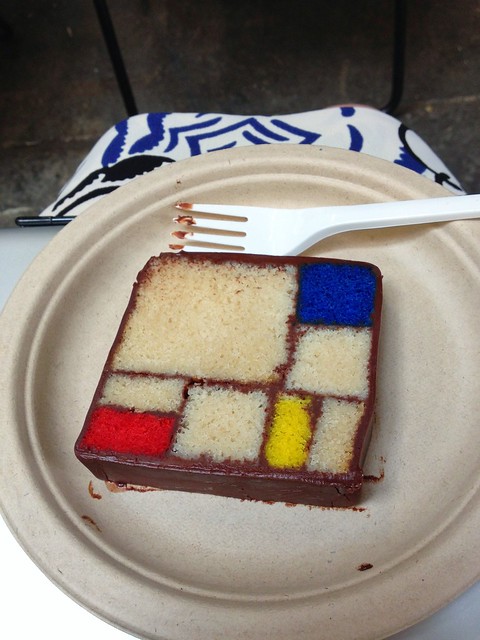
My sliver of the Mondrian cake! Ain't it purdy?! It was almost too pretty to eat, but it was as delicious as it was gorgeous.
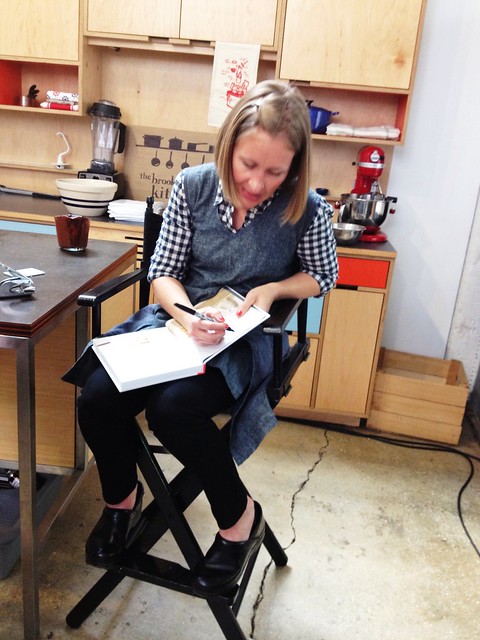
Caitlin Freeman signing a copy of Modern Art Desserts.

She had such a sparkling personality, and she was really fun to talk to -- especially since we both discovered our fascination with embossers. {1} Look at that cute little message she embossed onto the inscription page: "You can totally make the Mondrian cake!" She even encouraged me to get an embosser because they're not as expensive as they used to be. Not only do I want Deb Perelman to be my best friend, but her, too! {2} She was also nice enough to sign my copy of The Blue Bottle Craft of Coffee!
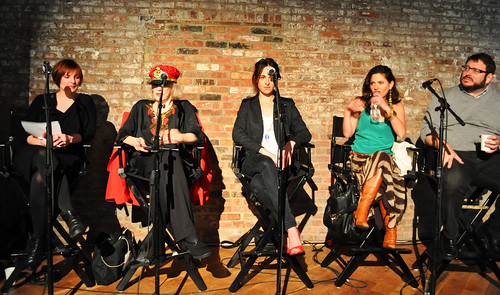
Findings: As you can much gather, I had quite the field day at the 2013 Food Book Fair. I got to meet two individuals in the cooking world that I've long admired and watch them in action. I learned tremendously about coffee and many of its facets -- origin, roasting, brewing, etc. -- and I know I have so much more to go. I also found out what would happen after sampling 16 kinds of coffee/espresso (I imagine that's what being on Ritalin would feel like...). I ate well at Reynard, and I even got to meet the editors and writers of some of my favorite foodie periodicals. I did attend two panel discussions as well (not detailed in this post), but I didn't find them as appealing as the ones I had attended last year -- my expectations were misaligned with what actually occurred. I'll know to choose better for next time. Though logistics were a bit stressful (the event seemed a little unorganized at first), the resulting experience turned out to be very rewarding, and I'm glad I was able to attend these amazing events. I look forward to next year's line-up, which I'm sure will boast a wide range of crazy awesome things for food enthusiasts alike to unite and congregate.
Price point: $10-50 for a ticket to each Food Book Fair event, $15-20 for each magazine, $25-35 for each cookbook.
--May 3-4, 2013
Food Book Fair (NYC)
Pure Kitchen
66 North 11th Street
Brooklyn, NY 11211
http://www.purekitchen.com
Reynard
Wythe Hotel
80 Wythe Avenue
Brooklyn, NY 11249
http://www.foodbookfair.comToby's Estate Coffee
125 North 6th Street
Brooklyn, NY 11249
http://www.tobysestate.com
Blue Bottle Coffee Co.
160 Berry Street
New York, NY 11211
http://www.bluebottlecoffee.com
Sweetleaf Espresso
135 Kent Avenue
New York, NY 11211
http://www.sweetleaflic.com