Showing posts with label Ferran Adrià. Show all posts

Monday, October 3, 2011

Book Signing | Ferran Adrià


So guess who Marcus and I got to meet this weekend? The culinary sorcerer himself, Chef Ferran Adrià, the former chef of the now-closed, world-renowned, modern gastronomic restaurant, elBulli! The new cookbook released by the chef, in summary, "chronicles the restaurant's famously thoughtful staff meals." Chef Adrià dropped several hints on what the premise of this cookbook during his conversation with Adam Gopnik at the 92Y when he was in the States last March. This included that for elBulli's staff kitchen meals (aka "family meals"), the challenge was putting a limitation of the amount to be spent on ingredient while at the same time being able to create a good, solidly tasting meal. He also noted that the typical four servings seen in most cookbook recipes don't accommodate the varying parties that are usually found cooking at home (i.e., singles, doubles, families with kids) -- with this in mind, the actual recipe needed may require less portions and/or a completely different meal structure. After casually perusing the pages of The Family Meal, Chef Adrià hits the nail right on all these points. It appears that ingredients are relatively easy to obtain and there's a handy matrix for the amount of people for whom you'll be cooking (i.e., for two, for six, for 20, for 75) and the ingredients' respective proportional measurements. So not only does this book have Chef Adrià's gastronomic influences throughout its pages, it's practical, relatively simple in directions, economical, and perfect for the meals I prepare at home now with Marcus in our new place together. Also, there is no worry about having too much left over and have it go to waste.


As the signing was to begin at 3 PM, Marcus and I made it a point to get there about an hour before. We were running a little late, so we got there around 2:15. This was the view of the line from where we ended up standing in line. Not too bad, I thought, from my previous experiences at Williams-Sonoma book signings. I estimated it to be about a 15-20 minute wait in line, depending on the parameters of the signing (posed photos permitted versus photos as the chef is signing, custom personalizations with an inscribed message versus just a written message, etc.).


While the book signees were waiting in line, the Williams-Sonoma kitchen prepared two sample recipes from The Family Meal.


One recipe was the coconut macaroon (page 126) -- not to be confused with Parisian/French macarons -- and the other was Mexican-style slow-cooked pork (page 214). The pork was served over a miniature tortilla and topped with minced red onion -- overall, it was very flavorful, soft, and juicy. Ahhh, would love to try to make this recipe at home! The coconut macaroon was lightly sweet and very coconutty!


Chef Adrià and me! Such a nice guy -- really funny, too! Since he doesn't know much English, he kept giving Marcus the thumbs up to make sure we got the photo, saying, "Good? Good?"


You can see the line creeping out the door, as we were able to leave, and the line of people waiting to purchase copies of the cookbook right in front here.


Per usual with book signings at the Williams-Sonoma Columbus Circle location for famous chefs, the line curves around the store as eager foodies wait (im)patiently to meet the said chef (Chef Adrià today, of course).


And almost always, the line is out the door!


My copy of The Family Meal!


Chef Adrià's kind words upon signing the cookbook: "Con mucho gusto" -- Spanish for "with much pleasure."

Findings: It was really nice to finally meet Chef Ferran Adrià in person, especially after seeing him speak at the 92Y back in March and being unable to meet him after due to books being sold out. And what an awesome chef's cookbook (a signed copy, no less) to add to my eclectic collection of cookbooks! I also love the structure of his cookbook in that it appeals to the everyday person -- one with a budget, relatively limited resources (i.e., what is found at an everyday grocery store), household of one or many, and somewhat of a time crunch. Chef Adrià addresses all of these issues in The Family Meal, which is something that I've been on the search for in a solid cookbook. I can't wait to explore this cookbook (yay for recipes that address two servings!) during the nightly meals that Marcus and I cook together during the week, after a long work day.

Lastly, how cool is it that I have a photo with Chef Adrià?! I'm still very starstruck about it.

Price point: $29.95 for each book.

--October 2, 2011

Williams-Sonoma
Time Warner Center
10 Columbus Circle, Suite 114
New York, NY 10019
http://www.williams-sonoma.com/recipe/tip/book-signing-events.html


The Family Meal: Home Cooking with Ferran Adrià
Ferran Adrià
available here at Amazon.com

Thursday, March 31, 2011

Lecture | Behind the Scenes at elBulli

This past week, Marcus and I attended a very interesting lecture hosted by the 92nd Street Y on the Upper East Side. It was a conversation led by Adam Gopnik, staff writer for The New Yorker, between Chef Ferran Adrià, the mastermind behind arguably one of the best restaurants in the world, elBulli, and Lisa Abend, Time magazine correspondent in Spain, who has a new book released entitled The Sorcerer's Apprentices about the apprentice chefs at elBulli. The conversation aimed to discuss what goes behind the curtain at elBulli and "the small army of young apprentice cooks charged with carrying out his unique culinary vision."


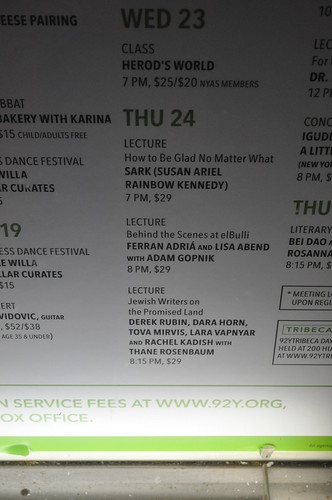
Calendar outside the 92nd Street Y featuring the night's event!


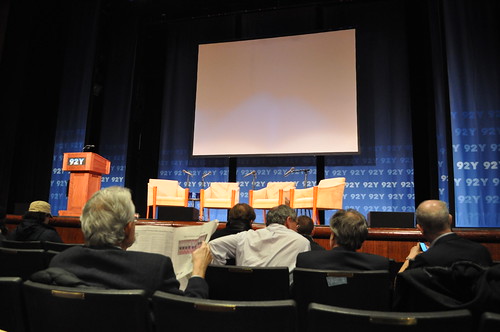
Inside the 92nd Street Y! Wish we were able to take photos during the lecture, but the policy says otherwise.

Mr. Gopnik came to stage first, prefacing the lecture with a lovely introduction about Chef Adrià and how when he was lucky enough to eat at elBulli that it seemed as if Chef Adrià was the maestro of a culinary symphony that is the essence of elBulli. He compared sharing a meal with Chef Adrià like finally a childhood fan being able to sit down and dine with Willy Wonka. I thought the description was quite clever. He also introduced Ms. Abend, too, briefly mentioning her recently published book about the young stagiaries at elBulli and how her story is from a "worm's eye view" of the famed restaurant.

Once the two featured guests came out on stage to their seats (Chef Adrià with his translator), Mr. Gopnik tried to start the conversation off by asking Chef Adrià about his earliest childhood memory of food, but Chef Adrià went off on a totally separate tangent. He asked Mr. Gopnik (as well as the audience) to observe the glass of water he was holding in his hand, to think about how many times we see it daily. He noted its obvious characteristics--how it is odorless, colorless, ultimately flavorless--and how there are not many products like this in the world. He then also noted the temperature of the glass of water and how we, with our human bodies, can consume many edible temperatures (i.e., the contrast between a hot consommé and a bowl of ice cream). The moderate temperature of the water and the fact that it has no base taste and no variations in flavor is important to this observation as well, he said.

He urged that we should observe it until we have used all of our senses, and once all exhausted, we will use intellect. Chef Adrià pointed out that if extraterrestrials ever came to earth, they would not know it is a glass filled with water. He also noted the link between water and our mortality if we do not consume enough of it--it is an important ingredient/product in nutrition as well as an important social issue (i.e., availability of drinking water throughout all continents in the world). So after all of this contemplation, the chef asked the audience if we should perceive food directly or through concentration? If we thought about all of things we consumed at this level of observation and concentration, he said we'd all probably go crazy, which is why he says there are certain moments in the year when you want to experience such madness. This is the philosophy behind elBulli.

Mr. Gopnik looked stunned, of course, interjecting that this was the most philosophical sip of water he has ever had. Chef Adrià interjected that it is okay to do this with wine!

But to continue what Chef Adrià was discussing, he mentioned that in 1980s, he was cooking with the sole purpose for others to enjoy. After contemplating this for about a decade, he changed his perspective to create a new level of gastronomy and cuisine. His mission was no longer just about pleasure and enjoyment--it became a mission to create, that is, an experience in cuisine. When he first proposed the ideas to everyone, he wasn't met with open arms. Instead, he was challenged, adding that they wanted to shut him in a mad house--that he wanted to charge $300 and make a joke out of elBulli. But Chef Adrià saw it in a different light--he started to look at cooking at that point in time like film, and what would become the forty to forty-five courses at elBulli would function as the film's "scenes." He shared with the audience that he wanted to evoke emotions in the restaurant's patrons--feelings such as generosity, memory, sense of humor, surprise, etc.

Here's a brief summary of some points I found interesting:
  • When Mr. Gopnik tried to summarize what Chef Adrià was trying to convey (i.e., paying close attention in the kitchen and in cooking), Chef Adrià replied that it was much simpler than that. He gave the example of visiting the Museum of Modern Art here in New York--that you ultimately decide what you want to during your visit, that it is not always about concentration (i.e., trying to find the meaning behind every work of art, etc.). He applies this line of thinking to cooking at elBulli.
  • The discussion about the profound ideas of elBulli and the resulting eager chefs that apprentice there each year led to Ms. Abend revealing that these lucky stagiaries arrive disappointed because instead of the "sorcery" they expected to take place in elBulli's kitchen, they're expected to perform tedious labor required in the kitchen (e.g., the corn risotto from the 2009 season's menu requires pulling out the teeny germs from each and every corn kernel)! The silver lining, Ms. Abend notes, is that these apprentice chefs learned to think more about food than they've ever in the past.
  • For Chef Adrià, he reported that he hasn't many intensely memorable meals, but he says the meals he has had in Japan come the closest, as they are the "strangest," in the sense that they're so different (not in a bad way, of course) from Western-style cuisine. Before stepping foot in Japan, he cooked with his heart, his hands, and his head, but after leaving Japan, he then learned to cook with his soul. The example that best describes this for him is with wasabi. In Japan, they stress and highlight that the very wasabi leaf used to make it fresh on the stop was picked by someone that morning. Chef Adrià said that the Japanese see effort behind it all and emphasize appreciation--something that is elemental in the country's cuisine. While in contrast, he feels that Westerners feel something totally different--more so a sense of entitlement. On the same lines as the thinking in Japanese cuisine, Chef Adrià said he values every member of the kitchen staff equally, that the dishwasher is just as important, if not more so, as a member of the creative team.
  • Chef Adrià noted that his relationship with food was normal from the getgo--nothing crazy as you may imagine--which made him question many aspects about food later in his life. But he was wary of letting passion for food become an obsession, which he finds to be very dangerous if one doesn't keep a certain distance between the two. In the same light, he finds creativity can be dangerous as well, with Mr. Gopnik responding that it is quite a Zen approach to food.
  • When addressed with the question as to what role does technology play in his kitchen, Chef Adrià says that people expect to step into his kitchen and be at NASA, but instead, as presented in Ms. Abend's new book, there are forty-five people using their hands. This isn't to say that there is no technology at the kitchen at elBulli--don't be absurd! Of course there is technology. Everyone has a continuous relationship with science and technology, especially with the omnipresent mobile phone these days, he pointed out, but nobody really thinks anything of it. But when it comes to the cooking and kitchen at elBulli, people expect different things. Chef Adrià added that science in cooking requires knowledge, not only of the culinary arts, but also of design, history, ecology, etc. He reiterated that things like liquid nitrogen (something that people always ooh-and-aah over when it is used in cuisine) aren't super technological--when it dissipates, it disappears right into the air that we breathe. It is all incredible amazement, but in reality, it's just a product, he added.
  • Ms. Abend noted that many of the apprentices asked to be moved from the kitchen to the front of house as part of the service team. So instead of loading tricks in back of house (i.e., in the kitchen), they wanted to see the magic in action (i.e., the reaction on patrons' faces as they're working through the "scenes" of Chef Adrià's culinary "film") noted Mr. Gopnik.
  • Chef Adrià mentioned he separates ingredients and the cooking of those ingredients into coherent courses into two categories. The first is a product-based cuisine (e.g., raw tomato), and the second is preparation-based cuisine (tomato salad, tomato soup, tomato sauce, etc.). He said he finds that it is always an issue in cooking, especially for traditionalists who dine at elBulli. It is obvious to Chef Adrià that you wouldn't enjoy it if you were looking for product-based cuisine. In the same way you can eat steak raw, you can also humanize it by cooking it, however style you want.
  • Ms. Abend noted that Chef Adrià never repeats a dish for a single diner (in a given season). She said that it has been like an evolution through past seasons to the current one--moving from product-based cuisine (as discussed above) to preparation-based cuisine.
  • When Mr. Gopnik asked Chef Adrià when he started molding the poetry of elBulli to begin evoking memories, Chef Adrià answered, quite aptly, "When I met journalists--I was inspired not to repeat dishes." He felt he had to be radical--if it was only a subtle change to elBulli, why bother to change at all, he reiterated. He continued to say that he could've continued elBulli for the next fifteen years, compiling a menu of "top" dishes from all the past seasons and live off that, mainly because diners would likely not know if anything had been repeated.
  • Chef Adrià briefly discussed his upcoming book that will be released in October of this year, which will focus on "Family Meals" (aka cooking at home). For staff kitchen meals, the challenge was putting a limitation of the amount to be spent on ingredients yet to be able to create a good meal. He noted that most recipe books usually are written for four servings. Ironically, he said, all the people I know that do cook at home are either singles, doubles, or have kids, which may require less portions and a completely different menu.
  • Continuing on the book discussion, he said the difference between professionals and nonprofessionals in cooking is basically one thing--"You're not organized!--It's like comparing Lady Gaga to Beethoven!"
  • Chef Adrià then posed the question as to how to change this, when Mr. Gopnik replied perhaps a good palate. Chef Adrià simply answered, "Nobody knows--it's a mystery," where he then went on to say maybe it's a good palate in an "enlightened capacity." He gave the example of Japanese cuisine once again. He asked the audience to imagine that you're given a pair of chopsticks, some wasabi, ginger, soy sauce, and a piece of sashimi--but the clincher is that you have no prior knowledge that the ginger acts as a palate-cleanser, that you use the chopsticks to swirl around a small amount of wasabi in the soy sauce, and that you use the chopsticks again to season the piece of sashimi with the soy sauce. The capacity to know how, why, and what are important to knowing how to cook and eat.
  • When an audience member asked about how elBulli addresses the ethical dimension in cooking, Chef Adrià answered saying that it seems like you can't write a book without emphasizing the uses of organic products. However, he noted, the premise of his book ("family cooking" and making cooking more affordable yet delicious) cannot use organic ingredients as it contradicts cooking on a budget, the more pragmatic approach.
  • Ms. Abend answered an audience question about her desired last meal on Earth as the last meal at elBulli on July 30, 2011--it will be the 1,846th course served at elBulli, which is in dedication to the year that Georges Auguste Escoffier was born.
  • Chef Adrià briefly discussed what will become of elBulli after its last season this year. It will become a "think tank" via a foundation, which aims to begin operations in 2014. Chef Adrià said he wanted to go this route because he considers himself a fortunate and lucky mean during the course of his life so far, so as a way to give back to society through culinary creativity and talent. The motto of the elBulli Foundation is a simple as this: "Freedom to create"--it will serve as the aforementioned think tank but will also serve as an archive of elBulli's history. The menu will be eliminated, and patrons will eat whatever the Foundation feels like feeding them, like the way you would eat over at a friend's house, he added.
  • When asked why he decided to close elBulli this year, he answered with words as poetic as his gastronomical wit: "A night at elBulli is like a day in the life of a concert pianist," where the pianist (chef in this case) is constantly practicing for upcoming performances (meals in this case) that the audience (new patrons in this case) are hearing (tasting in this case) for the first time.
Findings: I found the lecture to be quite inspiring and informative. Chef Adrià is quite the playful guy, and his openness and lively personality definitely made it even more enjoyable. I had read many an article about Chef Adrià and elBulli, but it was refreshing to see the chef in the flesh talk about the place that brought him to fame and success. It was also nice to hear Lisa Abend speak--I'm currently reading her book! I think the story she has to share about the stagiaries at elBulli is one of the few ways I can get close to elBulli without actually being able to eat there during its final season in 2011. Unfortunately, I was unable to meet Chef Adrià that night--the bookseller had sold out of books after I briefly waited in line, and I left my copy of A Day at elBulli at home--so that was a big disappointment. He did mention that he will be back in October to promote his new book, so I will be all over that, and I will make sure I have the copy of my book so I can finally meet him (and add said signed book to my library of cookbooks)! So if Chef Adrià is ever in town, I highly urge you to go hear him speak. He is quite the funny character--I think the slight language barrier makes it comical and light-hearted. I apologize for the wordiness--I just wanted to share everything I heard them discuss that night. So many interesting and mind-stimulating points!

Price point: $29 per ticket.

--March 24, 2011

92nd Street Y
1395 Lexington Avenue
New York, NY 10128
http://www.92y.org

Saturday, December 11, 2010

Lecture | Eating Culture

Back in October, I attended a lecture entitled "Eating Culture," hosted by The New York Public Library in a series of lectures called LIVE from the NYPL. The lecture featured a conversation between Copenhagen chef René Redzepi (of Noma, recently named #1 Restaurant in the World by San Pellegrino in 2010) and New York chef David Chang (of Momofuku fame), led by former editor of Gourmet magazine, Ruth Reichl.


"Eating Culture" aimed to discuss "what makes a cuisine," "what it means to taste a culture's culinary environment," and "the identity of place." This lecture was opportunely scheduled a day before the New York City Wine and Food Festival kicked off.


Inside Stephen A. Schwarzman Building within Celeste Bartos Forum, where the lecture took place.


As parting gifts for all lecture attendees, Chef Redzepi left these crisp, brown paper bags filled with what he referred to later as "old, shitty vegetables." These so-called vegetables include "vintage carrots" and other local vegetables as well as sea vegetables and wild kiwi from Maine. Details about these items to follow.

Before the lecture began, there was a brief introduction from Flash Rosenberg, the Artist-in-Residence at LIVE from the NYPL. More specifically, she is a live-action cartoonist who "creates situational portraits using images, words, and whimsy." She discussed her role at LIVE from the NYPL, explaining "how ideas are drawn (by her) as they are discussed in real time." She concluded this introduction with an animated conversation portrait from a prior year lecture entitled "A Day at el Bulli," with Ferran Adrià in conversation with Harold McGee and Cory Kummer. This was a nice segue into this year's food-related lecture ("Eating Culture"). Please watch the brief animation when you get a chance!

When the featured conversation started, Ruth Reichl began with how Chef Redzepi takes the approach of "understanding food" (with contrast to Chef Adrià, whose conversation portrait, mentioned in this summary by Eater NY, told the audience that "you can't and shouldn't worry about understanding his food"). Chef Redzepi elaborated by saying that while it is important to know about technique (e.g., how to cook a carrot) and prices, but the question to really ask is what is the food we have at hand (e.g., "What is a carrot?"). He then proceeded to stand up and asked each audience member to take the carrot out of the goodie bag. As instructed, I took it out of the bag and took a pretty puzzled look at it. It was probably the ugliest carrot I've ever seen. He suspected the audience would react this way, so he told us that this was a "vintage carrot" (i.e., just a very old carrot)--it was meaty with a caramelized texture and flavor. This was, of course, shocking as the carrot was quite aged.


Chef Redzepi went on to emphasize that the Nordic region of Europe does not have a wide variety of local ingredients at hand. Chef Chang reiterated by saying that Noma is the prime example of how ingredients can put limitation on what you can cook and how learn to make the best of that. He added that New York has everything, that we sometimes take it for granted as we don't think twice about the abundance of ingredients we have at our easy disposal. This led into a discussion of creating an American cuisine (as the common question is, "What is American cuisine?"), an American food culture.


Ruth Reichl transitioned the conversation in asking Chef Redzepi, "What is a restaurant?" He responded in saying that the "act" of a restaurant involves diners, servers, and chefs--all things great food needs to be surrounded by. Strip tablecloths, and there will be an emphasis on people and ingredients, he said. Ruth Reichl came back to say that Chef Redzepi seems to be reevaluating the relationship between the customer and the kitchen. Chef Chang even made another point that the chefs at Noma not only serves the food to patrons (deliberately so) but they also picked the ingredients as well. Chef Redzepi emphasizes this practice, he said, in order to promote commitment and awareness of those working in his kitchen as well as making the dining experience of the patrons part of the staff's experience.


During the next part of the lecture, Chef Redzepi showed the audience a series of videos that demonstrated the hard work (foraging, picking, harvesting) on part of him and his staff to build the kitchen's menu using the scarce (but very rich and interesting) ingredients available in the Nordic region near Copenhagen. Part of the plating and presentation at Noma is that they present the courses as it would appear in nature (e.g., root vegetables served in a terra cotta pot, an egg plated in a "nest," asparagus that tied to a spruce branch and smoked in the oven). While many have criticized his entrées look "too landscape-y," it shows how much thought Chef Redzepi put behind each one of his courses. At one point, the conversation got a little crazy:
Chef Redzepi: Even New Yorkers can start foraging.
Chef Chang: Where? In Central Park?
Chef Redzepi: Why not? Foraging brings us back to nature. Back in Copenhagen, we forage a lot of beach plants, which are rich with nutrients from sea water. It's like we're going back to see what the Vikings ate before their journey to plunder England.
I feel like a lot of things may have gotten lost in translation, but it was still a very enjoyable lecture. But anyway, Chef Chang said during his time over in Copenhagen with his Momofuku staff, they foraged with Chef Redzepi, and his initial impression was that "it was like eating grass." But later he learned, Chef Chang continued, that Noma excels in execution, discipline, camaraderie, and tenacity as a restaurant.

One of the last conversations on stage (summarized to the best of my ability from my notes, of course):
Ruth Reichl: So how do you make pay?
Chef Redzepi: Oh yeah -- I forgot about that. It's going to be more expensive as the preparation of our courses are more labor intensive than expected. For the first time, professional chefs are in nature, picking our own herbs and ingredients.
Chef Chang: I'm just trying to make tasty food. I'd like young cooks to learn the respect of the trade and a sense of ownership as well as to cultivate camaraderie in the kitchen.
Might I also add another tidbit (and probably the most memorable moment that night) that got lost in translation (as summarized by Ruth Reichl in her blog summary of the event): when Chef Redzepi pointed out that "chefs would make great terrorists, because they’re so single-minded and obsessed."

Findings: I found this conversation to be very informative about Chef Redzepi's now well-renowned restaurant as well as Nordic cuisine in general. Up until the lecture that night, I wasn't really sure what Nordic cuisine consisted of or what Chef Redzepi actually served at Noma. It was truly amazing seeing all of his signature courses offered at his restaurant documented in a series of video clips (some seen in Frank Bruni's article on the Danish chef). To be able to see the labor and dedication involved in preparing and plating of each dish was breathtaking. The discussion about national identity relating to cuisine wasn't all that exciting to me--while the questions of what is truly American cuisine or even what makes a national cuisine are certainly still out there (who knows if it'll ever be resolved or reconciled), the issue is not at all new. What I did find interesting about this particular discussion of these issues, however, was how Chef Redzepi has taken a lead in trying to define Nordic cuisine. His unconventional approach in foraging, plating, and presentation is arguably one of the reasons why Noma was named #1 this year. Also, as a fan of Ruth Reichl, it was nice to finally see her at a talk (last time I had tried to see her at a TimesTalk lecture with Kim Severson, Julie Powell, and Rachael Ray, she had unfortunately broken her leg and couldn't make her way to New York -- Nora Ephron had taken her place).

Price point: $25 for general admission.

--October 6, 2010

New York Public Library
Live from the NYPL
on Fifth Avenue between 40th and 42nd Street
http://www.nypl.org/events/live-nypl

Wednesday, October 6, 2010

Literary Fare | October 2010

I promise blog posts are in the making (three big ones should be finished in the next couple days)! Marcus even said to me the other day, "You are eating faster than you can write." Unfortunately (and luckily), morsel marauding yields such harrowing hardships. In the mean time, I'd like to note that big things are happening in the Literary Foodie world this week!

- The MICHELIN Guide New York 2011 recommended restaurants and hotels in NYC were announced today (though, the 2011 classic red guide will officially be available for sale tomorrow). While the three-star recommendations remained unchanged from 2009, among new additions to the two-star category are Michael White's Marea (blog post about my recent visit to follow), César Ramirez's Chef's Table at Brooklyn Fare, Masato Nishihara's Kajitsu, and Sotohiro Kosugi's Soto. I'm picking up my first copy of the MICHELIN Guide tomorrow, so big week for me, too!

- The New York Times Magazine's annual "Food Issue" (themed to be focused on community) will be out this Sunday, 10.10.10! Coinciding with the "Food Issue" is Food Network's Third Annual New York City Wine & Food Festival this coming Columbus Day weekend, hosted by and benefitting to two hunger relief organizations: the Food Bank For New York City and Share Our Strength. The Festival's aim is "to bring together legendary icons from around the globe and America's most beloved television chefs", which include extravagant tastings of both food and wine, culinary demonstrations, lectures, seminars, and the like.

A bunch of the Festival lectures/talks are hosted by the NYT at The Times Center as a series of "TimesTalks", held this coming Friday and Saturday. Among these talks are:
  1. "New York's Star-Studded Chefs" featuring Daniel Boulud (Daniel, DB), Jean-Georges Vongerichten (Jean Georges, Perry St.), and Michael White (Convivo, Alto, Marea) interviewed by former NYT restaurant critic, Frank Bruni [10/8, 6-7:15pm];
  2. "Rene Redzepi: NOMA" featuring René Redzepi of Noma fame (see below) interviewed by Frank Bruni [10/8, 8-9:15];
  3. "Iron Chef America: Behind the Scenes" featuring Bobby Flay, Jose Garces, and Masaharu Morimoto interviewed by NYT food writer, Kim Severson [10/9, 12-1:15pm];
  4. "Paula Deen: Butter Baby!" featuring Food Network star chef Paula Deen interviewed by Kim Severson [10/9, 2-3:15];
  5. "Alton Brown: Mixing It Up" featuring Food Network host Alton Brown interviewed by NYT food writer, Julia Moskin [10/9, 4-5:15pm];
  6. "Restaurant Buzz" featuring Donatella Arpaia (Anthos), Ken Friedman (Spotted Pig, Breslin), and Danny Meyer (Maialino, Gramercy Tavern) interviewed by Frank Bruni [10/9, 6-7:15pm];
  7. "Heston Blumenthal: The Fat Duck" featuring Heston Blumenthal of The Fat Duck fame in London inteviewed by NYT Dining editor, Pete Wells [10/9, 8-9:15pm].


I'm sad I will be missing this event this year, as I'll be in Chicago for the weekend. I would've loved to see Michael White, Jean Georges, Daniel Boulud, Danny Meyer, Heston Blumenthal, and René Redzepi! However, not all is lost--I'll be dining at Chef Grant Achatz's Alinea this coming Saturday night, and I'll be picking up my copy of NYT Magazine on Sunday in the next time zone. But this Festival is definitely on my to-go list for 2011!

- René Redzepi, the chef at Noma in Copenhagen (incidentally named by S. Pellegrino as the No. 1 restaurant in the world), released his cookbook, Noma: Time and Place in Nordic Cuisine, this past Monday. I have the pleasure of attending his book signing tomorrow at the Williams-Sonoma store at Columbus Circle, so expect a post about that shortly! He is also participating in a lecture (thankfully, as I would've missed his TimesTalk!) with David Chang of Momofuku fame, lead by Ruth Reichl, former editor of Gourmet magazine, at the New York Public Library, which will be attended by yours truly tonight, as well!

- Lastly, writer and co-founder of Saveur magazine, Colman Andrews, also releases his biography on chef Ferran Adrià of elBulli in Spain, entitled, Ferran: The Inside Story of El Bulli and the Man Who Reinvented Food, tomorrow. Though the NYT gave the biography as less than stellar review (which, I'm not going to lie, slightly disappoints me), I'd still like to check it out for myself!

An exciting week, it most certainly is!

Friday, August 20, 2010

Bucket List | as of 8.20.2010

Just wanted to make some cross-outs (my favorite part of making a list, in my opinion) and updates to the token "places-I-need-to-eat-before-I-croak" list:
  1. El Bulli (still a longshot to try to get there before its imminent closing in 2012, but it's still on my list, nevertheless)
  2. The French Laundry (definitely will try for this during Fall 2011--well, that's my plan for now, at least)
  3. The Fat Duck (a long-weekend visit to London will be a possibility Spring 2011; if not, there's always the 2012 Summer Olympics!)
  4. per se (even though I keep hearing talk of this Manhattan Keller-phenomenon being "overrated," I still want to taste it for myself, haha)
  5. Alinea (RESERVATIONS WILL BE MADE FOR COLUMBUS DAY WEEKEND THIS FALL DURING MY VISIT TO CHICAGO--I will not let anything keep me away from Grant Achatz and his gastronomic ingenuity!)
  6. Gramercy Tavern (definitely moving this as the next contender on my to-dine list for Manhattan)
  7. A Voce, Columbus (definitely would love to visit this soon--moving to my 2010 to-dine list for Manhattan)
  8. Tomoe Sushi (went with Marcus a couple months back; will post photos and entry soon, but definitely by far the freshest--and most affordable--sashimi I've had in all of Manhattan--definitely on the "hidden gem" list in my book!)
  9. Babbo (not sure when I'll make it here--I'm thinking about removing it from the list all together and replacing it with another contender, especially with the wage scandals in recent food news)
  10. Le Bernardin (definitely would love to visit this soon, also--gotta see if Eric Ripert has lived up to my expectations of perfectly cooked seafood)

Revised Bucket List:

  1. El Bulli (Roses, Spain)
  2. The French Laundry (Yountville, California)
  3. The Fat Duck (Berkshire, England)
  4. per se (Columbus Circle, New York City)
  5. Alinea (Lincoln Park, Chicago)
  6. Le Bernardin (Midtown East, New York City)
  7. Noma (Copenhagen, Denmark)
  8. moto (West Loop, Chicago)
  9. Jean Georges (Upper East Side, New York City)
  10. * reserved * [still contemplating this last one...open to suggestions!]

What's on your Bucket List?

Tuesday, March 9, 2010

Bucket List | If only money were no object...

So, if money were no object, here is my immediate list of restaurants to dine at in the next 3-5 years:
  1. El Bulli (Roses, Spain)


  2. French Laundry (Yountville, California)


  3. The Fat Duck (Berkshire, England)


  4. per se (Columbus Circle, New York City)


  5. Alinea (Chicago, Illnois)


  6. Gramercy Tavern (Gramercy Park, New York City)


  7. A Voce (Columbus Circle, New York City)


  8. Tomoe Sushi (SoHo, New York City)


  9. Babbo (West Village, New York City)


  10. Le Bernardin (Midtown West, New York City)


How about you, Umami? :)

LinkWithin

Related Posts Plugin for WordPress, Blogger...