Tuesday, October 9, 2012

Literary Fare | The Geometry of Pasta

In lieu of this week's Fresh Find, I wanted to share a cookbook that I recently picked up.


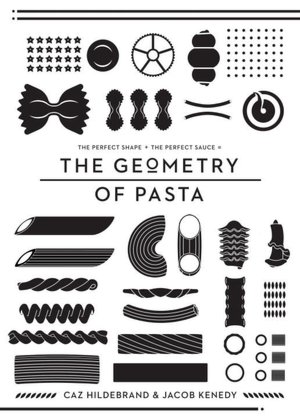
The Geometry of Pasta is a creative collaboration between Caz Hildebrand (creative partner at Here Design) and Chef Jacob Kennedy (of Bocco Di Lupo fame in London): Ms. Hildebrand designed and created the cookbook with recipes by Chef Kennedy. This cookbook is monochromatic, sprawled with super technical drawings (by Lisa Vandy of Now Ware), most of which are life-sized drawings of said pastas. Each pasta is a "chapter" which a brief history/story (if applicable) behind its shape/culinary use/etc. along with classic recipes recommended by Chef Kennedy. Beyond what we typically know as "pasta" (i.e., spaghetti, linguine, capellini, rigatoni, ziti, penne, macaroni, etc.), there are tons of lesser known pastas (read: strozzapreti, gemelli, and tajarin as ones I've read about recently after dining out) that are explore in more depth than you can imagine. As you probably gather from my posts here on Four Tines, I love me lots of history and stories behind any given element in the dining/cooking experience.

Overall, the book is incredibly well done -- it unifies the technical with the creative, the concrete with the abstract, and the pragmatic with the aesthetic. It makes for great bedtime reading -- learning about a pasta a week will have you reciting witty tidbits at your next fancy, schmancy Italian dinner outing.


The Geometry of Pasta
Caz Hildebrand and Jacob Kennedy
Price point: originally $24.95, $16.47 here on Amazon.com.

Monday, October 8, 2012

Dinner | Sakagura

Last weekend, I took Marcus to Sakagura (I gave him free reign to pick wherever he wanted to go), a Japanese spot over in Midtown East, to celebrate his birthday. It was a recommendation from Tiffany, a former colleague of mine, who had nothing but great things to say about it. Having been there several times, she was happy to say that pretty much everything is great. 


Sakagura is located in the cellar level of a corporate office building, so you may miss it your first time going -- at least that's what happened to us. Luckily, there was a sign outside to indicate where to go, leading us to this lantern-lit stairwell.


Japanese for "sake brewery," Sakagura was founded in 1996 and has become one of the top sake bars in the United States, offering over 200 varieties of carefully selected sakes as well as various authentic tapas-style dishes, and homemade desserts.


The bar area inside Sakagura. Look at the bar shelves lined with bottles of sake!


Another view of the restaurant's interior.


On the table was this cute little vase of pink blooms.


First, we had the surumeika yaki -- grilled Japanese squid brushed with garlic soy sauce. The squid was well-marinated with the garlic soy sauce (soaked in really nicely), and the grilled meat was incredibly soft and tender (not at all rubbery or overly chewy), which reminded me of a version of grilled squid we had at Izakaya Sozai in San Francisco. It made for a great first nibble.


Next we had the gindara yuan yaki -- grilled fillets of black cod steeped in sweet soy sauce. While it was a bit salty (a little too much soy sauce here), the texture of the fish was still super flavorful and silky (just as black cod characteristically is). A little sushi rice would have helped neutralize the oversaturation of soy sauce.


We also opted for the tori karaage -- deep fried chunks of chicken marinated in sake and ginger infused soy sauce. These were piping hot and pretty good -- the battering was thinly layered yet packed full of flavor from the herbs and spices. However, there was a little too much chicken and not enough battered bits to balance it out. This dish didn't seem like anything special or extraordinary, so while we did mostly enjoy it, it's not worth going out of your way and ordering.


Marcus wanted to try the yuba shumai -- minced pork dumpling with shrimp and lotus roots wrapped in a thinly bean curd sheets served with a Japanese ponzu sauce. I honestly didn't like this dish at all -- I typically don't fare well with shumai of any kind, dim sum or not. The pork's flavor was a little offputting and overwhelming -- the spices used just didn't sit well on the palate -- and it seemed that Marcus felt the same way, too. It was our least favorite of the entire evening.


For the "main course" portion of the dinner, Marcus and I shared two larger-sized dishes, the first being the fillets of beef grilled on top of hot stone served with ponzu sauce, lemon, and sea salt. We were given a thick cube of frozen fat to coat over the scorching hot stone in preparation of searing the raw fillets of beef. Once the cubed fat touched the surface of the stone, it sizzled loudly, and the surface was ready to go in a matter of seconds. We seared each side to our desired liking (medium rare-ish), dipped lightly in the ponzu sauce, sprinkled a little sea salt, and squeezed a bit of lemon juice on top. What resulted were super tender beef fillets seared right off the stone and dressed nicely with some citrus undertones -- absolutely delicious and satisfying. While I do love a good cut of steak, this was a great way to enjoy some quality pieces of beef, optimized as it was cooked by you at your leisure and desired duration. So good!


Of course, for our second main course, I had to have the uni soba -- homemade cold buckwheat noodles with fresh sea urchin sashimi and sea urchin sauce. Its close to icy temperature paired with the buttery texture of the uni and accompanying sauce sent a shiver down my spine -- it was chillingly delightful. I have the best boyfriend ever -- he let me enjoy the entire portion of uni tongues all by myself (he admits he's just not an uni fan), and I have to admit, I felt a tad guilty for eating it all (Lisa, where were you when I needed you?!). The soba was very fresh and cooked to the ideal texture, and the shredded nori (not pictured) went perfectly with it all (textural contrast and a little saltiness enhanced it a lot). It was undoubtedly one of the most noteworthy uni dishes I've had in New York City -- and I have had quite a few -- so I would say a trip out here just to have this would be worth it.


For dessert, Marcus wanted to try a couple flavors of Sakagura's homemade ice creams -- earl grey tea and green tea -- so they brought it out on a textured glass platter with a candle and a birthday message written in chocolate. They both tasted how they should -- i.e., with the strong, pervasive essence of each tea's tannic characteristics as well as flavor profiles. Even at their frozen temperatures, each spoonful was bursting with concentrated tea flavors. Loved both!


I desperately wanted to try the black sesame crème brûlée served with homemade black sesame ice cream. Given my propensities as a crème brûlée enthusiast, this unique, Asian-inspired take on the French classic just blew it out of the water. Not only was the ice cream made from black sesame seeds, but so was the custard in the crème brûlée. With the rich flavor and nutty yet silky texture from the crushed black sesame, this crème brûlée sang with such flavorful intensity that I swallowed it up in a matter of bites. 

Findings: Marcus and I had a fun time celebrating his birthday at Sakagura. Although we had a couple misses, we did get to enjoy some pretty strikingly flavorful small plates (noted: the surumeika yaki, the gindara yuan yaki,  the fillets of beef grilled over hot stone, and the uni soba). If I could pinpoint one thing that Sakagura does well, it would be dessert. None of the desserts are super over-the-top, which is what I like best about them. They are simple, straight to the point. The homemade ice creams are solid, and the crème brûlée was quite delightful. I would certainly come back for the dessert as well as to sample the other many things the menu of small plates has to offer -- it's hard to judge a menu entirely by the half dozen plates we did order when the entire menu is comprised of so many other items. Either way, this little hidden gem (quite literally) is worth checking out -- lots of exciting things happening with Japanese cuisine here.

Also, just wanted to wish Marcus another big happy birthday -- hope you had fun celebrating here. Love you!

Price point: $8-10 for each small plate, $20-22 for each large plate, $7-9 for each dessert.

--September 29, 2012

Sakagura
211 East 43rd Street (cellar level)
New York, NY 10017

Friday, October 5, 2012

Etcetera | Friday Fanfare, 2012.10.05

It's been a crazy week of nommin' for me. Marcus and I celebrated his birthday by taking two days off, to make it a four-day long extravaganza. It was so much fun to check out some new spots (Sakagura, David's Tea, and Maison Kayser) and to visit some old haunts (read: Dos Toros, Eisenberg's, and Argo Tea), so be on the look out for some new posts coming your way. In other news, this week Alice and I also finally booked our trip to Charleston for early November, so I am super psyched and pumped for that -- let the planning commence! :)

Happy Friday to you, and have a spectacular weekend!

Our one-year old kitten, Neutrino, just being her silly ol' self.

This week's noteworthy eats:
  • fish and chips along with a fried Mars bar from A Salt and Battery 
  • sugar doughnut from Balthazar Boulangerie
  • matzoh ball soup from Eisenberg's Sandwich Shop
  • hazelnut Earl Grey teapuccino from Argo Tea
  • Marcus's birthday dinner at Sakagura, including uni soba (homemade cold buckwheat noodles with fresh sea urchin sashimi and sea urchin sauce)
  • pancakes with wild Maine blueberries and warm maple butter along with sugar-cured bacon from Clinton Street Baking Co.
  • crispy chicken tacos from Dos Toros Taqueria (twice!)
  • chocolate-covered pistachio gelato bar from Popbar
  • hot long life oolong tea from David's Tea
  • macarons (gianduja, almond, green tea, yuzu, pistachio, pear, and spiced chai) from Bisous Ciao
  • French onion soup and croissants at Maison Kayser
  • pistachio-crusted sea scallops with roasted broccoli and garlic mashed potatoes

Some ruminating reads:

In case you missed it:

A roundup of drool-worthy recipes:

On the blotter for upcoming noms:

Thursday, October 4, 2012

Food for Thought | Pythagoras

“Salt is born of the purest of parents: the sun and the sea.”
--Pythagoras

Wednesday, October 3, 2012

Dinner | Jones Wood Foundry

Jess and I returned back to Jones Wood Foundry a couple weeks ago -- we loved it so much the first time we went (about a month or so prior to this second visit) that we wanted to come back with Marcus and her two sisters, Jill and Jen, in tow especially given Marcus's proclivities for a mean order of fish-and-chips as well as Jill's inner anglophile (plus I really, really wanted to get some decent photographs this time around with the DSLR I had forgotten to tote with me last time -- my iPhone just couldn't handle the serious lowlight here). Jess first heard of Jones Wood Foundry from Jill actually --  she had stumbled upon it while watching an episode of Unique Eats on the Cooking Channel where the program interviewed the gastropub's chef and its English-driven menu, including its specialty dishes (read: sticky toffee pudding).

Located in the Upper East Side, Jones Wood Foundry is "rooted in the proud tradition of the United Kingdom's public houses as genial gathering places for convivial eating and drinking." Chef Jason Hicks also co-owns this restaurant with Yves Jadot, both hoping to embody "a nurturing sense of homey comfort -- a reassuringly relaxed throwback to a less hectic era."

The restaurant's window display boasts UK-savvy paraphernalia, decked out in European football jerseys, flag pennants, beer taps, and other knacks.

I also wanted to share a little history behind the restaurant's moniker. Before the neighborhoods of Upper East Side, Yorkville, or Lennox Hill were established here in Manhattan, the area between 66th and 77th Streets (framed by what are now Third Avenue and the East River) was known as Jones Wood. At the time, it was "the most densely forested land on the island of Manhattan and was named after John Jones, who had purchased more than half of its 150 acres in the early years of the republic of the United States of America." By the nineteenth century, Jones Wood had become a popular destination for Manhattanites as "a verdant escape from the increasingly urbanized landscape" with attractions such as bowling, billiards, beer gardens, and facilities for sporting events and large public gatherings. As such, Jones Wood has been characterized as "America's first amusement park" and was part of 1853 state legislation which designated it as possible land for the location for "a great park, reminiscent of Europe's lavish public spaces, that would address the recreational needs of the growing city." The acreage that had been selected was what was to become Central Park, "an area deemed more suitable than Jones Wood because it was more conveniently located and thus more accessible to the populace it was to serve."


While Jones Wood remained as a relaxing, comfortable retreat for New Yorkers for the remainder of the century, its demise was soon approaching, as its location "was steadily encroached upon as the city moved northward" and was further destroyed by an 1894 fire that depleted eleven acres of its greenery. By the beginning of the twentieth century, real estate developers "gobbled up the rest of Jones Wood, leaving virtually no trace of the once lush forest, except for a little known space called Jones Wood Garden, a private hidden plot surrounded by twelve circa 1870s townhouses on 65th and 66th Streets between Lexington and Third Avenues." This secret garden is now joined by Jones Wood Foundry "in a salute to the memory of the long lost woodland as a welcoming gathering place for convivial pursuits."

The restaurant as a whole is comprised of an expansive bar at the front lined with all sorts of wine bottles . . .


. . . a cozy dining room in the rear as well as a communal table overlooking its secret courtyard garden (part of the aforementioned Jones Wood Garden).


The menu "represents the best of time-honored British culinary traditions that have been reinvigorated for twenty-first century palates."


Because I loved it so much from my first visit, I had to have the Kopparberg pear cider from Sweden. It was like biting into a fresh piece of fruit -- very refreshing and luscious. Jen followed suit and ordered the same! :)


While Jill and Jess each had the English organic honeydew pale ale by Fuller, Smith and Turner (i.e., a very light and refreshing beer -- like the fruit from which it is derived), Marcus went with the Chimay Blue, a strong dark ale from Belgium. Chimay Blue is a Trappist beer, i.e., beer brewed by Trappist monks in either one of the eight monasteries across Belgium and the Netherlands. It had a distinct after taste as well as a hearty, thicker consistency than the lighter beers that he's used to having (but not as intense as say a Guinness). Marcus really enjoyed the Chimay Blue, noting that it was arguably the best beer he's ever had, mainly because it tasted exactly how a beer should -- substantial and hale.


As my main course, I went with one of the specials that evening -- lightly seared tuna tenderloin wrapped in bacon and served over a wild mushroom risotto. It came with a parmesan dressing, but I opted to hold that (too creamy for me). The medallions of tuna were meaty and rare at the center while the bacon was an interesting contrast to this, with its crispy, savory, and fatty flavor/texture. While the tuna itself was pretty good, what really made this dish was the wild mushroom risotto. It was the perfect melding of creaminess with the al dente arborio kernels and the array of quartered wild funghi. I could easily say that it was one of the best mushroom risottos I've ever had. The kitchen really could've served up that risotto, and I would've been just as happy.


Featured in Time Out New York as one of the city's best new burgers, Jill wanted to see if the JWF burger was indeed worth this grand title. The burger's patty is a dry-aged blend of brisket and short loin from DeBragga, topped with Stilton cheese and bacon on a toasted bun. I thought the little toothpick flag was a darling touch. On the side were slow-roasted tomatoes for easy spreading (plus super Anglo-centric) along with pickles and thick chips (i.e., fries). From what Jill reported, the burger was incredibly juicy (how can it not be with all of that blended marblizing goodness?!), the bacon griddled to a golden crisp, and the melted Stilton certainly gave the promised "salty funk" noted by TONY. All of this compiled together  This burger does not mess around -- highly recommended!


Jess, Jen, and Marcus all went with the classic English meal, fish and chips with the fish being cod. Jess and I both had this during our initial visit (though I had the haddock, which I felt was much inferior to the cod offering), and we instantly fell in love with Jones Wood Foundry. The fish is beer battered and served with a tangy, homemade tartar sauce and fresh lemon (covered in a stretch-wrap cloth for mess-free squeezing). The beer batter is the selling point of this very dish here -- it's light yet flavorful and packs a delicate yet satisfying crunch. The cut of fish is thick and chunky, so don't be fooled that you'll still be hungry afterwards. Best fish and chips to be found in this city? It just might be!


Regardless of how full and content we were after our main courses, we still had some room for dessert. In fact, the very one we all were curious about was the sticky toffee pudding -- after all, it was the dish that was featured on Unique Eats from Jones Wood Foundry. Luckily, we all just wanted to sample a bite or two, so we decided to share one order. This take on sticky toffee pudding (typically a very moist sponge cake made with finely chopped dates/prunes and covered in a toffee sauce) was served with a dollop of vanilla ice cream and treacle sauce (i.e., molasses). It was a very rich and moist molten-style cake, only instead of chocolate, it was soaked in toffee and treacle. The bites of dates/prunes added some contrasting texture to the meltiness of the "pudding" and the creaminess of the ice cream. Given my palate isn't accustomed to this kind of dessert, it'd be very hard to eat solo, so it is perfect for sharing!

Findings: Jones Foundry is one of those strikingly awesome neighborhood restaurants you just want to go back to over and over. The staff is unbelievably friendly and cool, and even if you have to wait a little bit (especially during peak dinner hours), they are very accommodating and considerate. Be wary that seating may be slightly cramped (even with a roomy dining room, they like to pack people in), but this shortcoming is certainly compensated with the solid offerings on the dining menu as well as the long laundry list of relatively obscure British and European drafts on tap, bottled beers, lagers, ales, and ciders. If you don't leave here happy, you did something wrong. It is a merry and convivial place, and I see lots of ciders and Anglo-gastrogrub in my stomach's immediate future. So if in doubt, get a recommendation for drinks from the staff; if you're feeling authentic, get the fish and chips; if you're feeling a little conservative, try the JWF burger. You'll win either way.

Price point: $8-12 for each beer/cider, $18-28 for each main course, $9 for dessert.

--September 20, 2012

Jones Wood Foundry
401 East 76th Street
New York, NY 10075

LinkWithin

Related Posts Plugin for WordPress, Blogger...